

Big Picture
Happy Friday! As promised, lets talk Meta Muse, ChatGPT, and macro. If you want to stay on top of Ai data and macro, and companies, this is the place… Meta Connect was this week, that was fun given Muse launch…
But first, some market talk. Markets have been gyrating at the surface level but even more so underneath. Wait until you see the drawdown chart. The rotations are vicious, very much a trading mentality going on, little Buffett like owning. Now naturally the view is, markets near highs = bad. Or bad breadth in the market = bad. (Breadth essentially measures whether we’re seeing more stocks rise vs fall.) So two debunking data points on that today.
But quickly, look at the numbers on what actually happens near all-time highs. One-year forward returns after a record close have averaged 9.9% versus 9.4% for every other day. Sounds super counterintuitive to some degree, but strength begets strength.
So far this year we’ve gone from only AI working, to AI getting hit very hard and everything else working, to AI again in the last 2-3 weeks, and now I think we are probably heading for another rotation. The potential catalyst is there. As we get oil up, yields up, and potential Fed hikes, the administration is on its back heels here, and there seems to be a desire to get the Iran conflict out of sight so oil prices can come down. More on that below.
But cheaper oil would be supportive for yields, and both together would be supportive for economically sensitive names. Consumer discretionary struggles every time you get commodity and long-bond gyrations. The housing-related space has struggled with the exact same pressure. Remove that pressure and those are the groups with the most room to work. So the moves will likely be explosive, but it’ll take resolution.
The gap is already wide. Over the past year the S&P 500 is up yet consumer discretionary is down -8% to -25%, and homebuilders and real estate names are down -13% to -40%. That is the rotation setup I express on a single chart, and it pairs with a money market complex that has never been this full of cash while stocks are elevated. Historically, as MacroCharts points out, this may be setting up for an interesting moment.
We will also cover more macro that validates we are likely still in a prolonged cycle, along with AI, Muse, and ChatGPT, so read until the end.
[1] New highs have not been a sell signal.
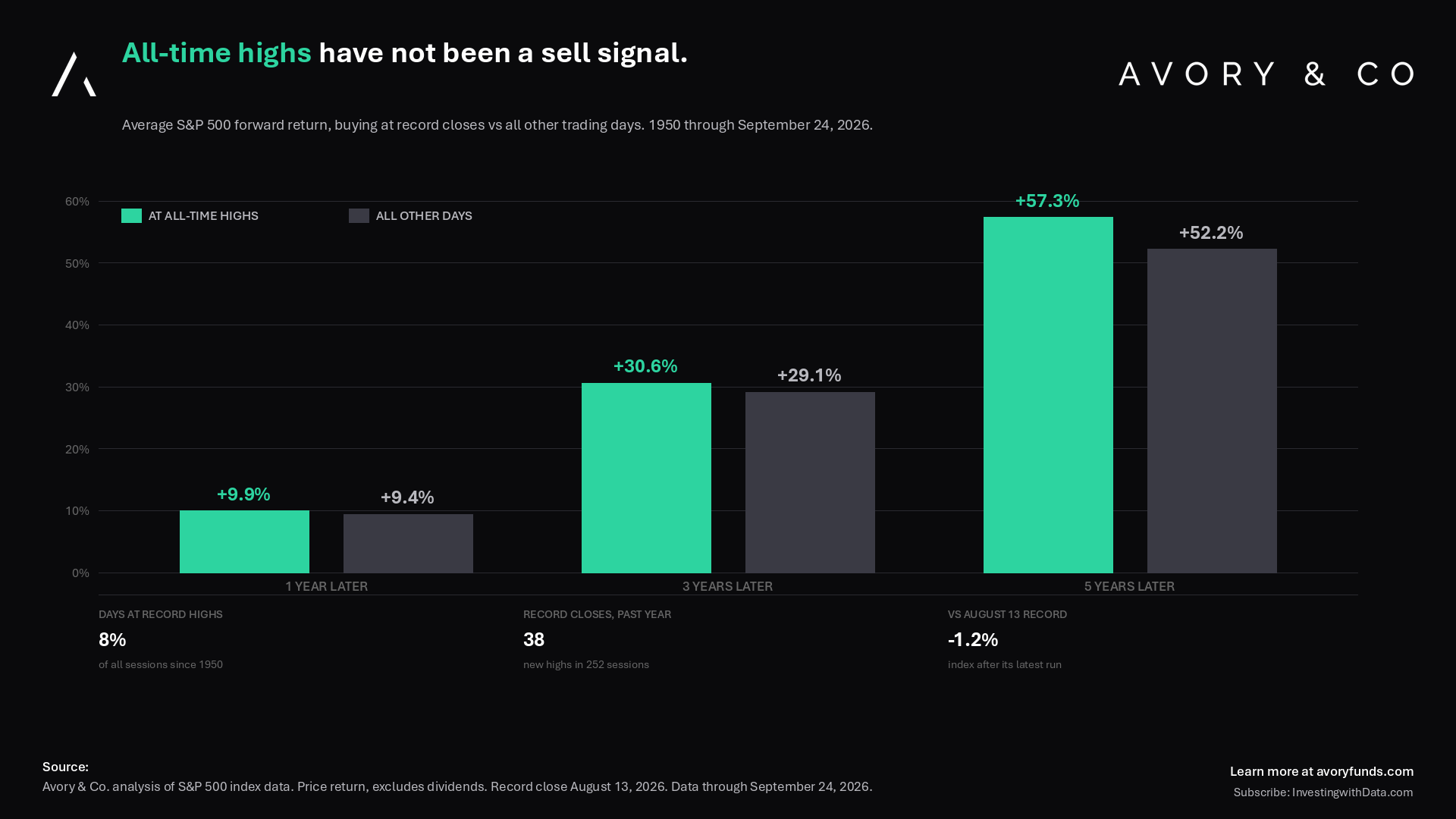
Some market talk, as mentioned, to kick it off. Since 1950, buying the S&P 500 at a record close has been a perfectly reasonable strategy. Forward returns from record days essentially match, and slightly beat, returns from every other day across one, three, and five year windows. The dataset covers 1,537 record closes across 19,304 trading days. Either way, human emotion naturally says hey, highs, time to sell, versus okay, are there other opportunities that have not yet been realized? That brings us to the second chart.
[2] Most of the index is already in a bear market.
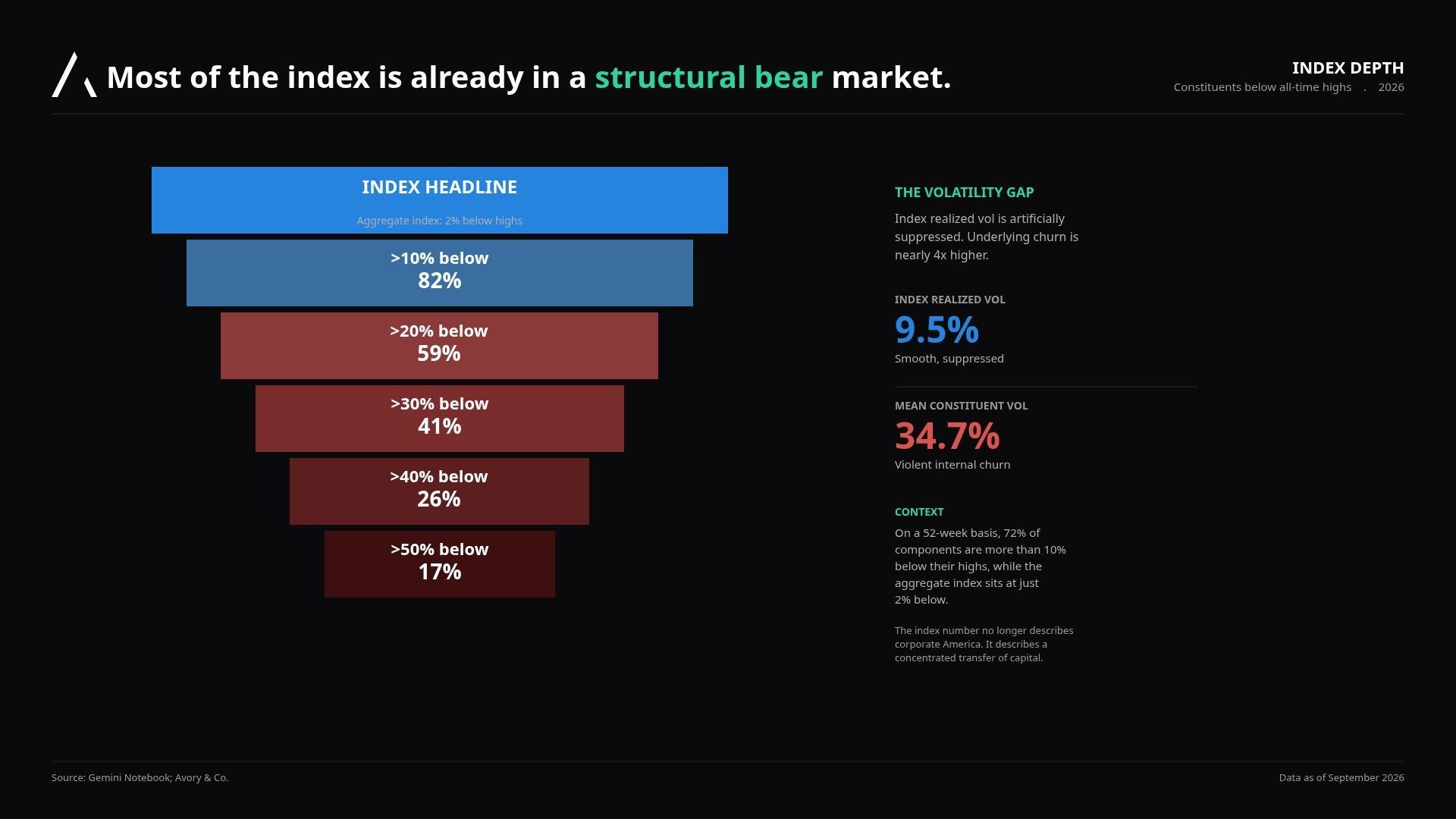
Here’s the drawdown chart I mentioned. The index headline sits just 2% below its highs, but 82% of constituents are more than 10% below theirs, 59% are more than 20% below, and 17% are down more than 50%. Index realized vol is 9.5% while the average constituent is running at 34.7%, nearly 4x higher. So the calm on the surface is hiding a lot of churn underneath, which is why the rotations feel so vicious. You can see where that churn is coming from on the next chart.
[3] The AI trade runs through hardware and industrials.
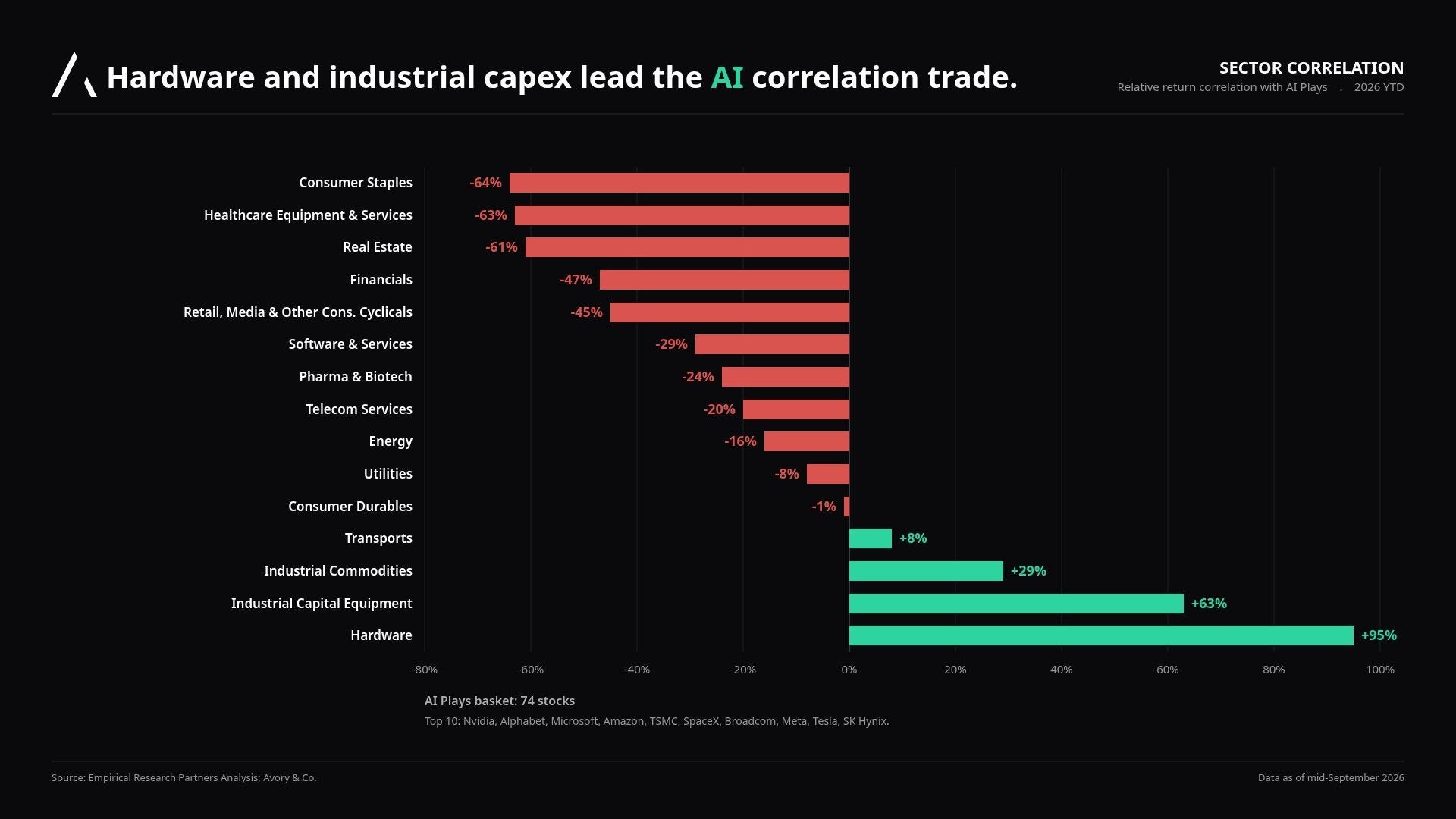
This looks at how sector’s relative returns have correlated with their 74-stock AI Plays basket this year. Hardware correlation sits at +95% and industrial capital equipment correlation at +63%, while consumer staples, healthcare equipment, and real estate are all around -60%, with financials and consumer cyclicals near -45%. Obviously the groups moving opposite AI are the same economically sensitive names we think benefit from a rotation. So again in some ways this is not about fundamentals, and more about trading and timing.
[4] Then the rotation watch.
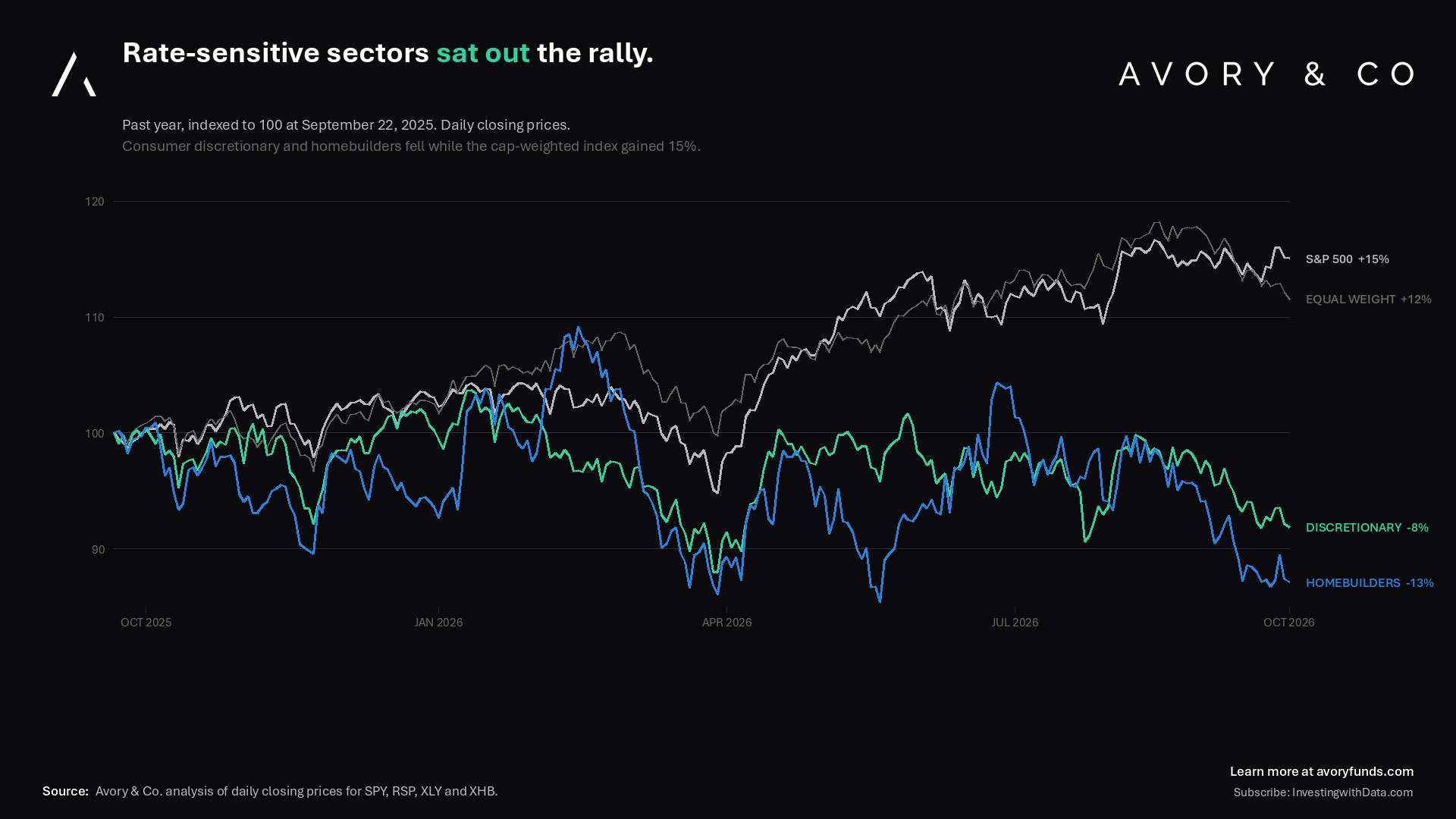
There are clearly plenty of opportunities if you look around. AI is all the conversation, but clearly with sectors down 10% to 30% from highs, having exposure to those (assuming valuations and fundamentals make sense) can be the other phase of this bull market. These haven’t gone anywhere for a couple of years. If we can get the oil concerns fully in the background, then we think we can see a big uplift in non-AI and non-Tech. Despite us being Tech-centric, the value outside of direct Tech has been interesting for years. If oil and long yields roll over, this chart is the scoreboard for the rotation.
[5] Then the cash pile.
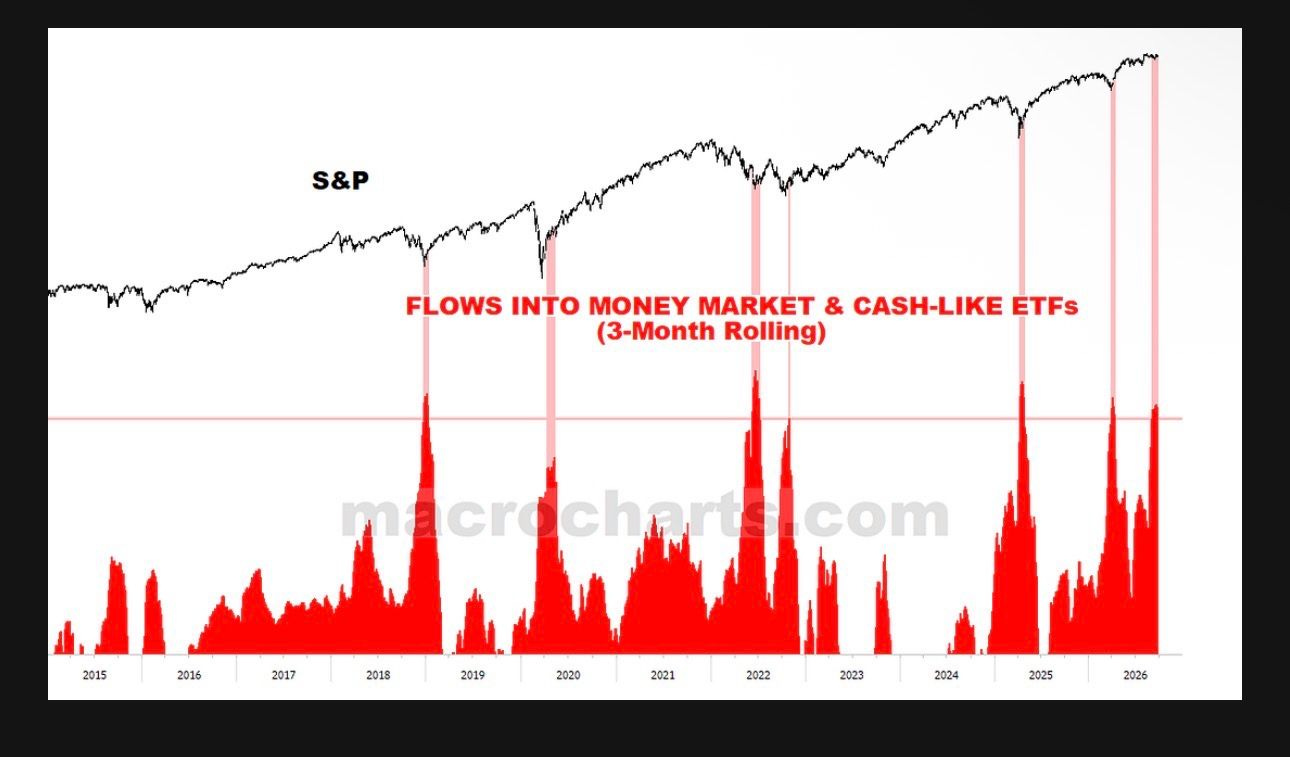
This one is interesting because it seems very logical. I found this chart from MacroCharts, and it tracks flows into money market and cash-like ETFs against the S&P. The insight is simple and it has repeated for a decade: the big cash surges cluster at market bottoms, when people panic. Late 2018, March 2020, and the 2022 bear market all line up. The latest surges are arriving with stocks at all-time highs instead, which is the part worth watching.
Our own read on the Fed’s Z.1 data backs it up. Money fund assets just hit a record $8.4 trillion, with $960 billion of net inflows over the trailing four quarters, and the three biggest inflow years on record are 2023, 2025, and 2024. That much cash at highs, combined with what we mentioned earlier, is the fuel for the next leg, and it could go into economically sensitive names should we see resolution on yields and oil.
[6] The macro backdrop is boring, in a good way.
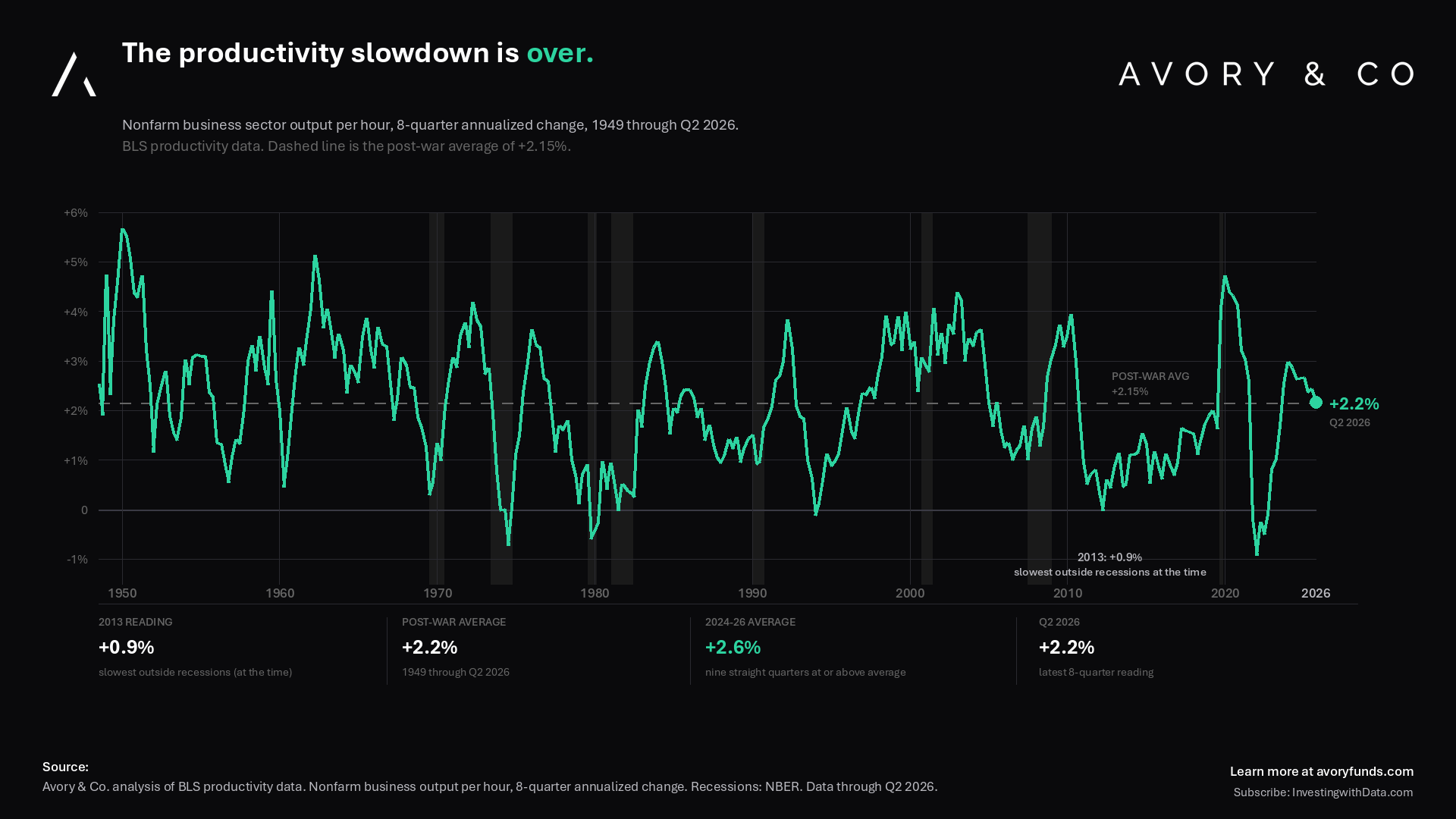
Now, productivity is such an important data point. Eight-quarter annualized output per hour is running at 2.16%, right on top of the 2.15% post-war average, and well above the 0.9% trough from 2013 that everyone remembers. So we are seeing productivity. Not the promise of AI making everyone 10x more productive, even though I do think the best users of AI are likely 5-10x more productive, but productivity remains firm, which is healthy.
[7] Volatility of volatility agrees.
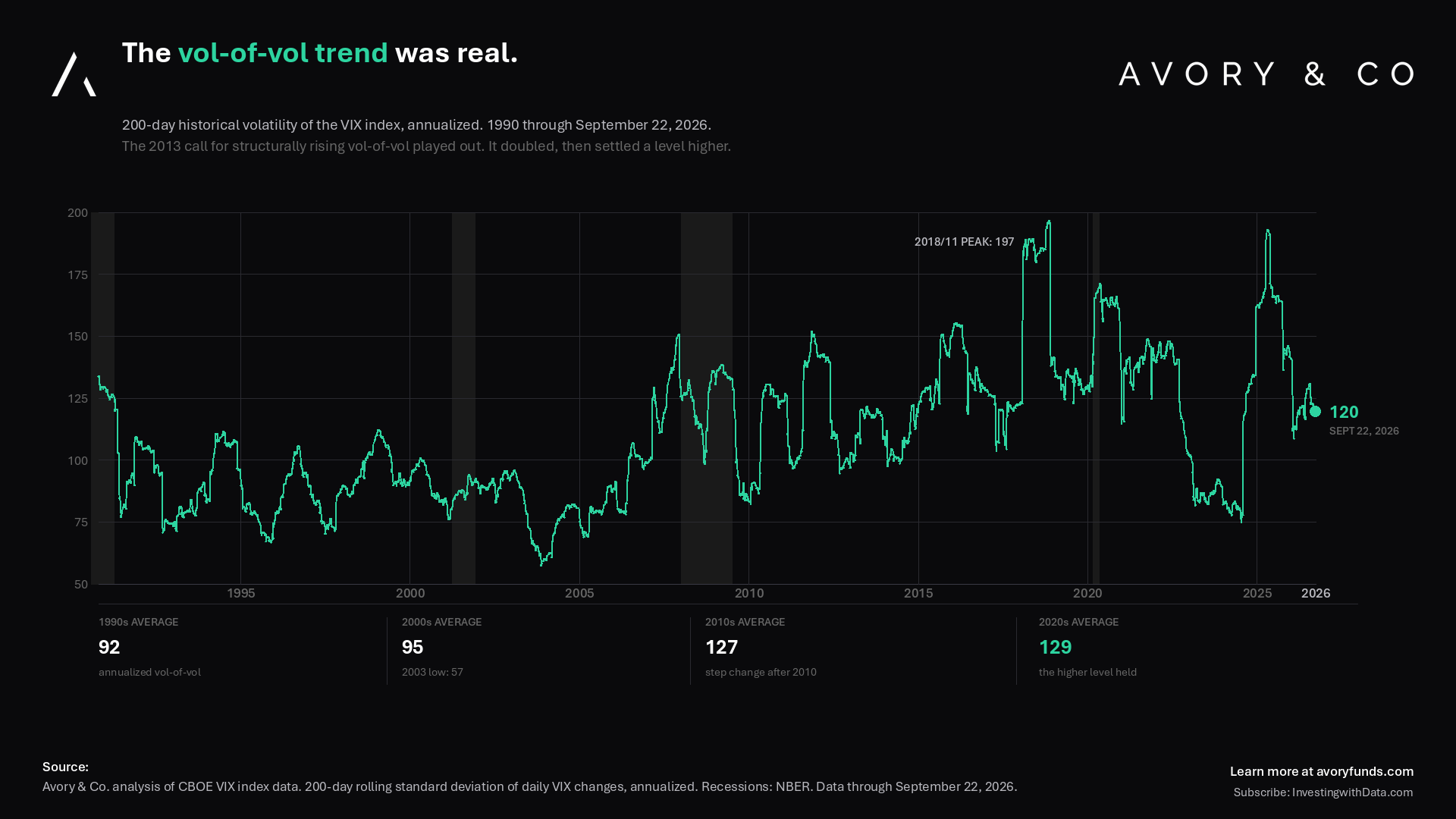
Then we have the volatility of volatility, and it agrees. The VIX’s own 200-day vol-of-vol sits at 120, below its 2010s average of 127 and its 2020s average of 129. The options market’s stress gauge is calm and has been falling, so that’s not a fear signal.
[8] Capex is outgrowing GDP.
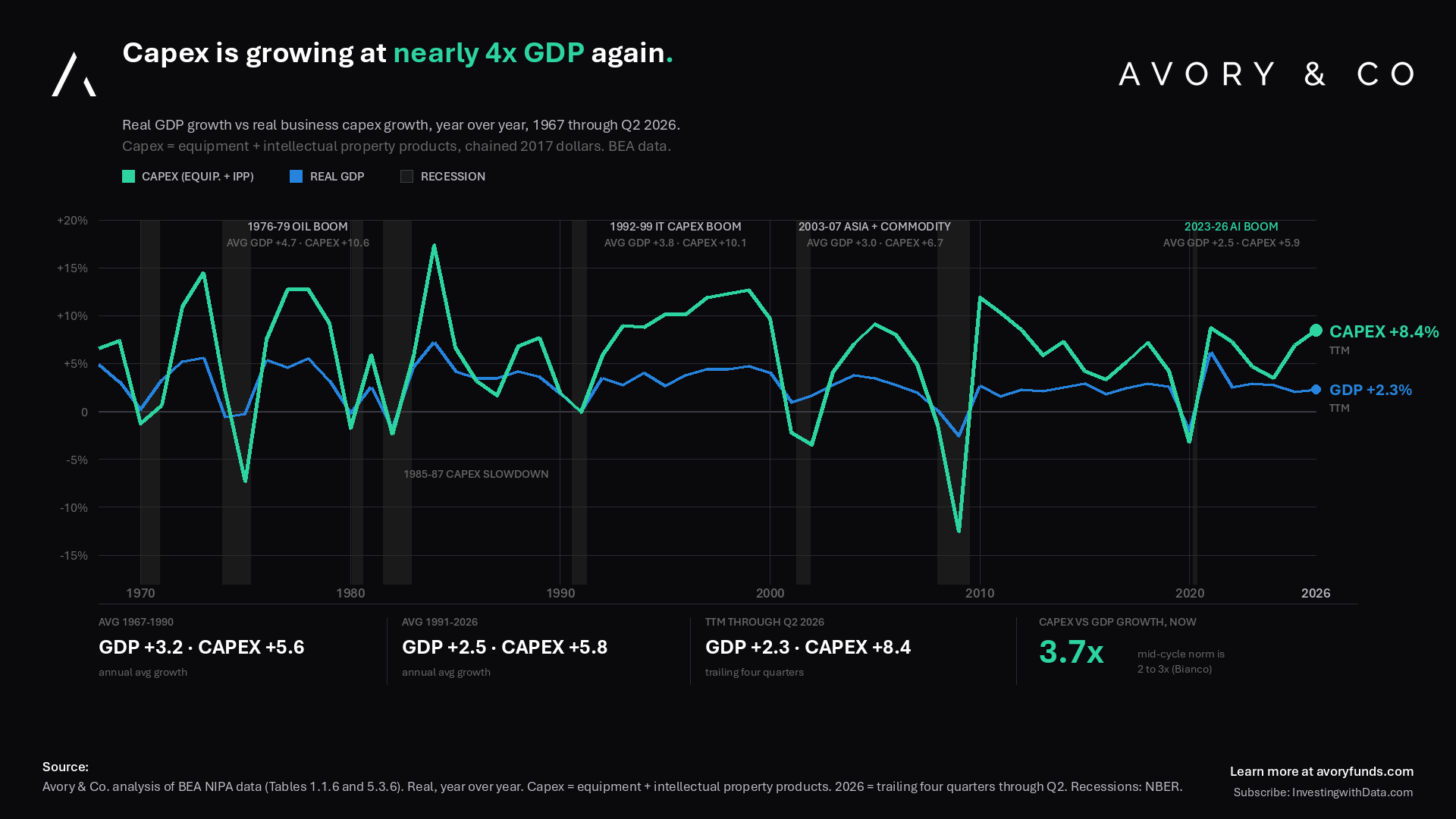
This one is big. The investment side of the economy is not waiting for anyone. Capex is growing at 8.4% against 2.3% GDP growth, a gap that has only shown up in the big investment booms like the late 1970s and the 1990s. So this is healthy too, and shows we are seeing a true cycle at play.
[9] Consumer AI keeps compounding.
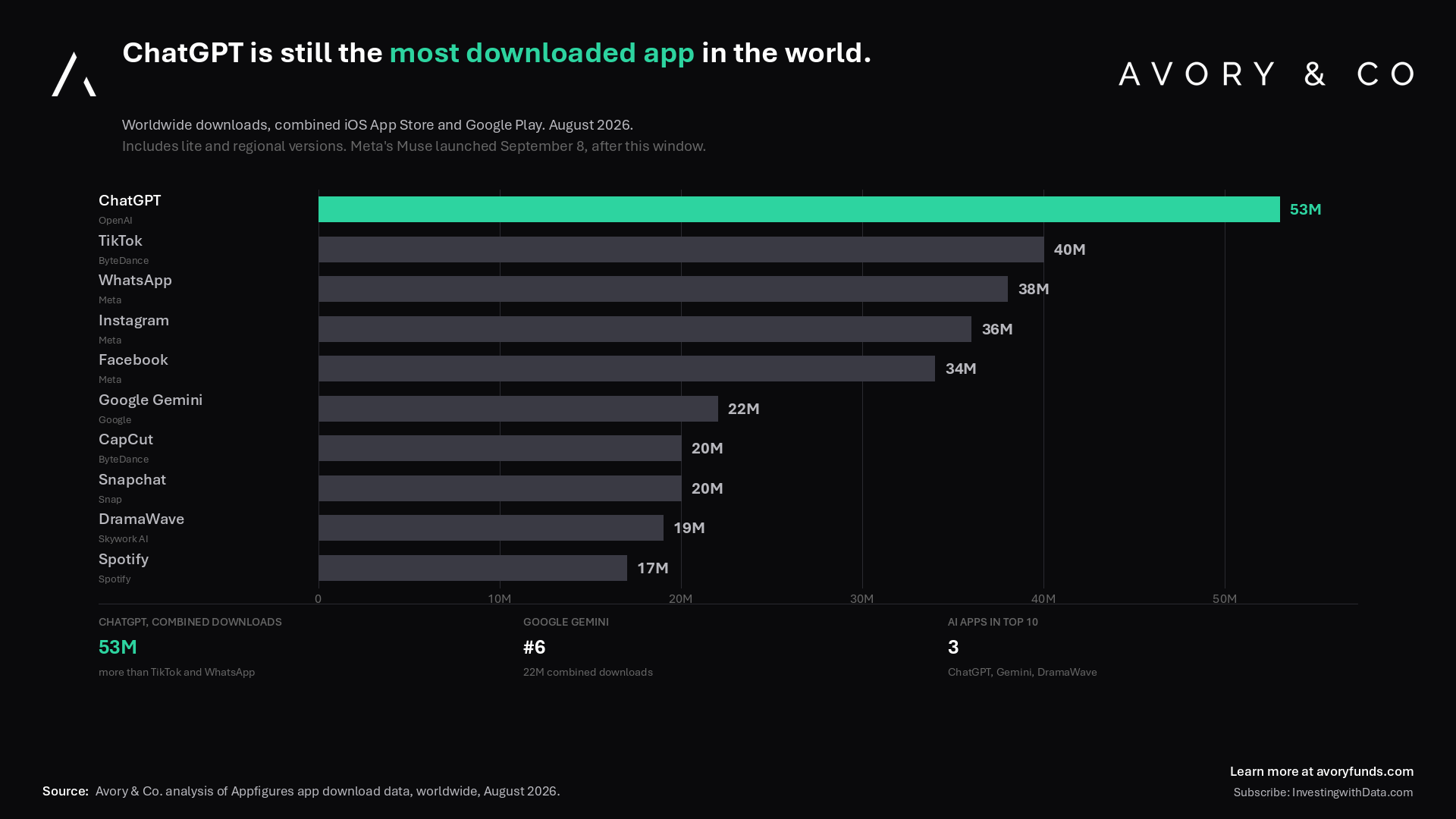
Now to AI, because it’s critical to our views. Data for August shows ChatGPT at 53 million combined downloads, ahead of TikTok at 40 million and WhatsApp at 38 million. AI apps now sit permanently alongside social and messaging at the top of the charts, with Gemini at 22 million. We are waiting for Meta’s Muse data to come out, and over the next couple of months I expect it to make some noise on these charts.
[10] Muse is number 1 on both app stores.
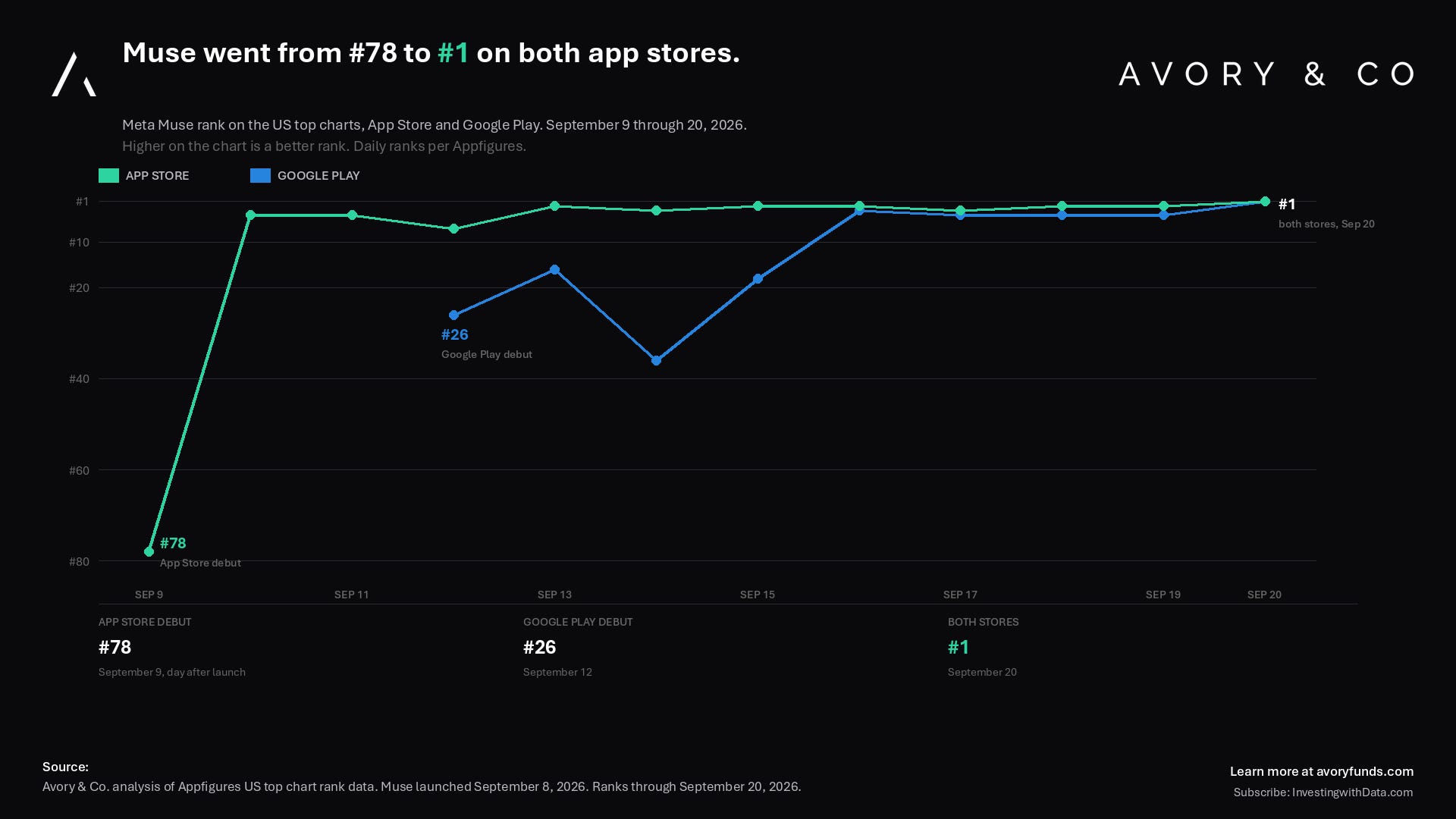
So far, here’s the data. Meta’s Muse is the new entrant most are hearing about. It went from 78 on the US App Store in launch week to number 1 in under two weeks, and it now holds number 1 on both the App Store and Google Play. This is a big deal. The best version of consumer AI to date. Alexandr Wang and Zuck nailed it. They spoke about it at the Meta Connect conference this week, which we tuned into. Lots of exciting stuff there. And if you listen to our Avory Around the Desk podcast, you’ve heard how we have been on this Meta AI train for some time.
[11] Enterprise AI is still early.
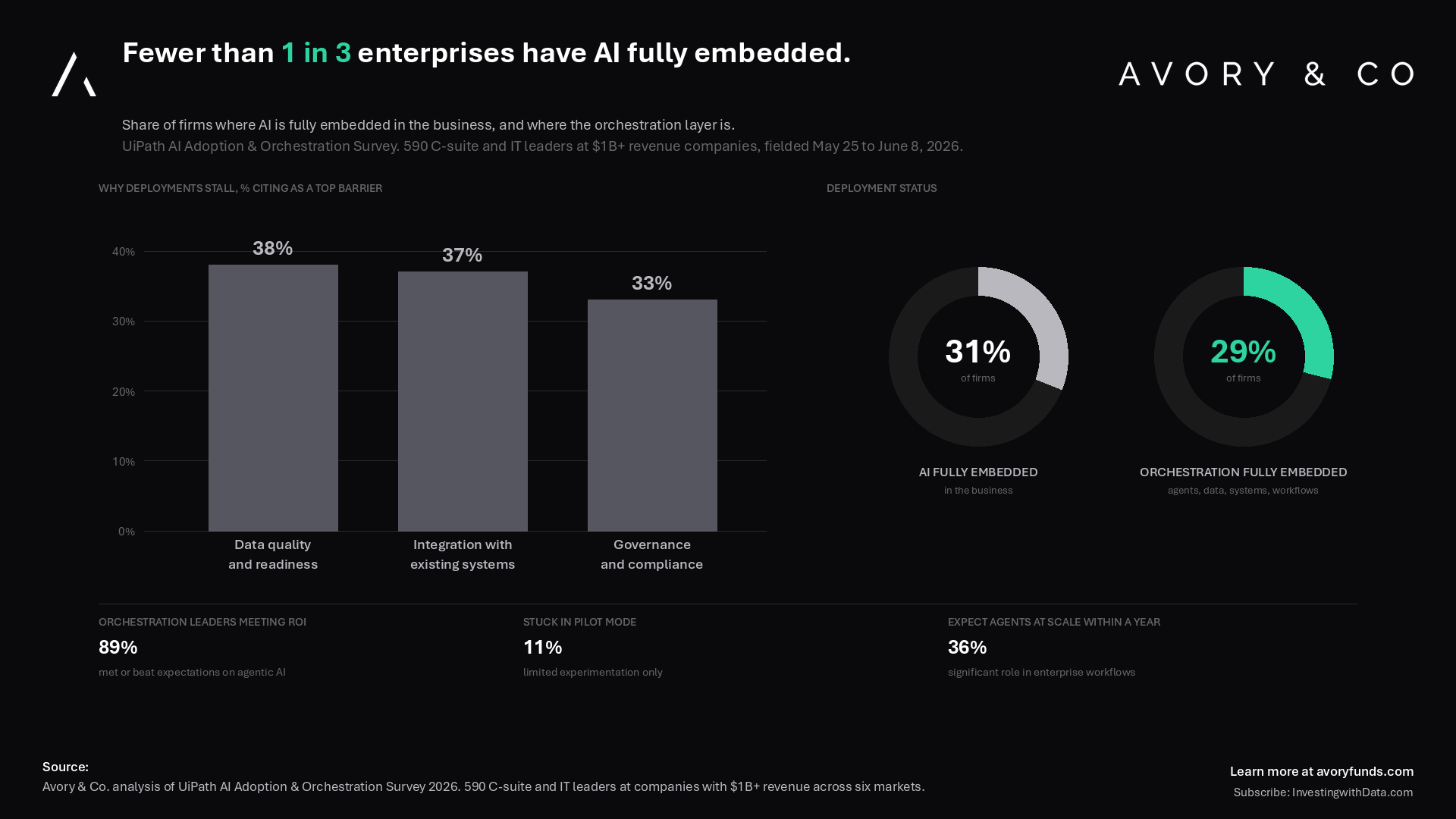
Ok, turning to enterprise. We tuned into the UiPath investor day, and UiPath’s 2026 adoption survey was released. Only 31% of large enterprises have AI fully embedded in the business, and only 29% have the orchestration layer fully in place. The barriers are boring and hard: data quality at 38%, integration with existing systems at 37%, governance and compliance at 33%. But the payoff shows up where deployment is real. 89% of firms with orchestration embedded met or beat their ROI expectations, and 36% expect agents to play a significant role within a year.
So as we have said, consumer or SMB AI is much easier than enterprise. Having enterprise exposure already means you are in position to help the AI transformation for orgs. Think Salesforce, ServiceNow, even UiPath, which are all entrenched in the enterprise. It’s also why last week we spoke about how monumental it was for OpenAI, Nvidia, and Anthropic to be at the Salesforce Dreamforce event. They know that to get into the enterprise, usually the best way is to already be there.
Net Net
We are back on rotation watch. Oil and long yields are the catalysts, and consumer discretionary and housing-related names are top of mind. A record $8.4 trillion of cash sits in money funds, built at highs rather than lows, which is either dry powder or an insurance policy. But productivity is at trend, realized vol is calm, and capex is showing normal bull-cycle behavior. So the play is likely rotation as the cycle continues, versus end of cycle. The big deal this week and last is consumer AI. We are seeing real use cases here, and also seeing what the sales playbook may be for enterprise AI, as it’s still early. More Meta Muse and AI data next week!
That’s all for this week!
About Avory & Co.
Investing Forward.
Avory specializes in high-conviction equity strategies, emphasizing Secular Growth and Transformation Stories driven by exceptional teams. Data guides decisions. We cater to high net worth investors, family offices, and institutional investors. Note: This information doesn’t constitute a recommendation to buy or sell any mentioned securities. Avory is based in Miami, Florida with clients all across the globe.
Speak to us:
Send us an email: Team@avoryco.com
Want to invest? We are on most platforms.
Want More
🎥 Avory YouTube: Channel
🎙️ Avory: Podcast