

Big Picture
💡 The AI names shook out, the Fed stood pat, hyperscalers delivered, Buffett was right.
This was a very interesting week. From AI funds blowing up, to earnings, to the Fed.
The gyrations across AI names finally started to show their hand. It was tough watching random stocks rise 100% in a month simply because of AI exuberance, but being disciplined means not chasing short-term returns and instead asking what is sustainable.
If 1999 is any guide, most of the perceived AI winners will ultimately be losers, while the smaller group of real winners becomes clearer over time.
We are starting to see that with the hyperscalers. Amazon and Meta (which we own), along with Microsoft and Google, are already benefiting from AI. They are ALL designing their own chips, building their own data centers, using the compute internally and selling excess capacity to others at a premium. Not bad.
Meanwhile, many AI names fell 30% to 50% in two weeks, and a prominent hedge fund reportedly blew up, forcing Citadel to step in and take over the portfolio. It was 4x levered, what did you expect. Those are not normal market conditions. It reinforces the point we have made for a while: leverage and speculation were helping drive many AI-related stocks higher.
Again to be clear, we believe deeply in AI and have investments tied to what it is today and what it can become. But this was another reminder of what happens when speculation gets too far ahead of fundamentals.
Couple other aspects this week. The Fed also held rates steady. There had been some discussion of a surprise hike, but we did not think one was warranted or that surprising the market would have been productive. Holding rates was the right decision.
Then we got hyperscaler earnings, which were constructive across the board. Advertising remained strong, Amazon’s retail business grew at one of its fastest rates since COVID, and the consumer continues to look healthy. Enterprise demand through Microsoft and Apple was also solid, with little evidence that AI is eating away at core software spending.
One point we made on X received more than 300,000 views. Hyperscalers increased capex, but nowhere near the increase we are seeing in memory prices. Makes you think.
Memory prices are up 2x to 3x. If those increases were fully flowing through to the cost of the buildout, capex growth should be closer to 20% to 40%. Instead, it got moved up by roughly flat to up 8%. May be time and place, or it may be signal. Either unit demand is slowing at the margin, hyperscalers are finding ways around the cost increase, or someone else in the supply chain is absorbing it. Given hyperscaler margins are still rising, you can draw your own conclusion.
Lastly, the labor market remains stable. Initial claims are holding up, while the alternative data we track and apptopia data continues to show improvement in both blue-collar and white-collar hiring.
Let’s get into the data!
[1] This was a wild week. A $45B AI fund got washed out.
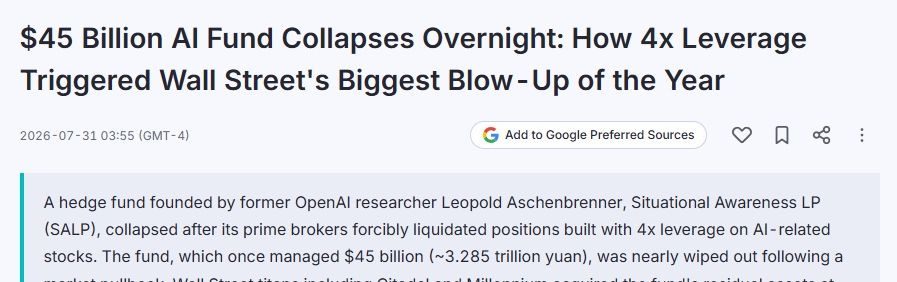
Ok lets start here. Yikes…
Situational Awareness, the AI fund founded by former OpenAI researcher Leopold Aschenbrenner, was 4x levered to the AI trade. Doing so with tens of billions of dollars was part of what drove up AI names in the first place.
That leverage and speculation is exactly what led to the fund being washed out this week and taken out at a discount by Citadel.
This is what we mean when we talk about speculation running ahead of the fundamentals, and it’s the setup for everything else in this weeks issue.
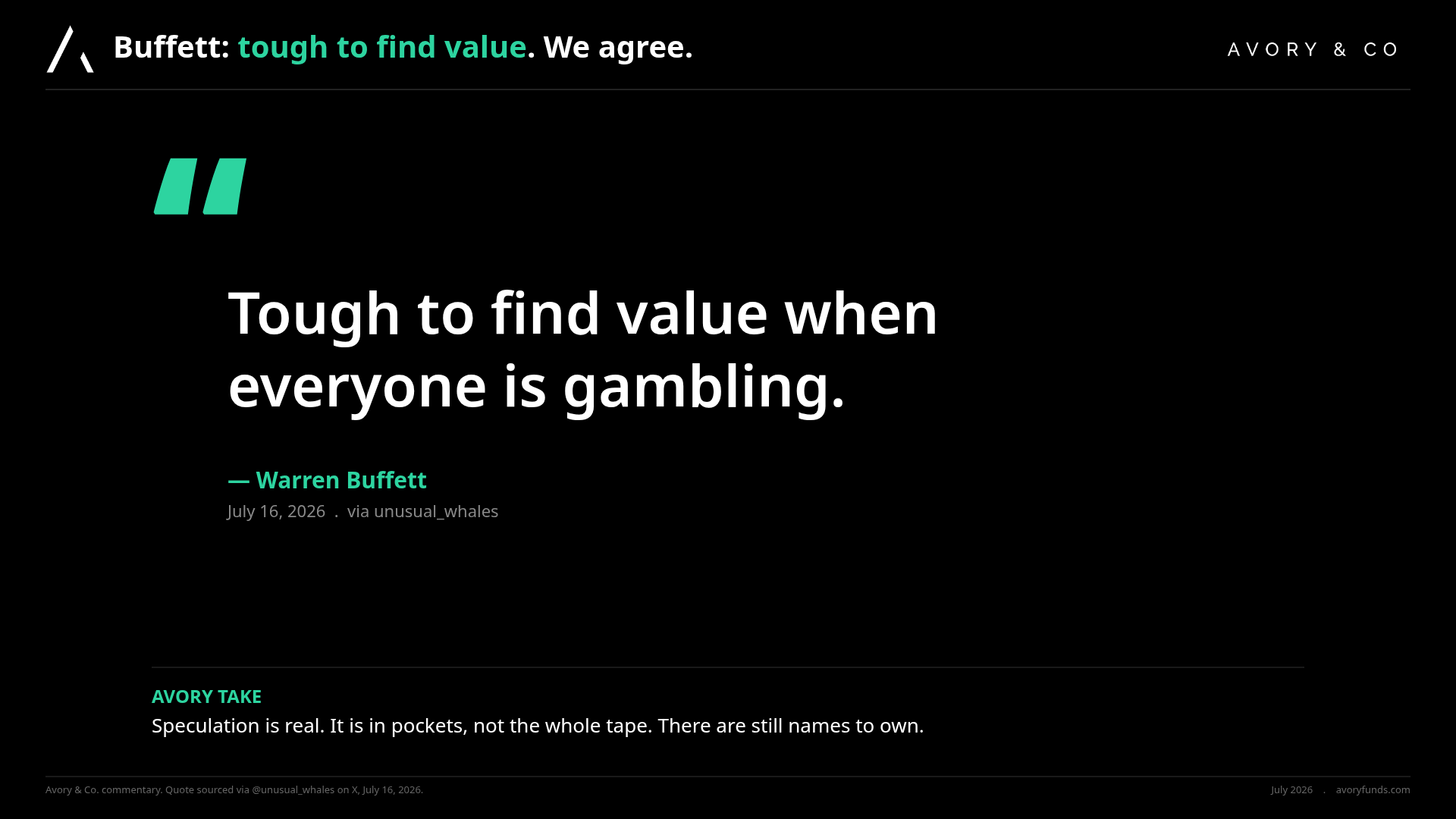
Remember this quote we shared just 2 weeks ago… Good ole Warren dropping truth bombs
[2] Hyperscaler capex is nowhere near the +20-40% memory pass-through implies
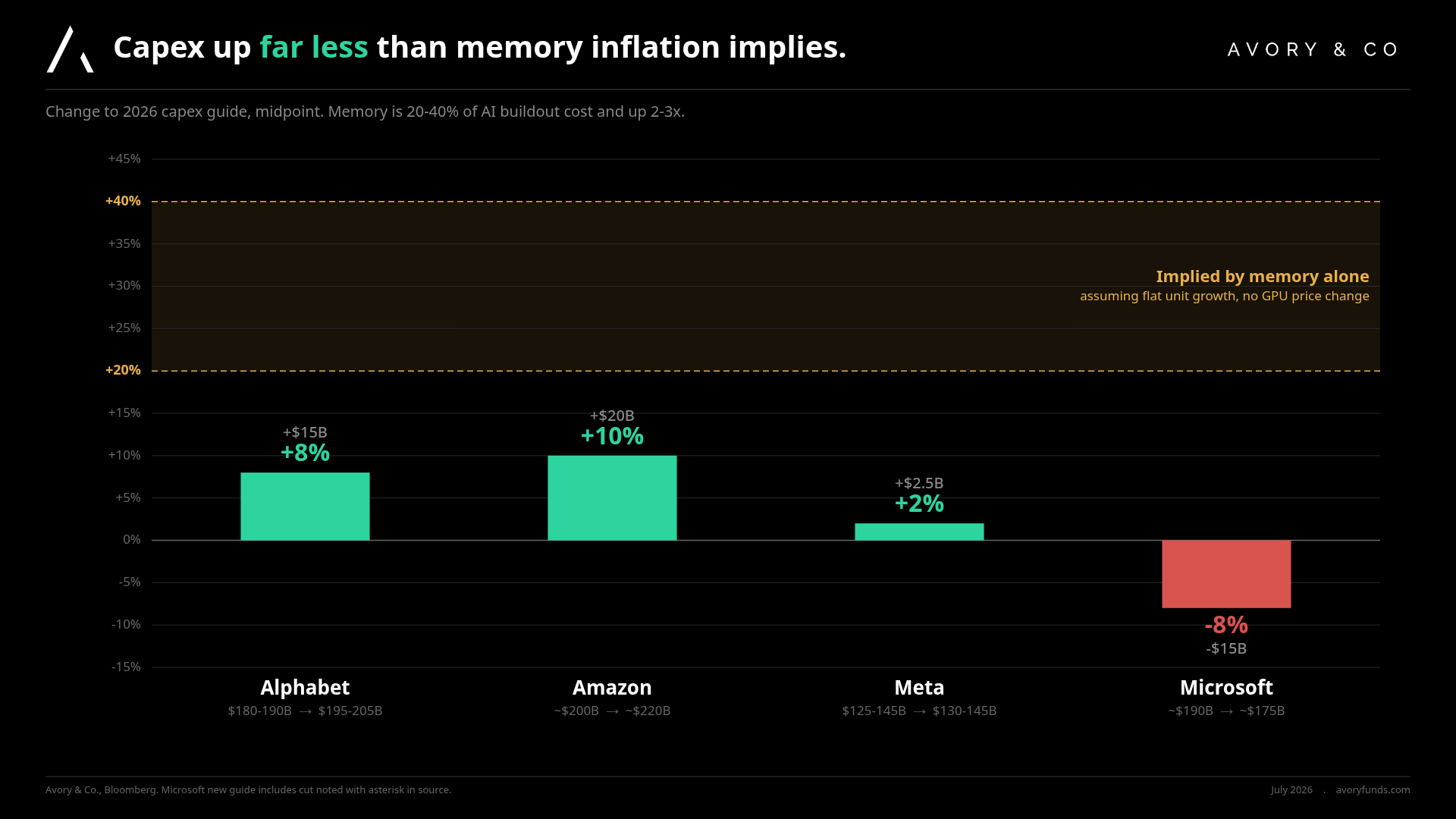
Now after getting the earnings this week and knowing price of memory we wanted to make some hypothetical assumptions…
Here you can see the disconnect that’s shaping our read of the entire quarter.
Memory is 20 to 40% of the cost of an AI buildout, and prices are up 2 to 3x. If hyperscalers were passing that fully through and holding unit growth flat, capex should be up +20 to +40%. Instead Alphabet is +8%, Amazon +10%, Meta +2%, and Microsoft actually cut guidance -8% (accounting change).
Either the impulse in unit demand is fading, or the hyperscalers are eating a lot of the memory cost themselves. Something we’re going to be watching closely but their margins are not getting worse while memory names have 80-90% margins.
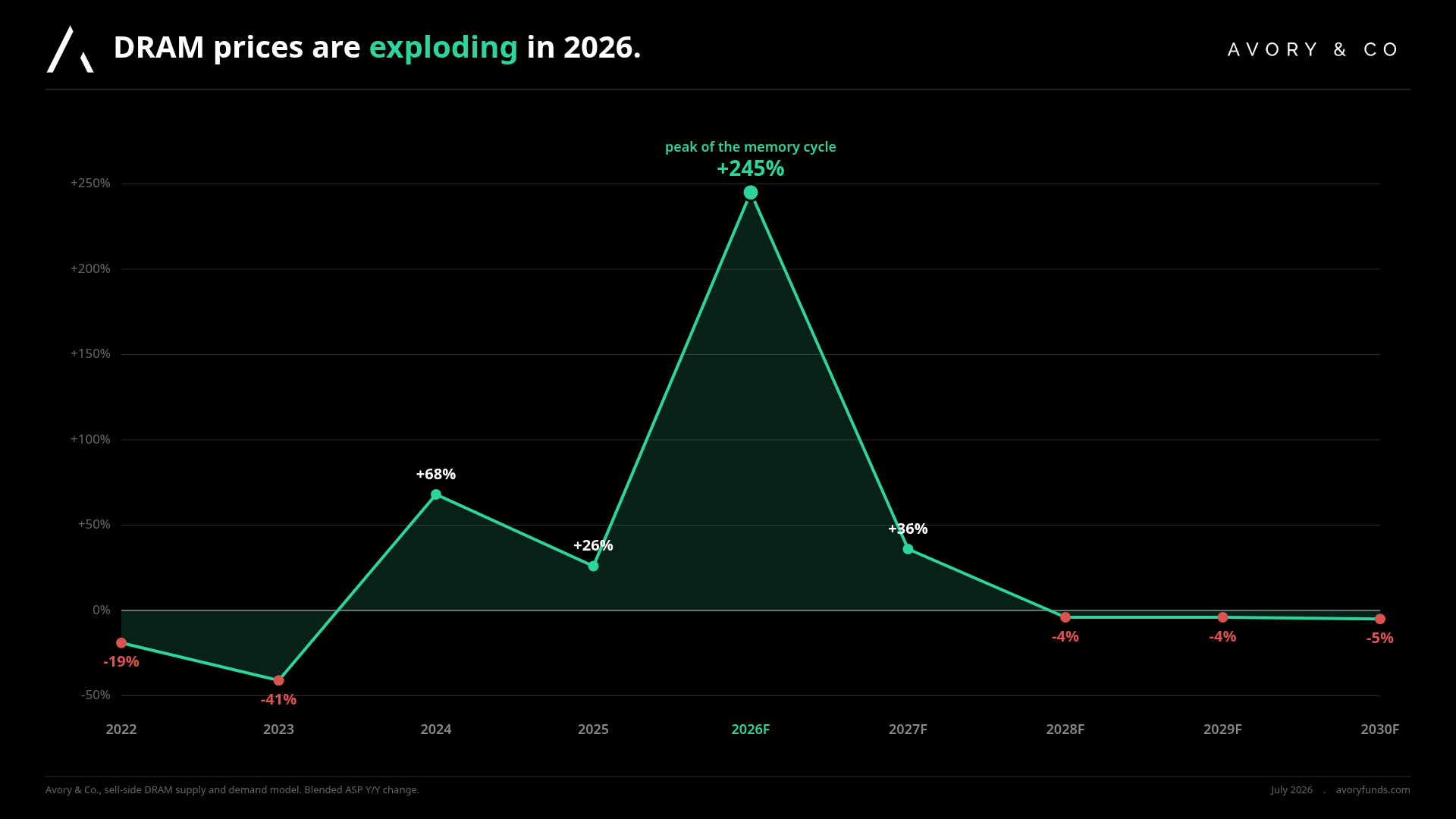
[3] DRAM prices are ripping, with 2026 up +245% Y/Y in the forecast.
Here is the evidence.
The Y/Y price change in DRAM is the memory story in one chart.
After -19% in 2022 and -41% in 2023, prices flipped hard in 2024, and the current outlook has 2026 up +245% Y/Y with another +36% in 2027 before rolling over. The 2027 is an estimate from Nomura, but still.
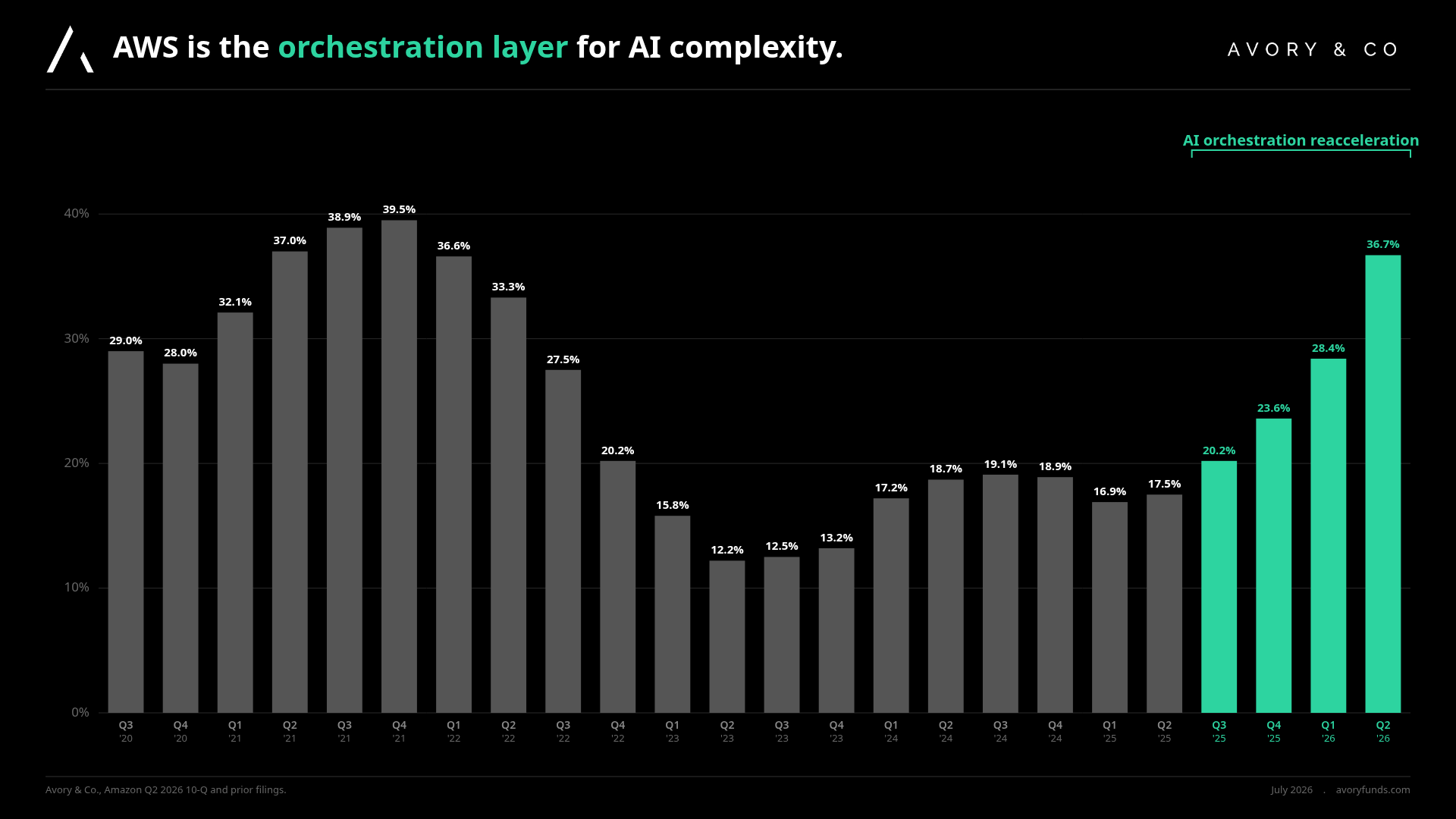
[4] AWS growth is holding, another sign the enterprise is in good shape.
Now to earnings.
AWS is clearly winning. It delivered another strong quarter, and the read-through for enterprise demand remains constructive.
Growth is very strong for a business of this size, and margins remain healthy.
AWS is also winning in AI for a simple reason: AI is difficult to implement. At the compute layer, companies need access to infrastructure powerful enough to run these workloads. AWS and the other hyperscalers take much of that complexity off the customer’s plate.
Then you have the model layer. Amazon Bedrock allows companies to run AI workloads on AWS, choose between Amazon’s own chips or hardware from Nvidia, AMD and others, and use the model that best fits their needs.
This allows businesses to focus on what they do best rather than managing compute infrastructure, model deployment and delivery.
We call this orchestration, and Amazon is winning.
[5] Meta’s ad engine keeps compounding.
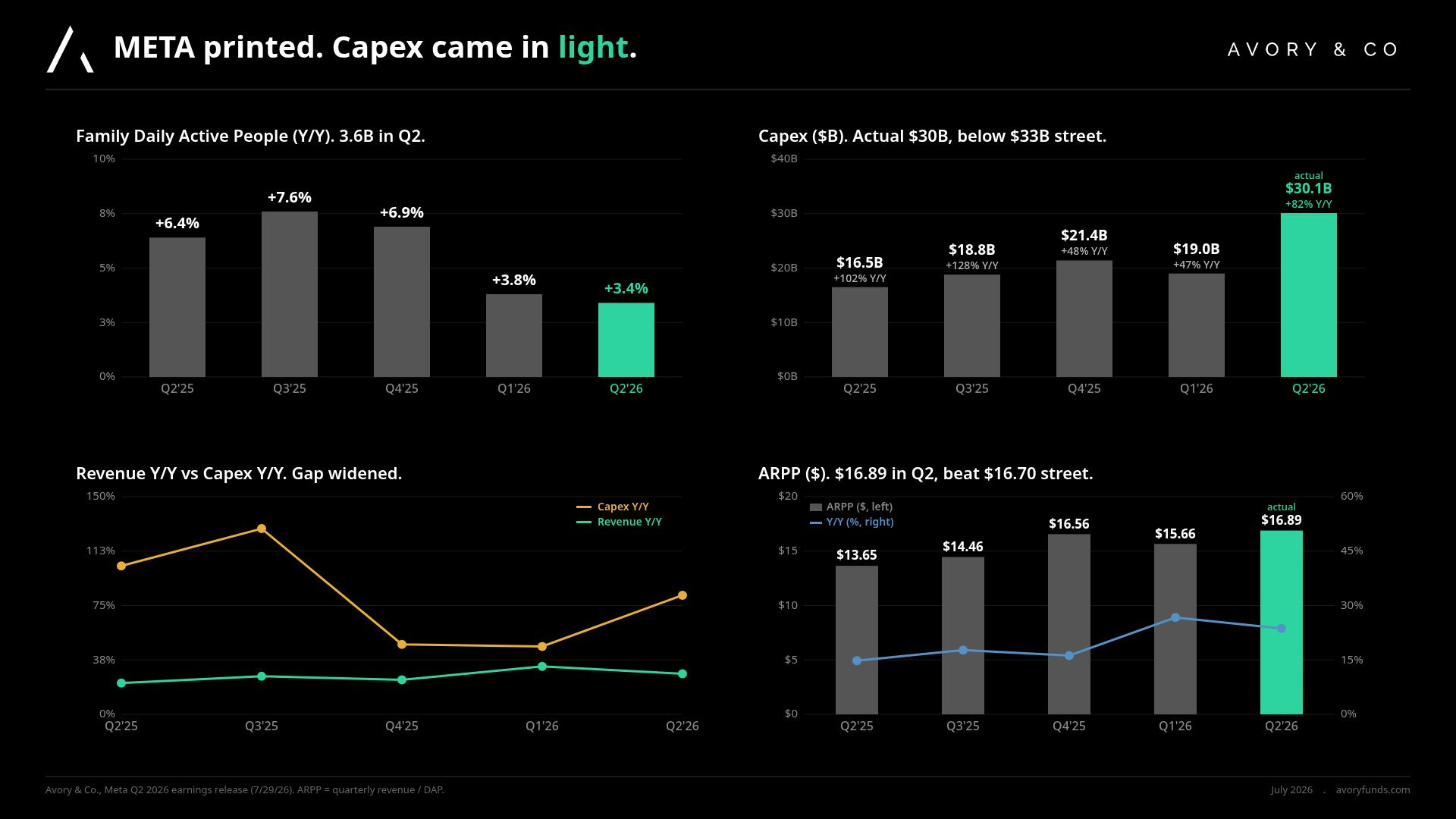
Meta’s earnings showed the advertising business continues to run very well.
Revenue grew 28%, and the company guided to roughly 22% growth in Q3, despite facing its most difficult Y/Y comparison.
The read through is that the consumer remains healthy enough for advertisers to keep spending.
Meta also saw both impressions and price grow at double-digit rates. To us, that suggests the AI story is working for them. Engagement is improving, while advertisers are generating strong enough returns to support higher pricing. Sounds good to me.
Is Meta actually using AI? Yes. The company said Instagram Reels recommendations are now entirely powered by large language models. More than 50% of recommended feed content is also less than one day old, more than double the level from last year.
AI is not a side project for Meta. It is increasingly what runs the core platform.
There is still plenty of noise around Meta’s AI spending, but the actual capex numbers were more measured than what I keep reading. Meta seems to always be punching bag despite strong growth and profits.
Here’s some math… Capex came in $3 billion below expectations this quarter and was guided $1.5 billion above expectations next quarter. On a two-quarter basis, that is still $1.5 billion below what the Street had expected.
Meta also increased its full-year capex guide by only 1.9%, one of its smallest increases.
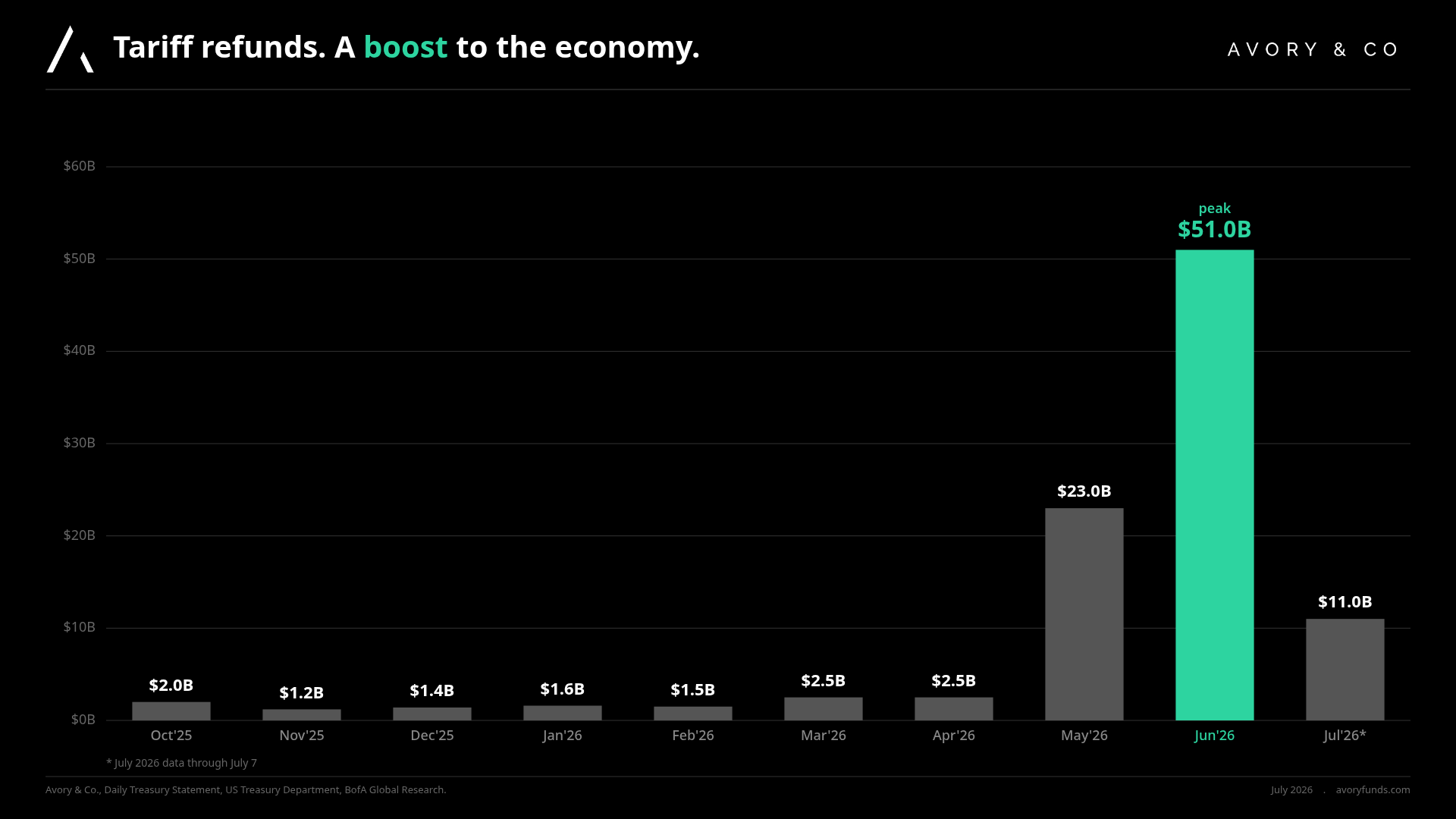
[6] Tariff refund payouts are running well above the prior run-rate.
Now to some other news.
Economy is getting a boost.
The refund bucket keeps expanding, and the pace is a good marker for what’s actually flowing back into corporate P&Ls.
Tariff refunds are happening. We heard it from Starbucks and many others this week in their earnings calls. We tracked BofA data to small businesses, and the story is same. Money back to economy.
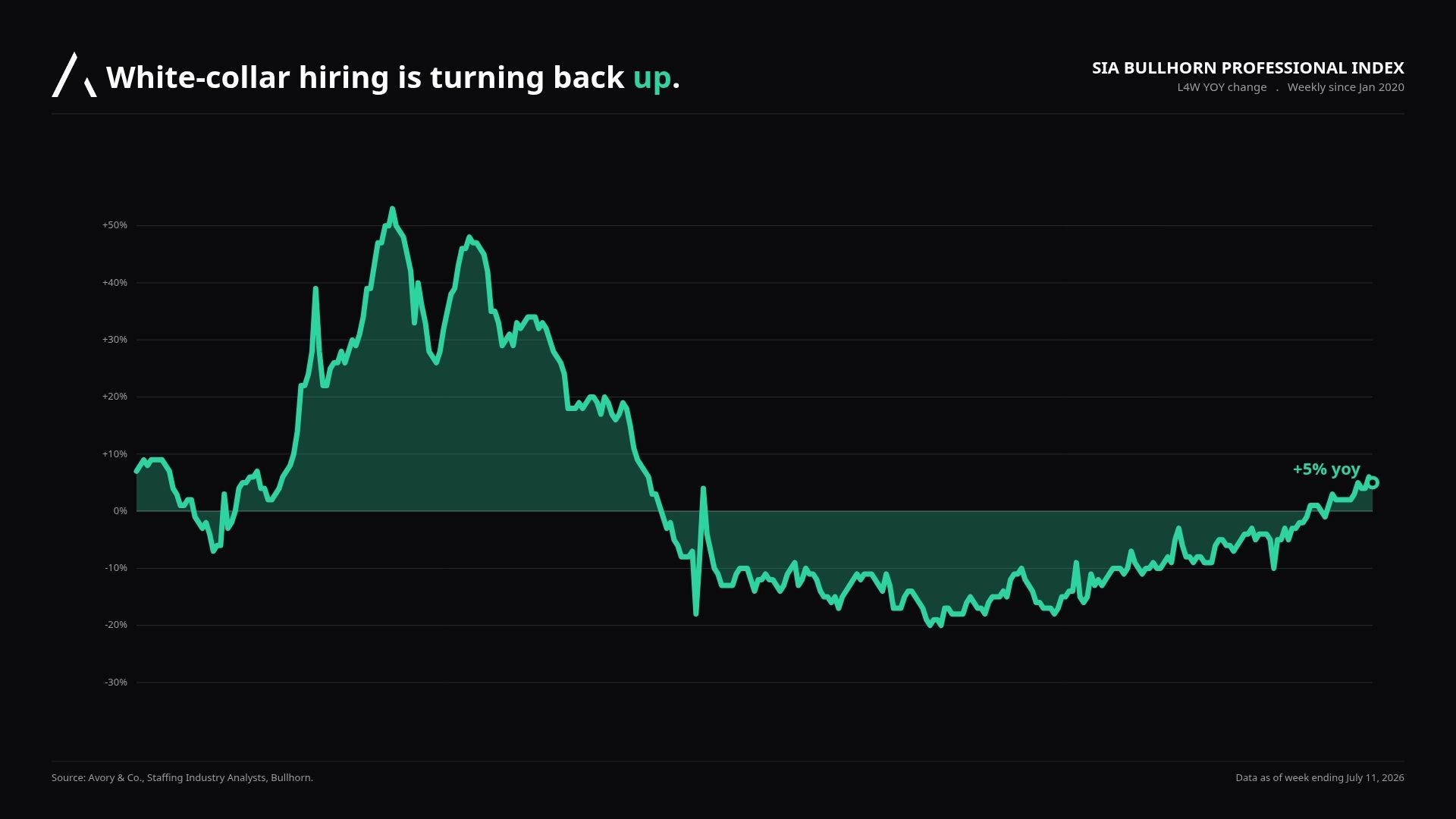
[7] White-collar hiring is turning back up, now +5% Y/Y.
Now to jobs.
The Bullhorn Professional Index has been in a two year drawdown since the 2022 peak, and it’s now running +5% Y/Y for the four-week trailing.
This is the cohort that everyone has been worried about on the AI-displacement narrative, and the data is so counter to the narrative. Hiring is coming back you just have to look at data not feelings.
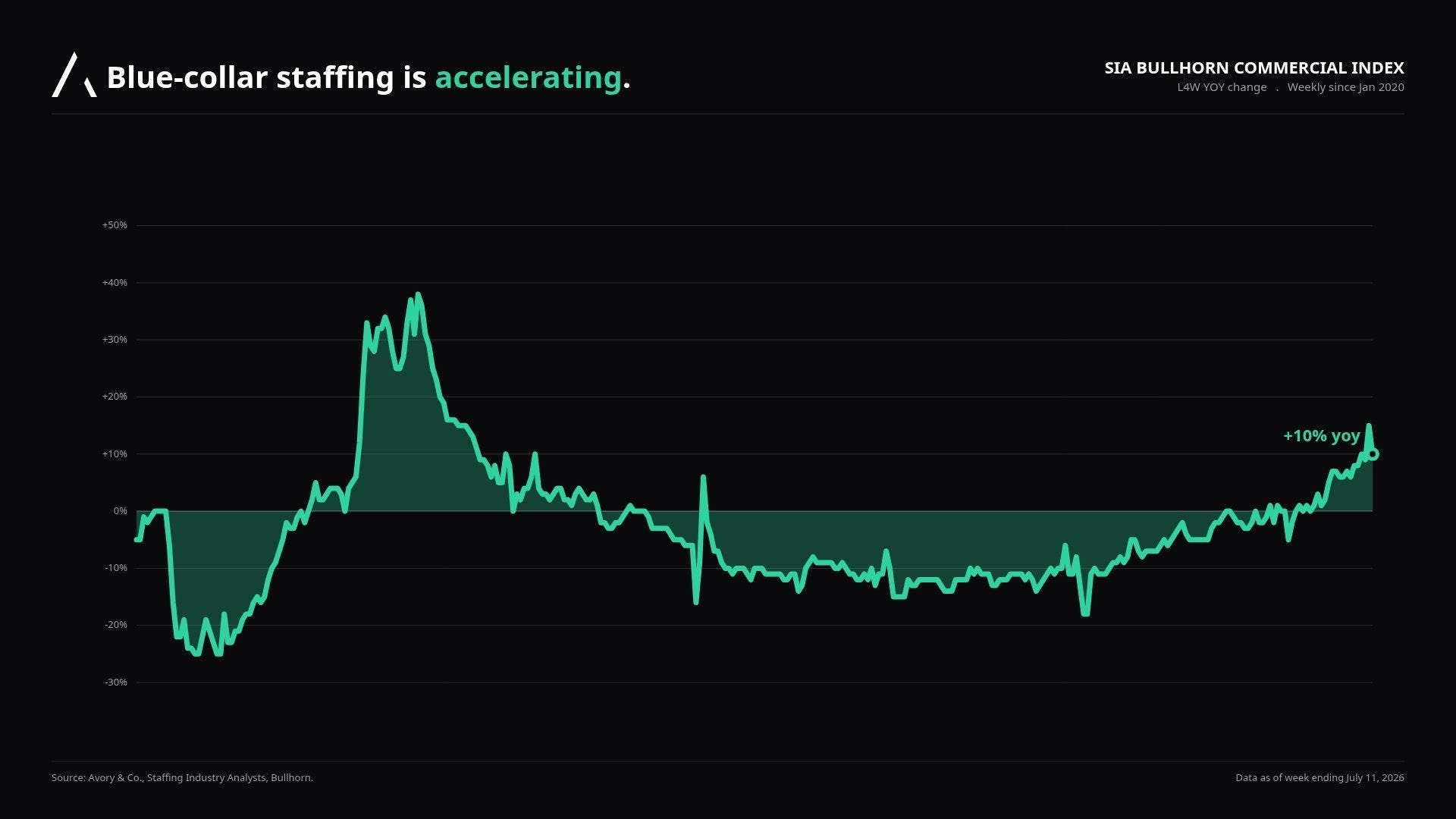
[8] Blue-collar staffing is accelerating, +10% Y/Y.
Another datapoint.
The Commercial Index is running +10% Y/Y and accelerating hard off the 2023-2024 lows.
Combined with white-collar turning up, this is a very clean signal that the labor market impulse is picking up on both sides. Good read for the consumer and for the broader economy.
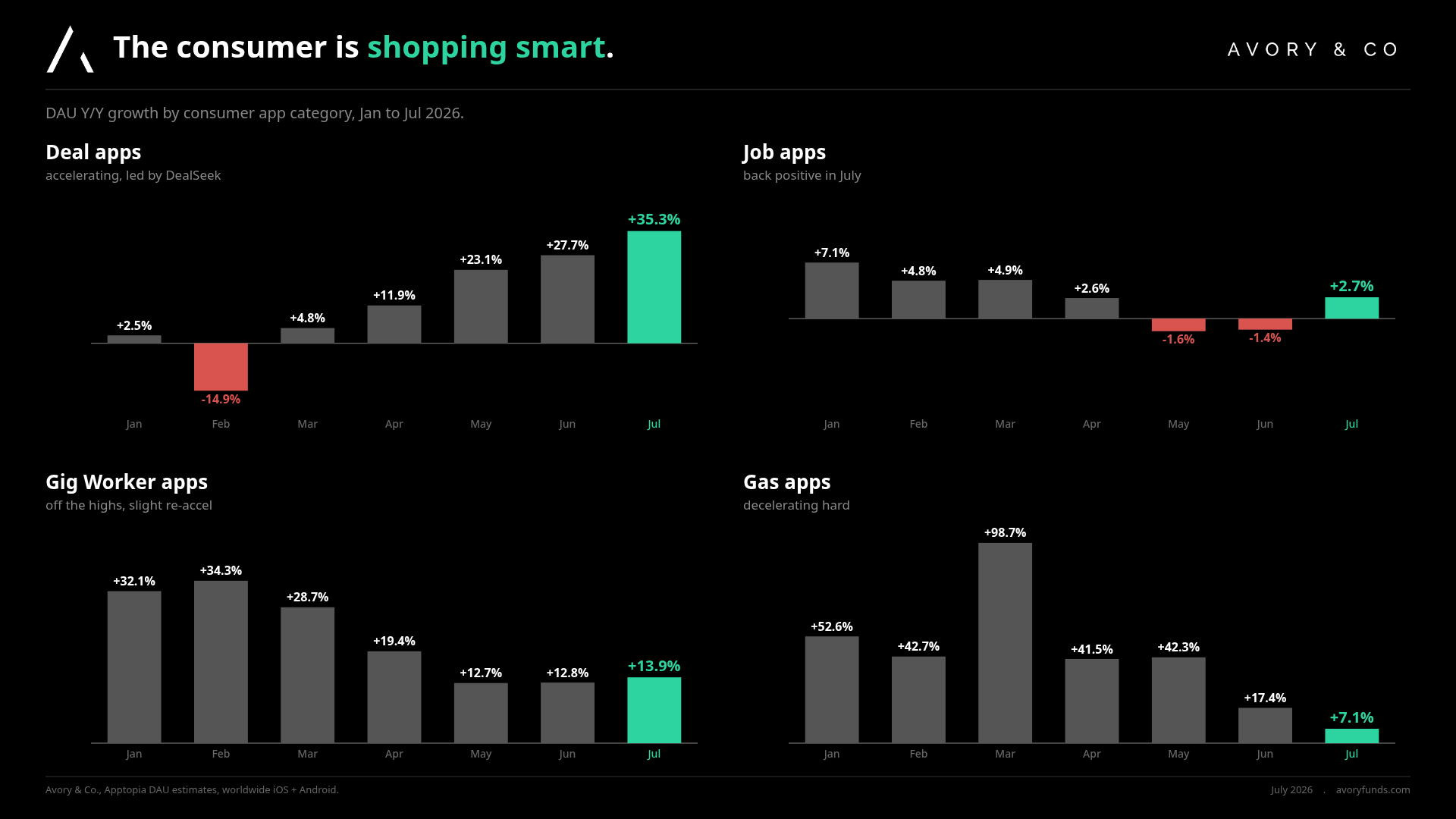
[9] The consumer is shopping smart across four different app categories. Apptopia Data.
This is a cool dashboard.
We like to bring in Apptopia download and engagement data to check consumer intent, and this week the reads are mostly constructive.
Deal apps accelerating to +35% Y/Y , most of this coming from one app DealSeek. So consumers looking for deals, nothing new but something to watch.
Job apps back positive in July after two negative months.
Gig Worker apps off the highs but slightly re-accelerating.
And Gas apps decelerating hard as the fear of a gas spike comes out of the system.
Most moves are in constructive directions but cool way for us to measure real-time consumer health… (IF YOU LIKE THIS DASHBOARD, LET US KNOW IN COMMENTS, WILL ADD MORE OFTEN)
[10] Kimi had a viral moment in July, briefly surpassing DeepSeek.
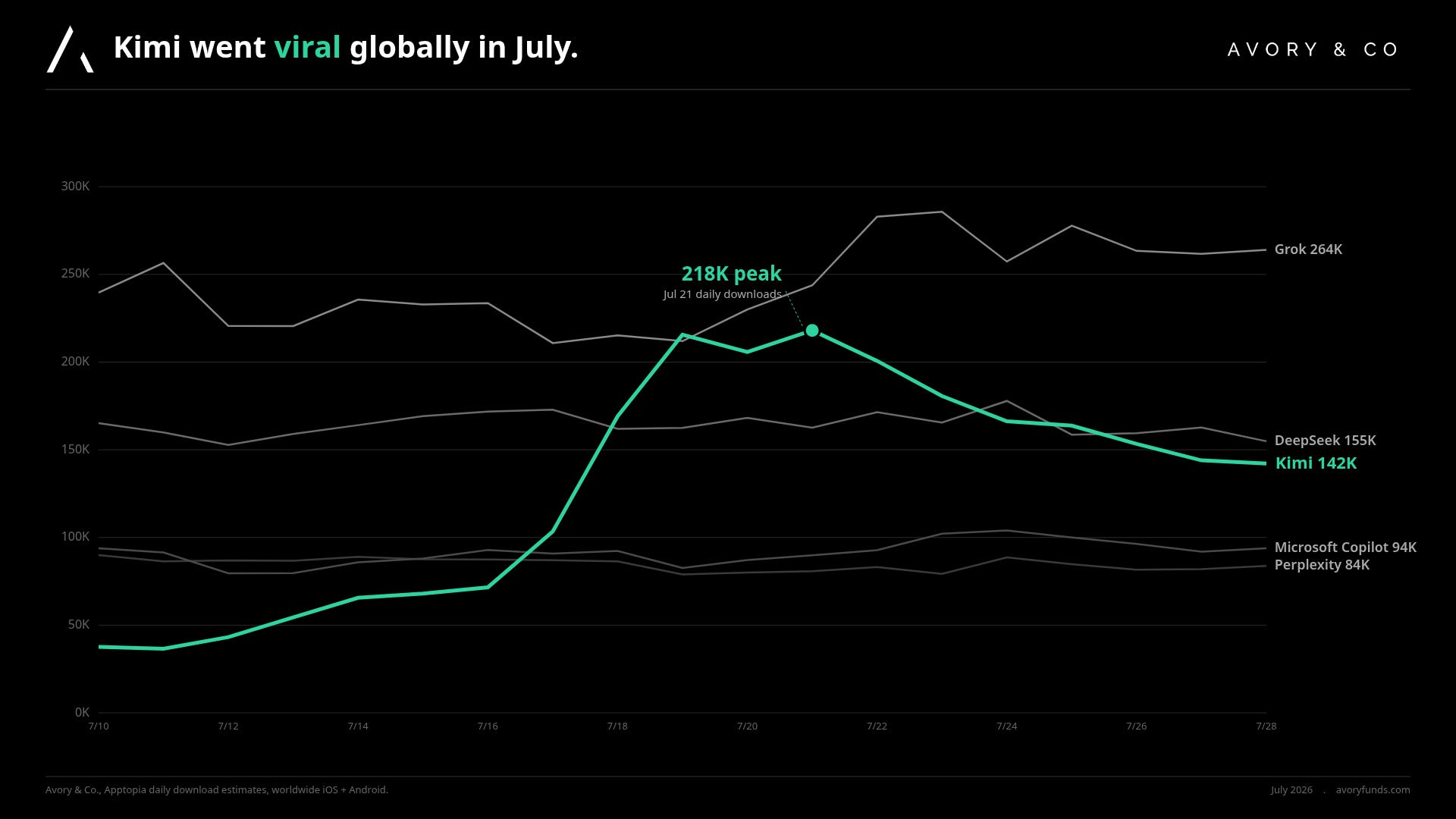
Now you may or may not have heard of Kimi. So we looked at the data.
Kimi went from ~37K daily downloads to a peak of 218K in about two weeks. Impressive trial spike, and it briefly took over DeepSeek. But context matters. Kimi is still well behind Grok, and both are miles behind where ChatGPT and Claude sit on the consumer side.
Our read is that the consumer AI market remains ChatGPT and Claude territory, and the interesting battle for Kimi and the challengers is on the enterprise side, not consumer.
[11] Snap’s fastest-growing cohort is Age 46+, nine straight positive quarters.
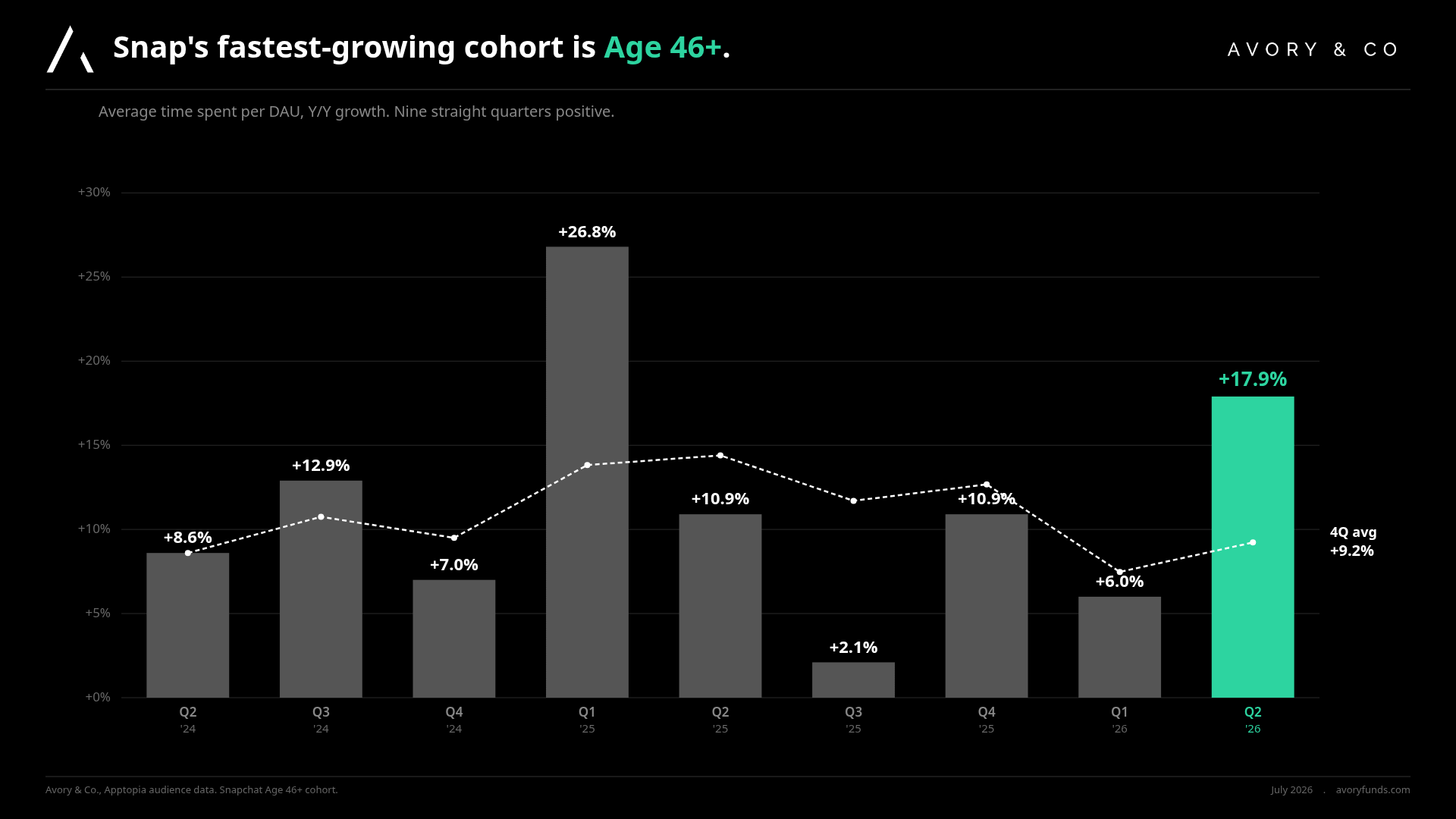
We were looking at data this week and we came across this. Asking ourselves whether Snap is aging up, and the data says yes. Time spent per DAU for the 46+ cohort has been positive Y/Y for nine consecutive quarters, with Q2’26 running +17.9%. The 4Q average sits at +9.2%. Snap’s platform is broadening its user base into the older cohort, and that’s a durable shift, not a one-quarter print. Lets see how it shows in Snap earnings coming up…
[12] Venezuelan crude is flooding back in.
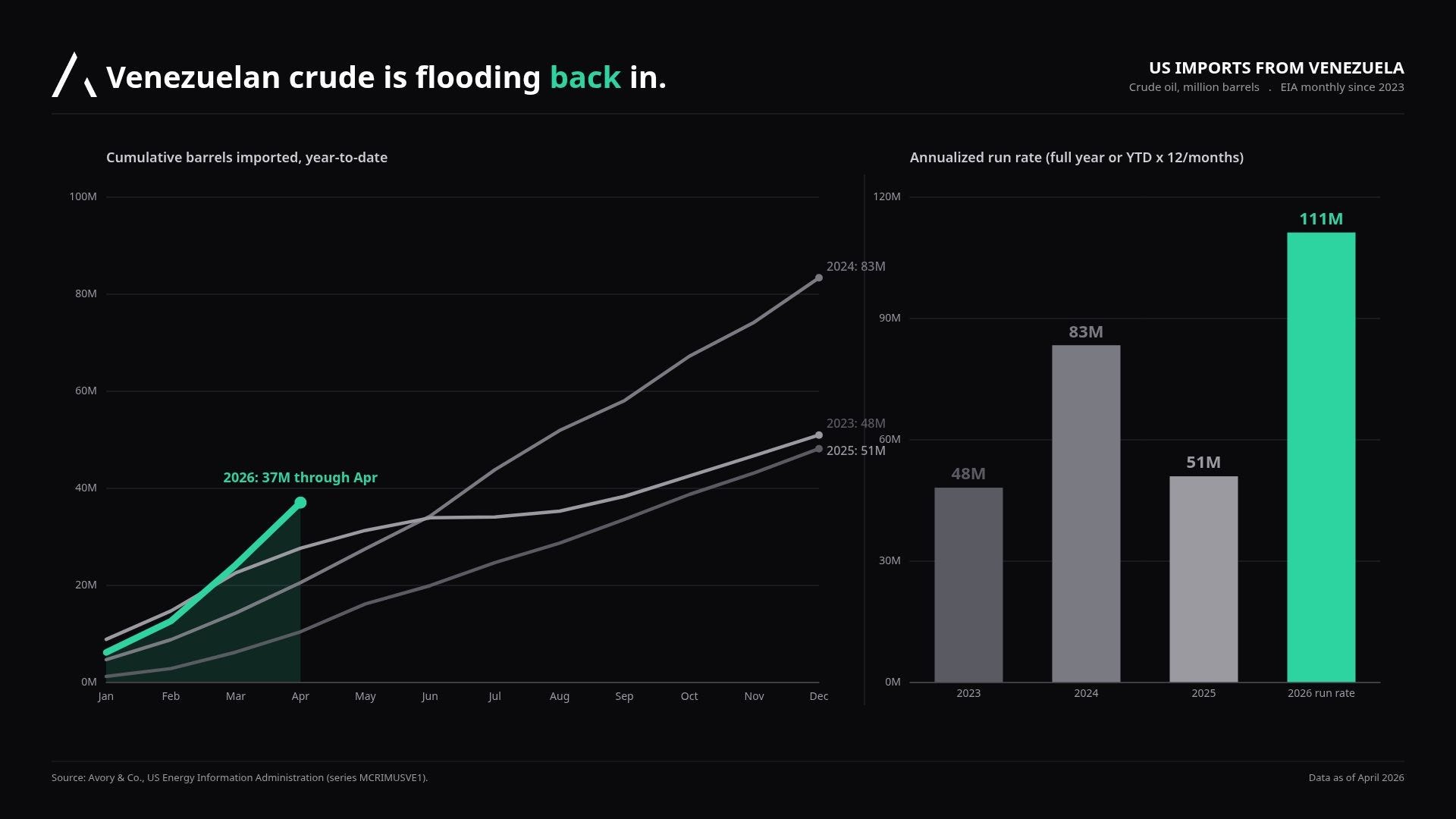
The 2026 annualized run rate for US imports of Venezuelan crude is 111M barrels, up from 51M in 2025 and 48M in 2023.
It’s another data point that adds supply into the global energy picture, and it’s part of why energy has stayed calmer than the war headlines would suggest. We continue to see evidence that neither side truly wants to escalate. If they did, we’d have already gone further by now.
Net Net
The AI shakeout was overdue, and the leverage that got flushed this week was a healthy reset. The Fed did the right thing by staying put. Hyperscalers delivered, and their earnings tell you the consumer and the enterprise are both in good shape. But the one thing we keep coming back to is the move in memory prices. Memory prices are up 2 to 3x, and capex is up single digits. Something has to give, and forsure that will be the read we’re watching into next quarter.
That’s all for this week!
MAKE SURE TO SUBSCRIBE TO AVORY AROUND THE DESK PODCAST
Spotify: Here
Apple: Here
About Avory & Co.
Investing Forward.
Avory specializes in high-conviction equity strategies, emphasizing Secular Growth and Transformation Stories driven by exceptional teams. Data guides decisions. We cater to high net worth investors, family offices, and institutional investors. Note: This information doesn’t constitute a recommendation to buy or sell any mentioned securities. Avory is based in Miami, Florida with clients all across the globe.
Speak to us:
Send us an email: Team@avoryco.com
Want to invest? We are on most platforms.
Want More
🎥 Avory YouTube: Channel
🎙️ Avory: Podcast
Disclaimer: Not a recommendation to purchase or sell any securities mentioned. This is for educational purposes only.