

Big Picture
💡 Burry, Buybacks, and AI Squeeze. So many signals.
Happy Sunday. I wanted to wait for Friday close to occur to ensure we did not get more info post market close Friday after US Treasury bought back bonds + Yen intervention…
A lot happened this past week and more is coming next week with Nvidia reporting. Everything seems to connect given AI and financing are aligned, and yields tie to both. We heard Bessent went back on the mic last week reinforcing what has become a very clear playbook. Stability in yields matters a lot, and sometimes more than the absolute level, both on the yen side and for the US long bond (30 year). Buyers of bonds just want to know prices won’t fluctuate all that much, and if you zoom out, yields have actually been fairly range-bound over the last four years. We’re still sitting in that range.
The reason stability matters so much right now is what’s happening on the spending ledger. Net interest continues to move up the ladder of federal spending categories, which means steady to lower yields is critical to keeping the fiscal math in a good spot. But you have two forces pulling opposite ways. Capital gains tax cuts on the revenue side, a war occupying and increasing outlays on the spending side. Both are pressuring the balance, while the interest cost line itself is also pressuring yields.
On AI, the data this week was interesting. Adoption is growing, something we believe in and something we have clear evidence on. And we are seeing IT budgets grow not shrink or simply AI replacing spend, which is key to the software working story. Also open weights are now inside the frontier pack, Microsoft entered the model board with its own silicon, and the memory names are lining up buybacks instead of reinvesting, which makes me hmmmm.
But before all of that, one visual. Here you go.
[1] Burry brings up Etched. We already brought this up…
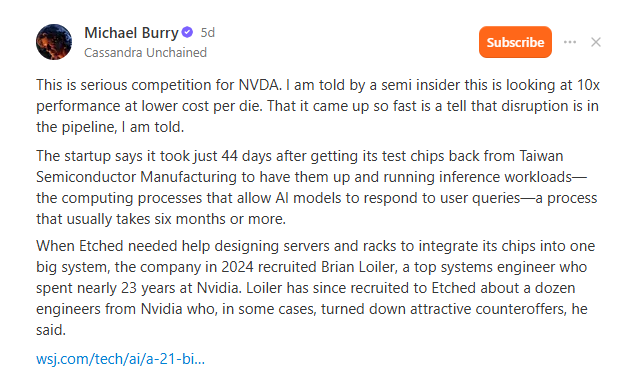
Michael Burry surfaced Etched this week, and the reaction has been a lot of “wait, what is this.” We’ve been talking about Etched for months.
The point isn’t that Burry is right or wrong…
The point is that disaggregating the current compute stack, breaking apart the layers that are backed up and expensive, is a real signal, and it’s closer than the market probably thinks. We learned during COVID that barriers break. What usually took a decade took months. I know it’s a soft topic for some, but I’m referring back to vaccines, which the world condensed the production time frame on as supply and demand were out of whack.
For AI, historically it takes about three-six years to build a fab that can compete. Given the money flowing into this space and the demand and supply imbalance, that timeline is likely shrinking. Something we’ve been explicit about.
Key to put this in the back of mind as it can impact margins everywhere.
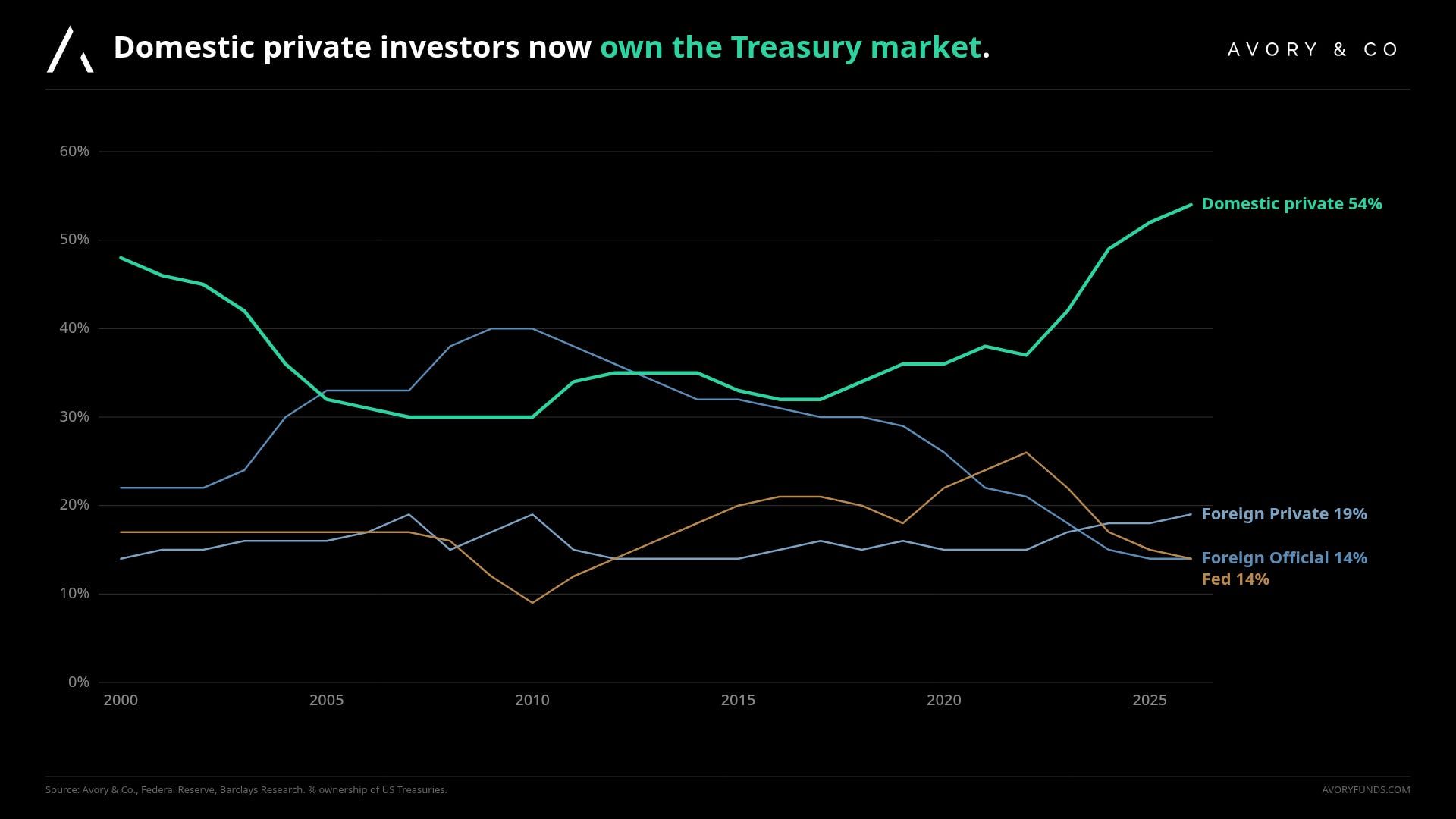
[2] Domestic private is now the biggest holder of Treasuries.
Bessent hhas called himself the “primary caretaker of the Treasury market,” and his recent actions are starting to make that framing pretty clear.
Whether it’s intervention around the yen or, more recently, attention on the long end of the U.S. curve, the message has been fairly consistent: policymakers seem much more concerned with disorderly moves and volatility than with defending any specific level of yields. Bond buyers can live with higher yields. What becomes more problematic is when the market starts moving violently and price discovery feels unstable. And despite all the noise over the last several years, if you zoom out, Treasury yields have actually remained within a relatively defined range. We’re still sitting inside that range today.
What has changed much more dramatically is who owns the market.
Domestic private investors now hold roughly 54% of the U.S. Treasury market, up from around 30% for much of the last decade. Meanwhile, foreign official ownership has fallen to roughly 14%.
That is a very different buyer base than the Treasury market was accustomed to historically.
It also helps explain why Bessent appears increasingly focused on maintaining liquidity, orderly markets and confidence in the long end.
[3] Net interest is now the second largest federal spending line.
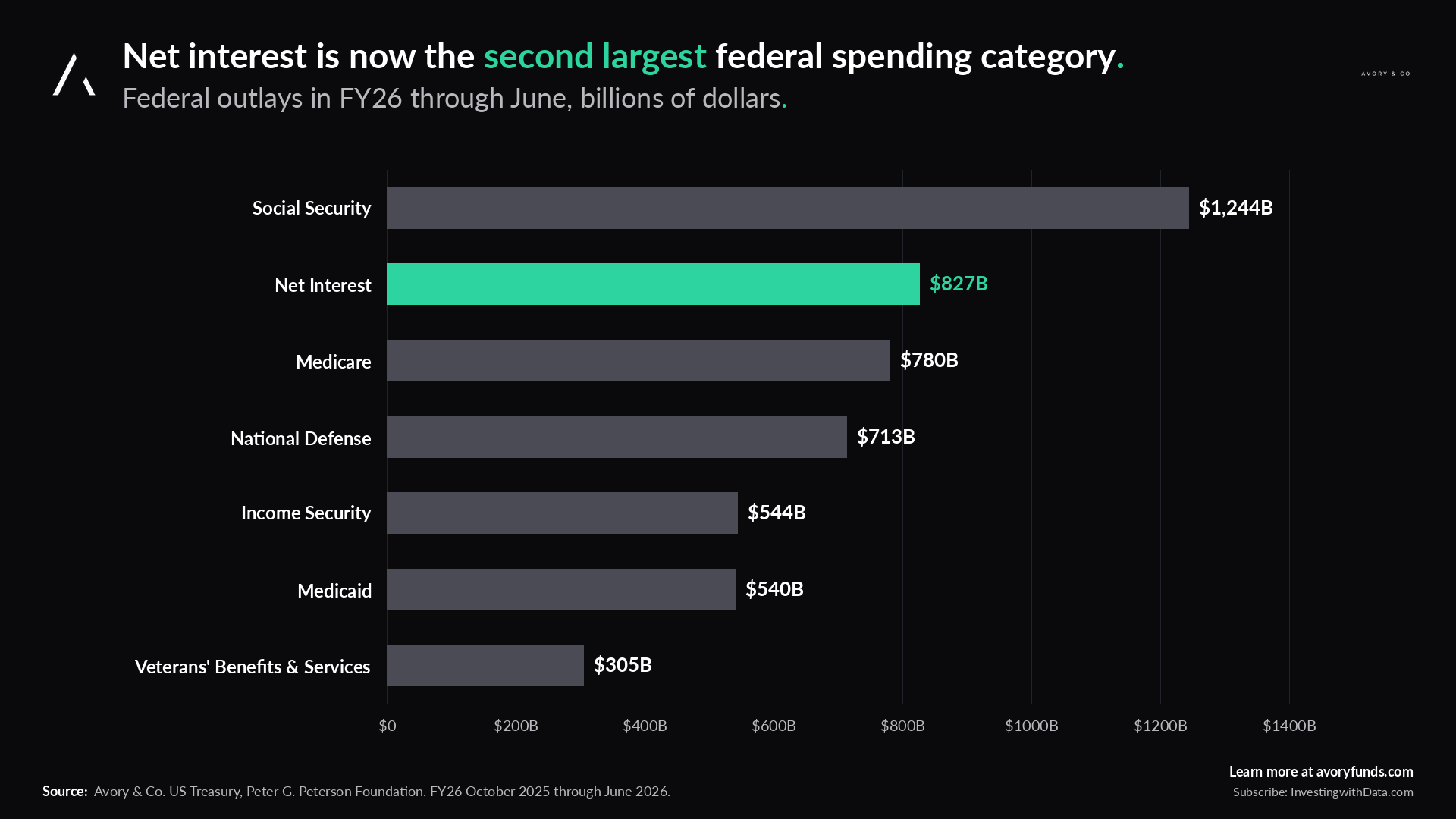
This is why stability and eventual direction of yields matter so much.
Net interest ran at $827B through June of FY26 and is now the #2 spending category, ahead of Medicare and Defense, sitting only behind Social Security.
Steady to lower yields is very critical to keeping the fiscal math in a good spot. But you have two forces at play. The revenue side is hinting at capital gains tax cuts, which the administration has floated over the last several weeks. And on the spending side, a war is occupying and increasing outlays.
Two sides of the ledger going in opposite directions, which we think is impacting yields as well. Tough job for Bessent with that in store, so proactively showing support I think is important.
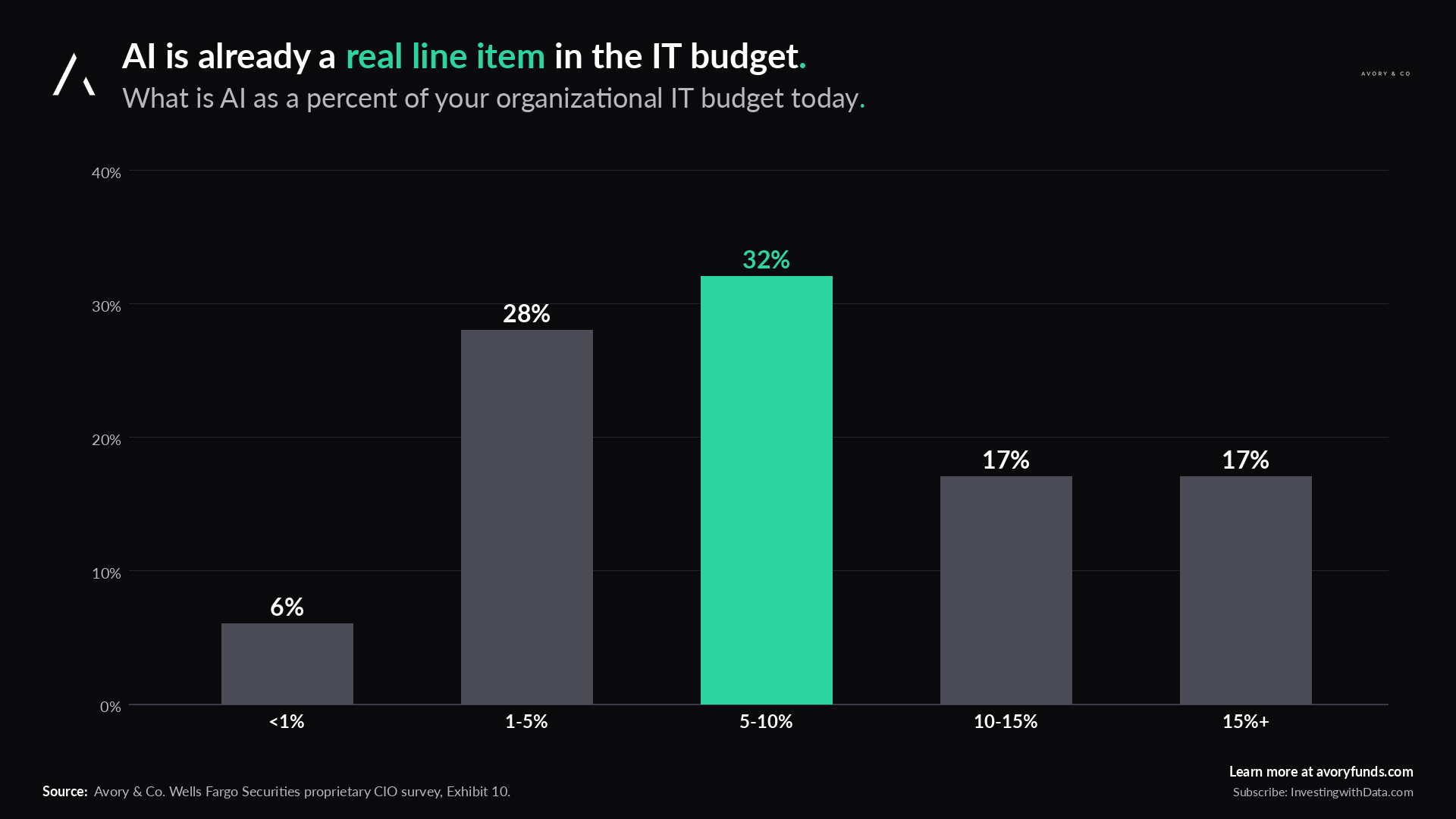
[4] AI is already a real line item in the IT budget.
Now back to AI.
A study showed that 34% of organizations already spend 10% or more of their IT budget on AI.
The mode is 5-10%, at 32% of respondents.
Only 6% are still under 1%.
So we are making progress on real use cases here and it is showing in budgets.
[5] AI eats crappy software, but IT budgets are growing.
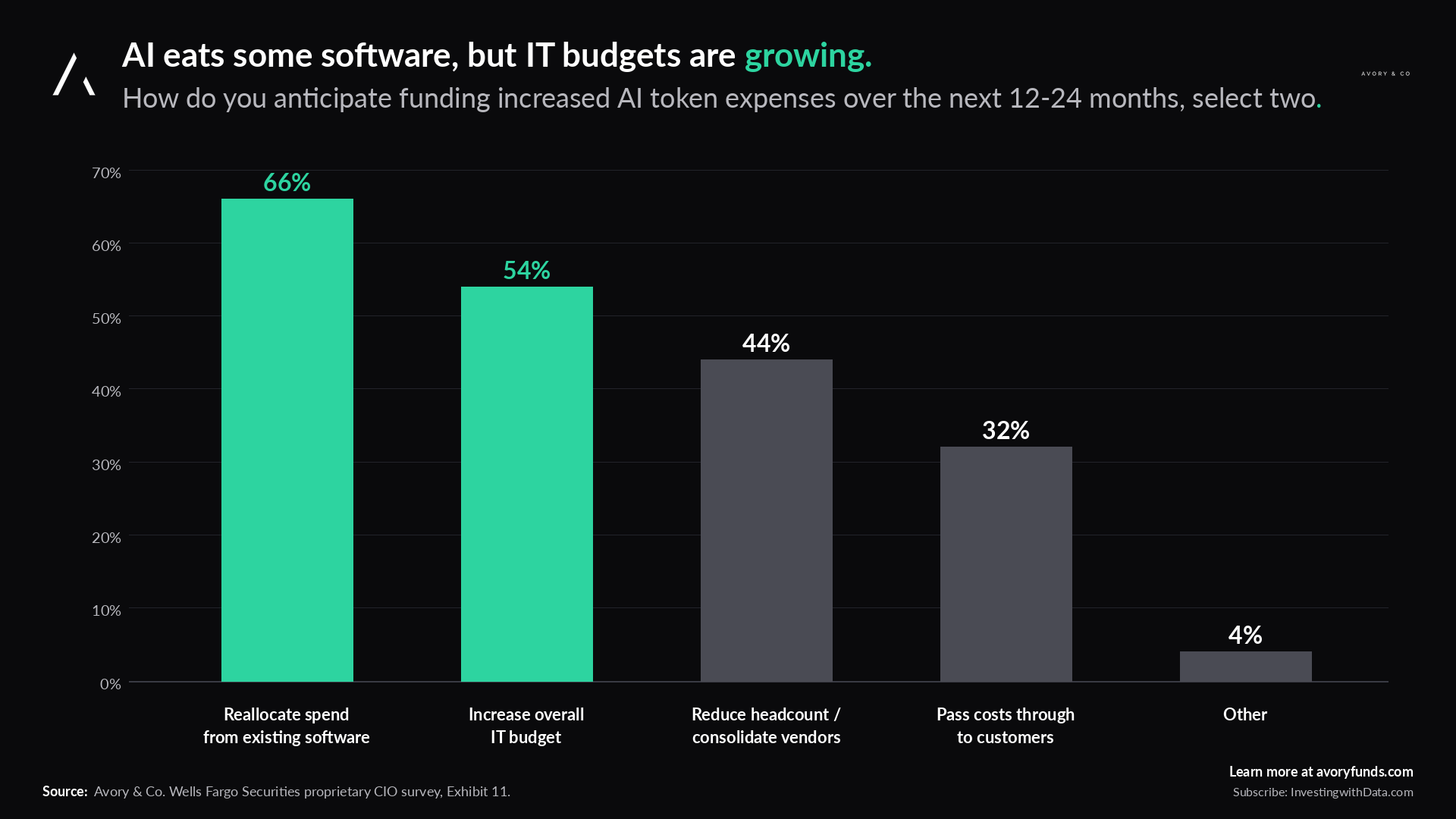
Now then the question that matters for investors is where is that AI spend coming from.
66% say they’re reallocating from existing software.
54% say they’re increasing the overall IT budget.
Both of those things are true at the same time. AI is eating the simple software categories, the ones that lack defensibility, regulatory burden, or governance burden. Some of those tools are being replicated and live-coded for single-purpose solutions.
Others are being absorbed by vendors that are expanding horizontally. But the biggest takeaway is that overall IT budgets are growing, not shrinking, because of AI.
We think entrenched software with APIs, MCPs, and headless architecture, like what Salesforce announced, benefits from this. Additional IT dollars will continue to flow to current software vendors that can absorb the new workload. We have been saying this for a while now.
[6] AI spend is concentrated at the top, and AI-heavy companies are moving faster.
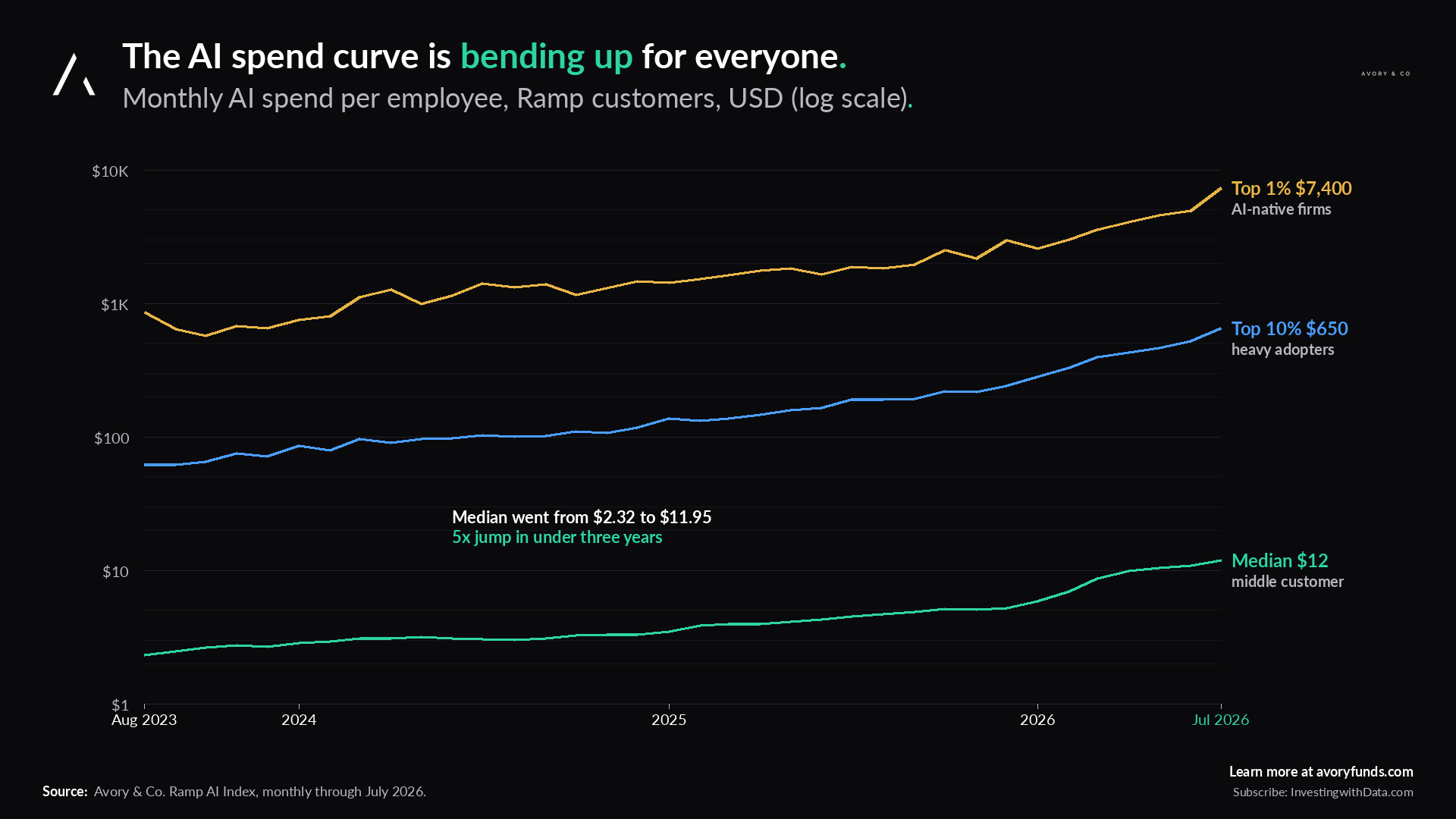
Ramp data is pretty good here.
The median company using Ramp is now spending $11.95 per employee per month on AI, up from $2.32 a year ago. That’s a 5x increase.
The top 10% are at $650, and…
the top 1% are at $7,400 per employee per month.
That’s a massive gap between who’s using it at scale and who’s not. Some of that has to do with coding versus non-coding companies. But there’s a second story here. AI-heavy companies are also moving faster.
Block is a great example. AI-pilled in a good way, as we haven’t seen product velocity like this from them since their early days. It’s showing up in the data and it’s showing up in their roadmap.
This ties to the last data point on the survey of IT spend.
[7] Anthropic has held its lead over OpenAI.
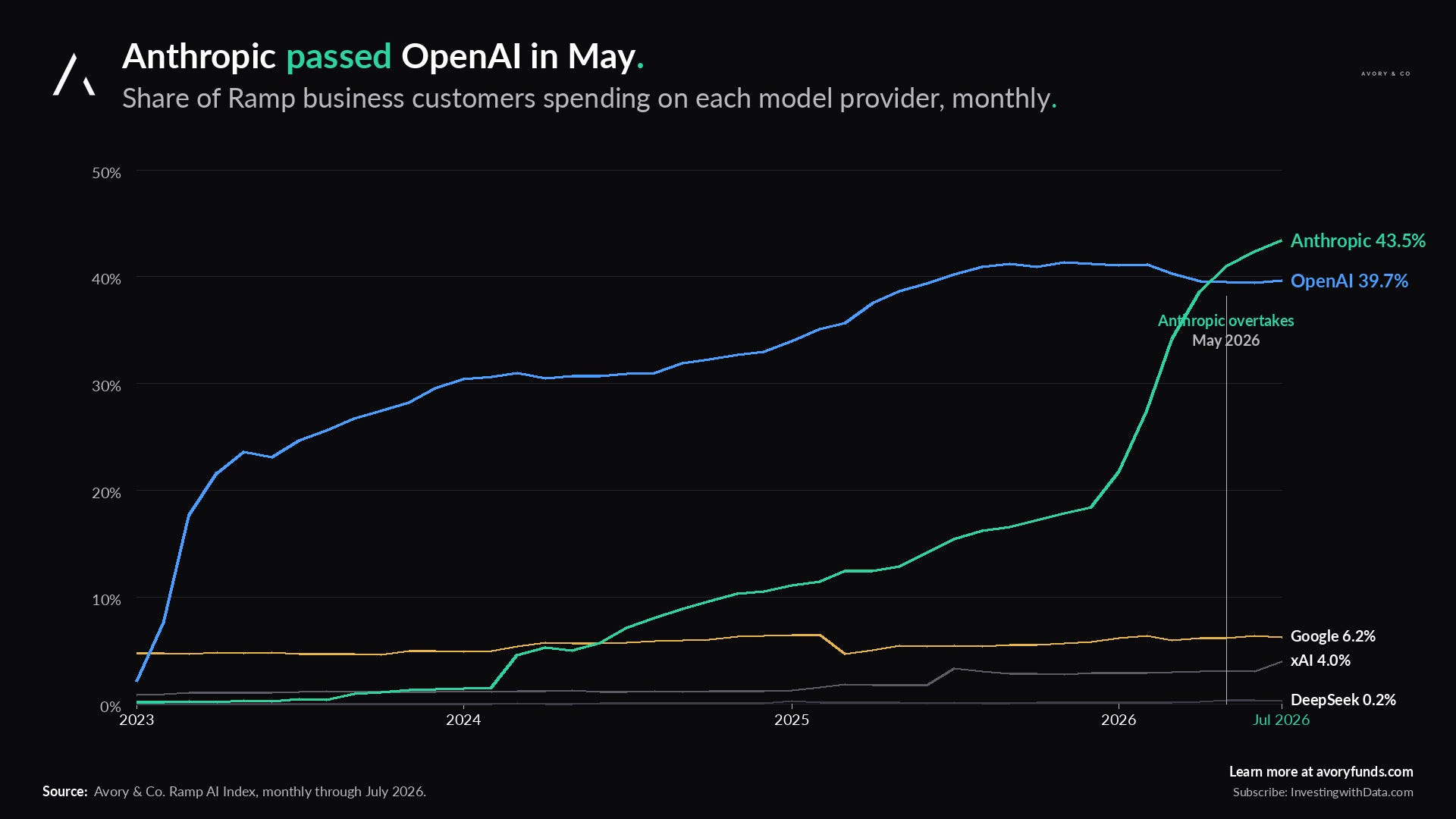
We also got an update on spending by model provider.
Anthropic passed OpenAI on Ramp’s AI Index in May 2026, and now sitting at 43.5% versus OpenAI’s 39.7%. That’s a ~4 point lead, and from what we know, it’s held over the last several months.
The bigger point is what’s happening below.
[8] Microsoft took the crown on image editing.
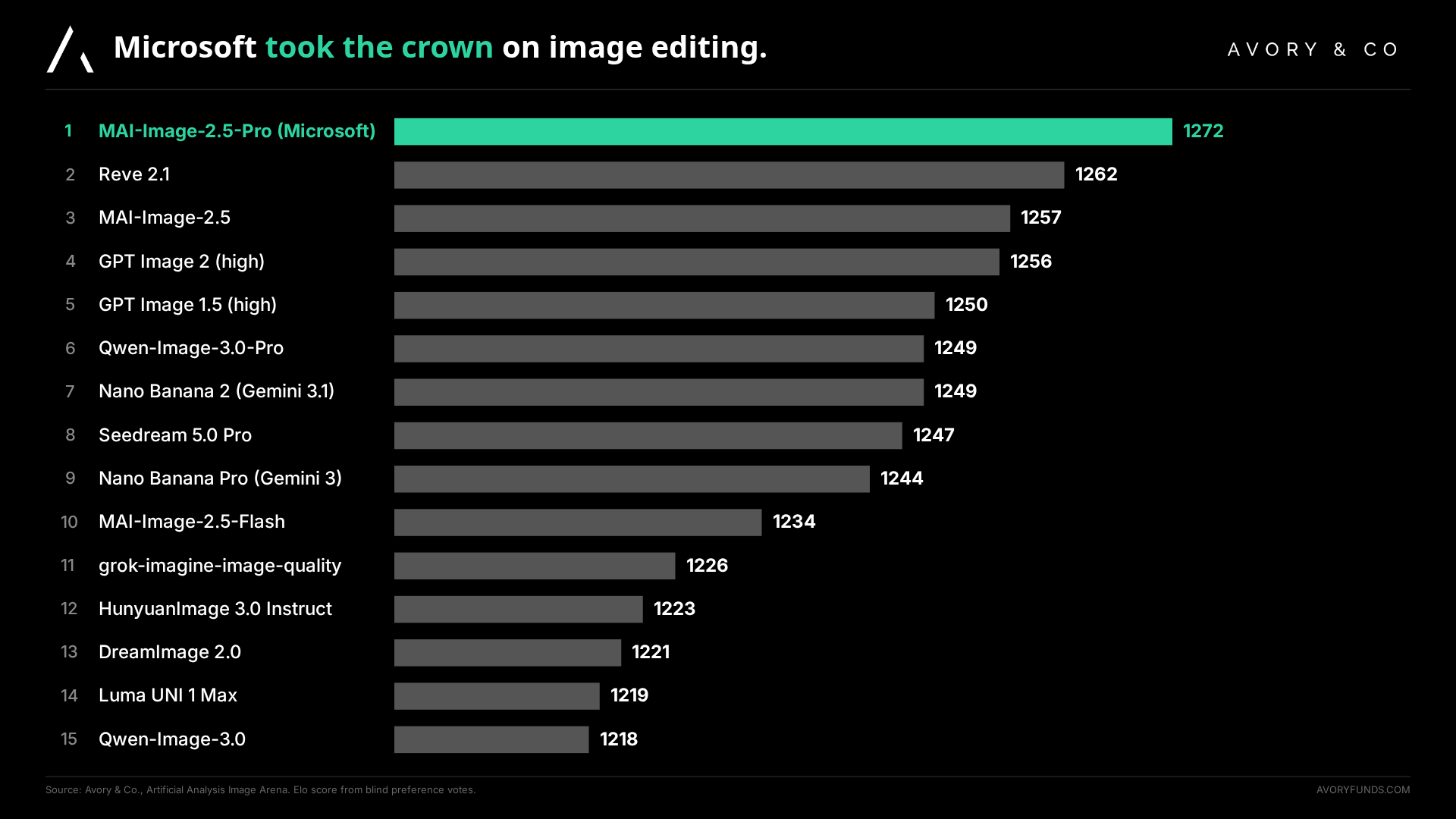
Microsoft has entered the frontier.
MAI-Image-2.5-Pro sits at #1 on the Artificial Analysis Image Arena with an Elo of 1272, ahead of Reve 2.1, GPT Image 2, Qwen, Nano Banana, and Seedream.
This was self-built on their MAIA silicon (their own chip). That is key because Microsoft is now competing at the top of the model board with hardware they own end-to-end.
[9] Open weights are now inside the frontier pack.
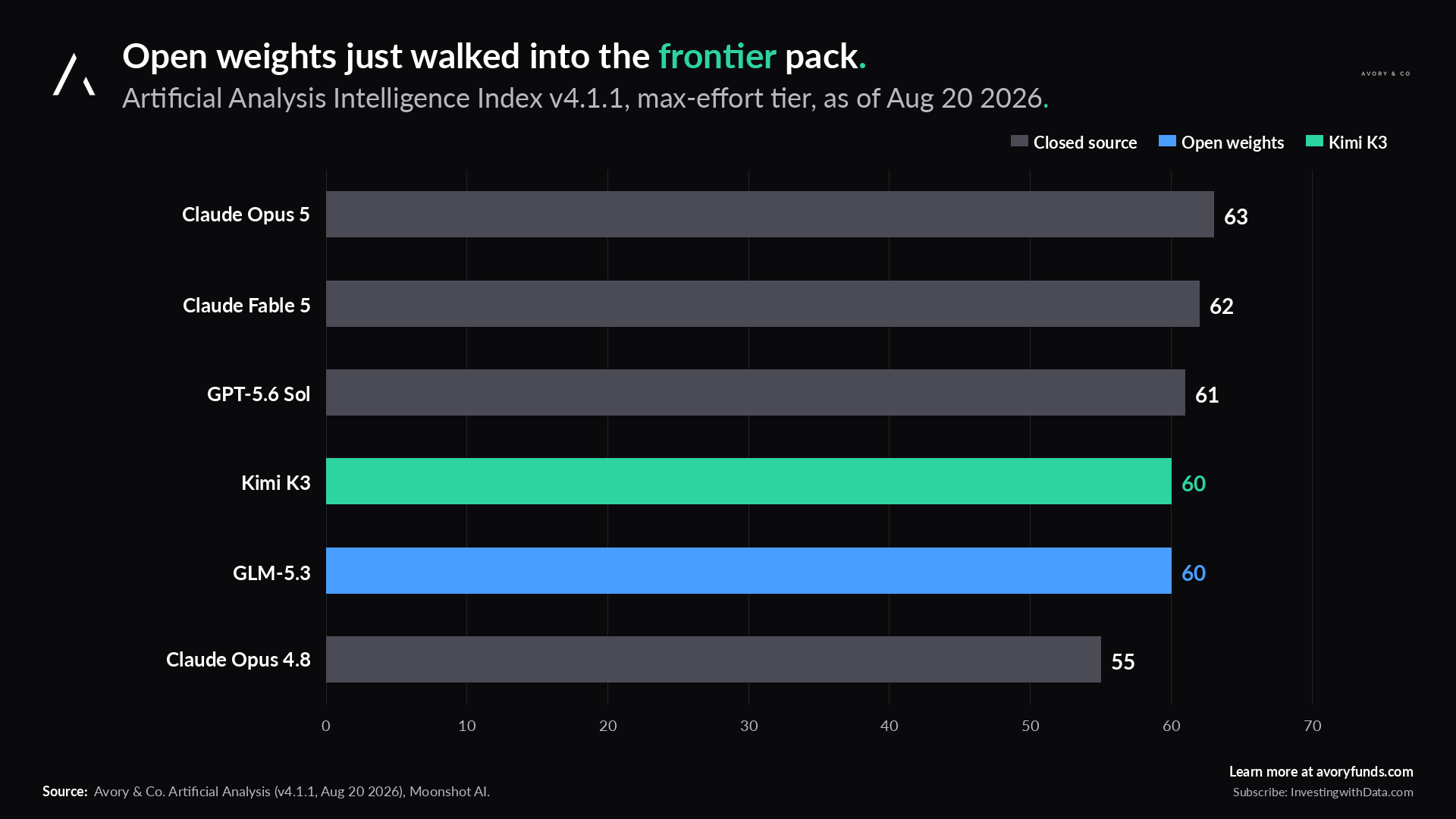
So that last datapoint was closed source and built by the cloud vendor.
Now Kimi K3 from Moonshot scored 60 on the Artificial Analysis Intelligence Index. That puts it inside the top tier, behind only Claude Opus 5 and Claude Fable 5 and comparable to GPT-5.6 Sol.
This is the other side coming at AI labs.
This is the first open-weights model to get here. This is critical. If the compute and open layer keeps pushing up the leaderboards, that further squeezes the model labs.
Margin compression from above and below is now a real force in the model layer.
[10] OpenRouter usage keeps expanding.
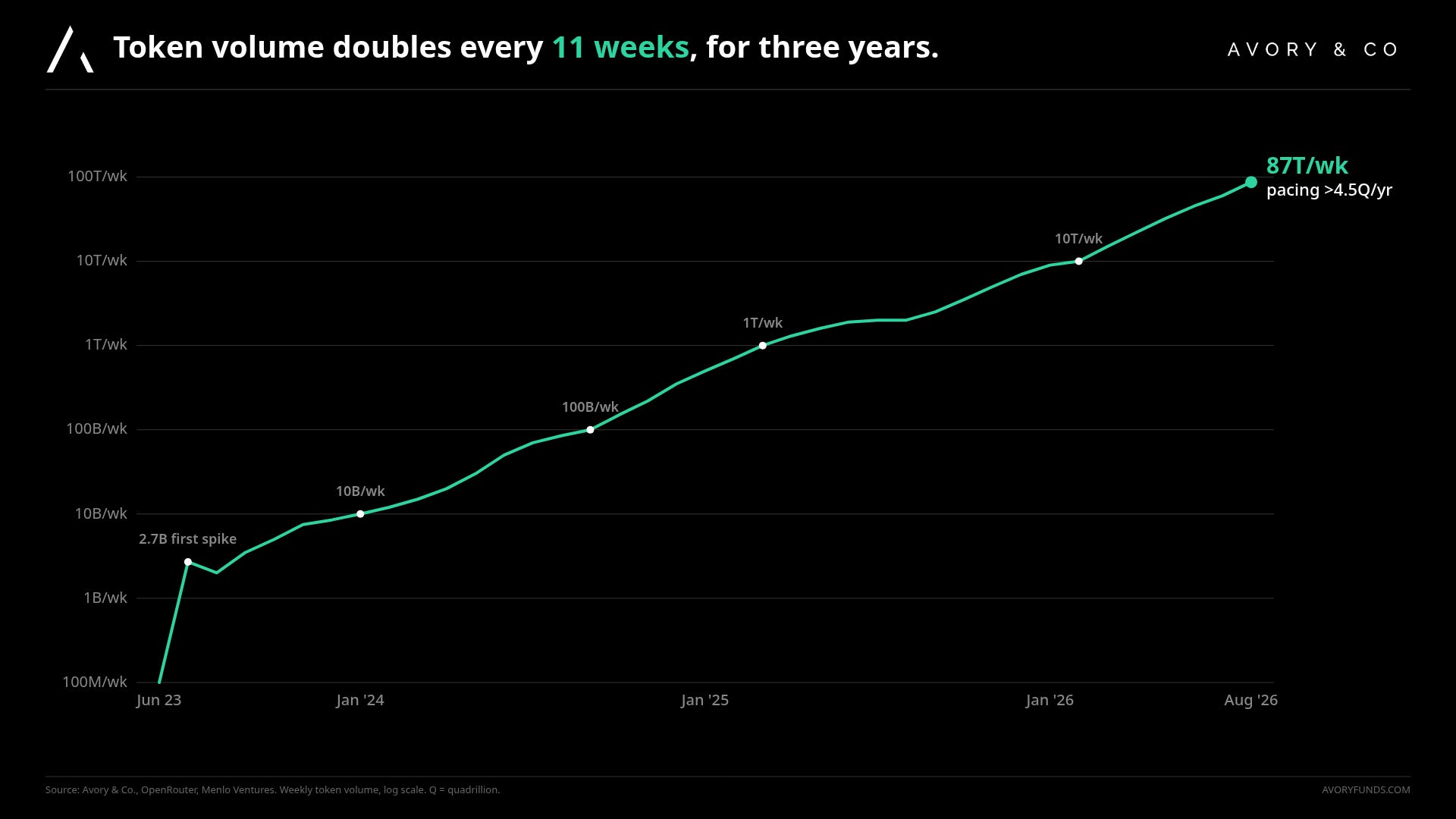
Now this data also shows that demand in general remains. Not survey data, but token volume. The overall routed model volume continues to climb, and the mix keeps rotating. What’s interesting is not any single model win but the shape of the market.
Applications are increasingly agnostic about which model sits behind them and are optimizing for cost, latency, and task fit. That’s another data point suggesting the model labs face pricing pressure from every side, not just from the top.
[11] Nvidia reports next week. History says the bogey is 3-5%.
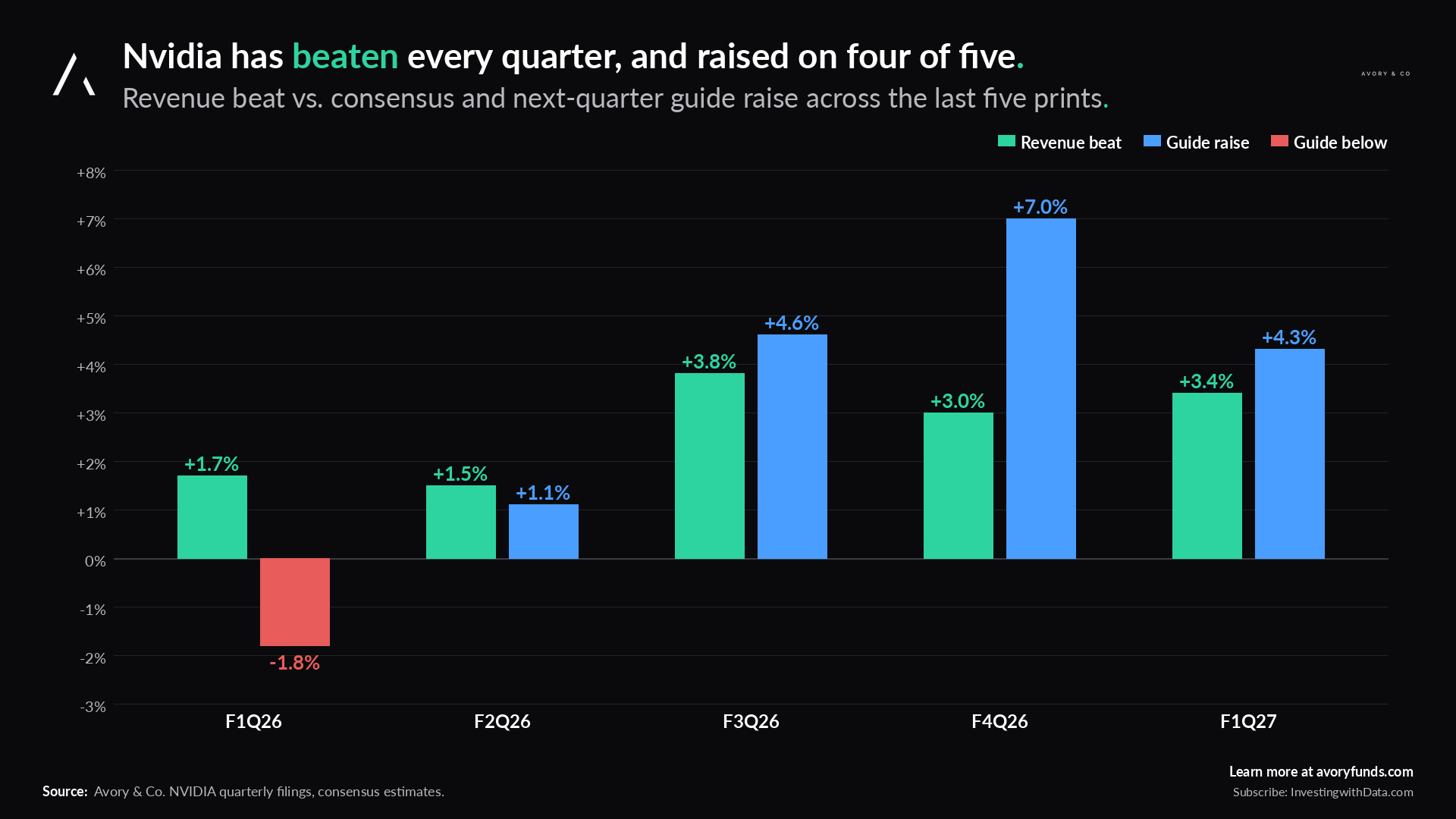
Nvidia has beat revenue estimates in every quarter of the last several years.
The last four quarters averaged a 5.2% beat, with a range of 3.5% to 8.5%. Historical average across 22 quarters is closer to 10%.
The market bogey is somewhere in the 3-5% range now, and the second question is how much they beat their own guide by. Guide magnitude matters as much as the print itself for Nvidia who’s stock really has not done much post 2024.
[12] Samsung is planning up to $79B in shareholder returns.

Samsung reportedly plans to announce a shareholder return package worth as much as 110 trillion won, or roughly $79B. That’s a massive number.
Business is running well. Cash generation is following. And the answer isn’t more capacity or more M&A. It’s returning cash to shareholders.
Makes me wonder. If the AI investment opportunity was so big and the returns would last for a long time, you’d think these companies would reinvest back in the business rather than tee up capital returns after their stocks have soared.
That combined with Burry surfacing Etched, and with what we know about the disaggregation of the compute stack, is worth pausing and thinking about.
[13] SK Hynix is buying back $29B. Hmmm.
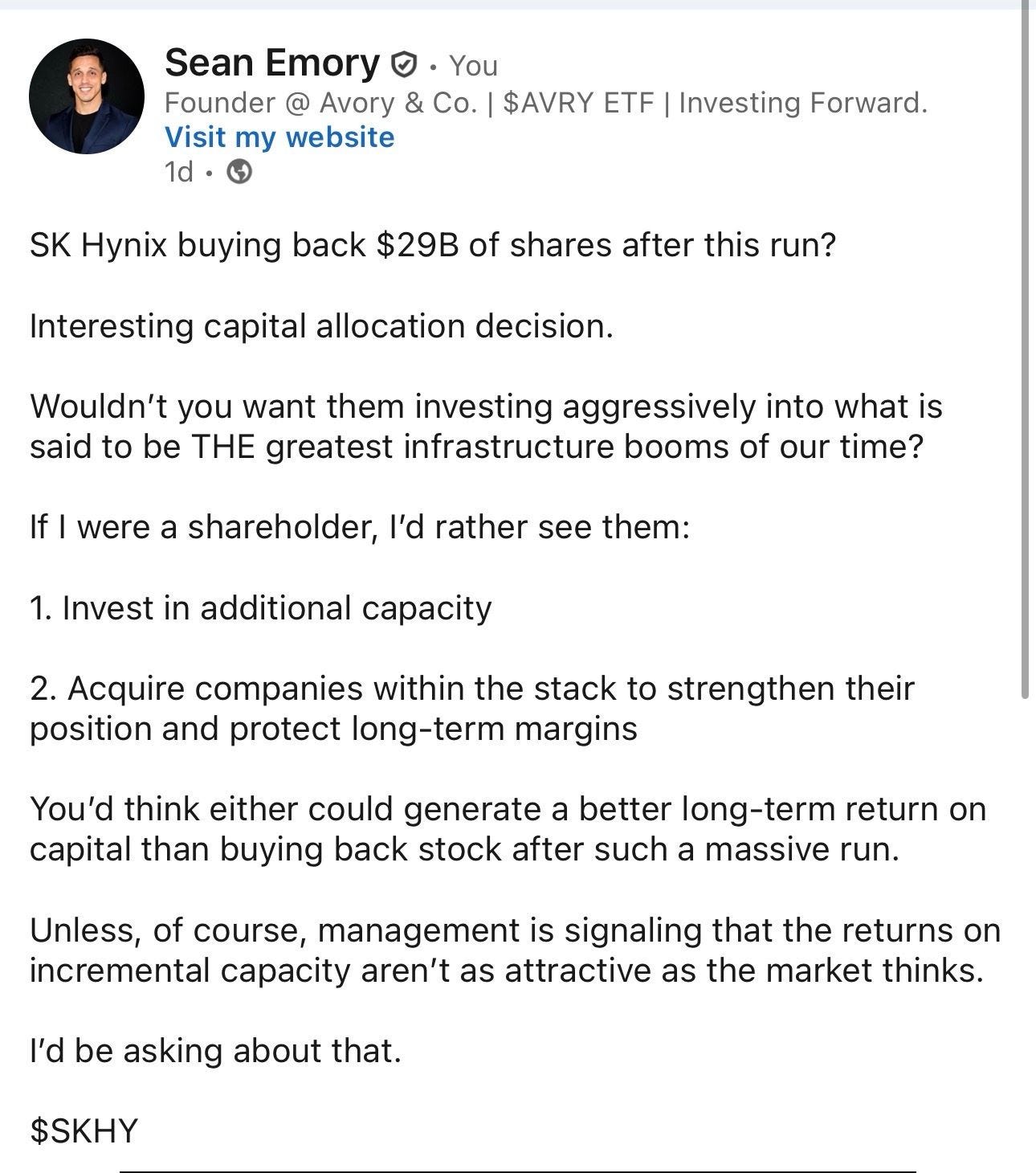
Same story as Samsung. SK Hynix announced a $29B buyback after this run.
If AI is truly the greatest infrastructure boom of our time, and memory is sold out through 2026, again why aren’t they investing aggressively into more capacity or acquiring companies within the stack to strengthen their position?
Net Net
Busy week overall as we saw influx of important info. Some signal and some facts. But lead with Burry showing Etched, but honestly we were already first to that earlier this year. At the same time, yields increasingly need to stay contained because net interest is now the second-largest federal spending line. That puts real pressure on policymakers to avoid another sustained move higher in the long end. Meanwhile, AI is clearly real. IT budgets are growing, not shrinking, and companies leaning into AI, like Block, are moving faster both in product and in how they compete.
But the picture underneath that is getting more complicated. Adoption is still top-heavy. The model layer is getting squeezed by open-weight models from below. Microsoft is pushing further into the stack with its own frontier models and silicon. And after a massive run, some of the memory names are talking about buybacks instead of pouring every available dollar back into capacity So it it interesting. Next week we get Nvidia, I will have a podcast session on this so STAY TUNED!
That’s all for this week!
About Avory & Co.
Investing Forward.
Avory specializes in high-conviction equity strategies, emphasizing Secular Growth and Transformation Stories driven by exceptional teams. Data guides decisions. We cater to high net worth investors, family offices, and institutional investors. Note: This information doesn’t constitute a recommendation to buy or sell any mentioned securities. Avory is based in Miami, Florida with clients all across the globe.
Speak to us:
Send us an email: Team@avoryco.com
Want to invest? We are on most platforms.
Want More
🎥 Avory YouTube: Channel
🎙️ Avory: Podcast
Disclaimer: Not a recommendation to purchase or sell any securities mentioned. This is for educational purposes only.