


Big Picture
💡 AI buildout, why SpaceX is now an AI compute company, and earnings from Meta, Tesla, and Blackstone.
Lot to share this week from some earnings from leading companies, to AI debt talk, to some consumer data. Got to spend some time this week with some other funds out there at 2 events. Picking each others brains was healthy. AI was front and center of each circle, but clearly some more caution in the air than my conversations a year ago. People are less inclined to step in front of the equities here, and more inclined to look at the debt of them. Remember just 3 days ago we shared the Salesforce buying Braze info. On there we said watch out AI traders, as funds are short software, and long AI. And that deal changed everything. Go read it too..
Now on that note…we have been spending a lot of time looking at how the AI buildout is actually being financed, and this week we pulled the credit default swap data across both the hyperscalers and the newer AI infrastructure players. What you see is a massive divide between balance sheets that fund CapEx out of cash flow and the leveraged builders where the credit market is starting to price real risk… this should be seen as an early warning shot.
At the same time, earnings season is ramping up, and the 3-month rolling corporate guidance spread is sitting about two-thirds of the way back to its 2021 peak. On one hand, activity is clearly holding up. On the other hand, AI euphoria has pulled tech expectations so high that the rate of change on beat and raise spreads is going to get much harder from here. That gives us even more ammo as we rotate toward economically sensitive businesses where expectations have stayed muted.
We also got huge earnings updates from Meta (owned), SpaceX, Tesla, and Blackstone (which we own). Meta’s ad machine is still humming and Reality Labs losses are finally peaking apparently, SpaceX is now majority an AI compute business rather than a rocket or telecom company, Tesla’s autonomous miles are scaling 8x Q/Q right as a SpaceX combination enters the conversation, and Blackstone’s stock jumped 9% as the market starts closing the disconnect between its share price and its 50% earnings growth. Plus, we close out with real-time card and brick and mortar spending data that supports everything Meta’s ad business is telling us about the consumer.
We are investors, not traders. Lets get into the details and data!
[1] Hyperscaler credit default swaps show where the balance sheet stress sits. Some look rough, some others okay…
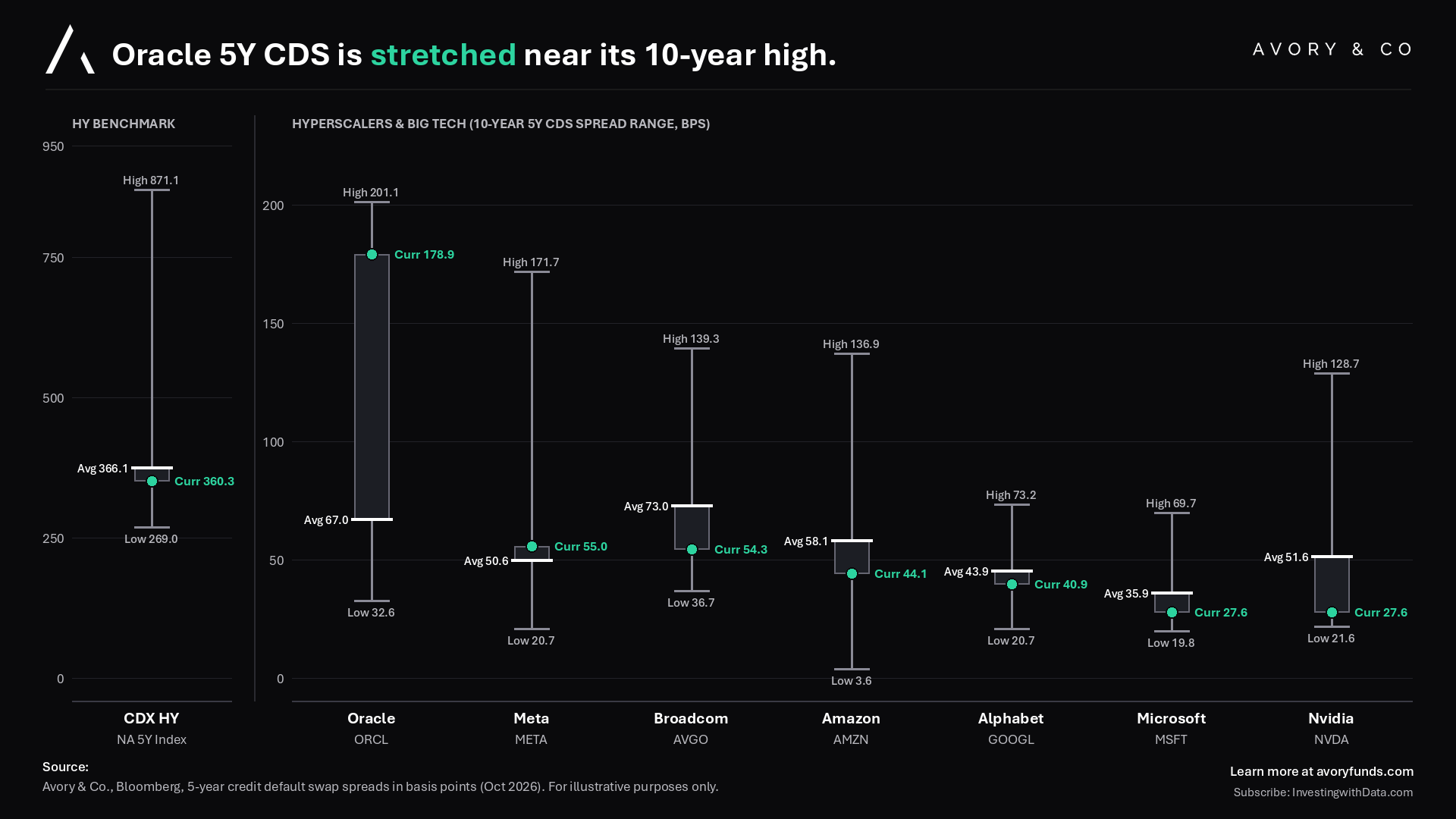
First, here is the 5-year credit default swap range across the major hyperscalers since late 2025, showing the low, high, average, and current spread for each name.
Alphabet 54 bps current (Avg 32 bps)
Microsoft 51 bps current (Avg 33 bps)
Amazon 58 bps current (Avg 38 bps)
Meta 64 bps current (Avg 49 bps)
Oracle 125 bps current (Avg 111 bps, High 173 bps)
Even among the trillion-dollar cloud giants, the credit market is separating self-funded balance sheets from debt-funded CapEx. Alphabet, Microsoft, Amazon, and Meta are all trading in the 50 to 64 bps range, while Oracle sits more than double that level at 125 bps after touching 173 bps at its peak. You can see what happens when you move further out the risk curve on the next chart…
[2] AI neocloud credit default swaps are pricing high-yield risk.
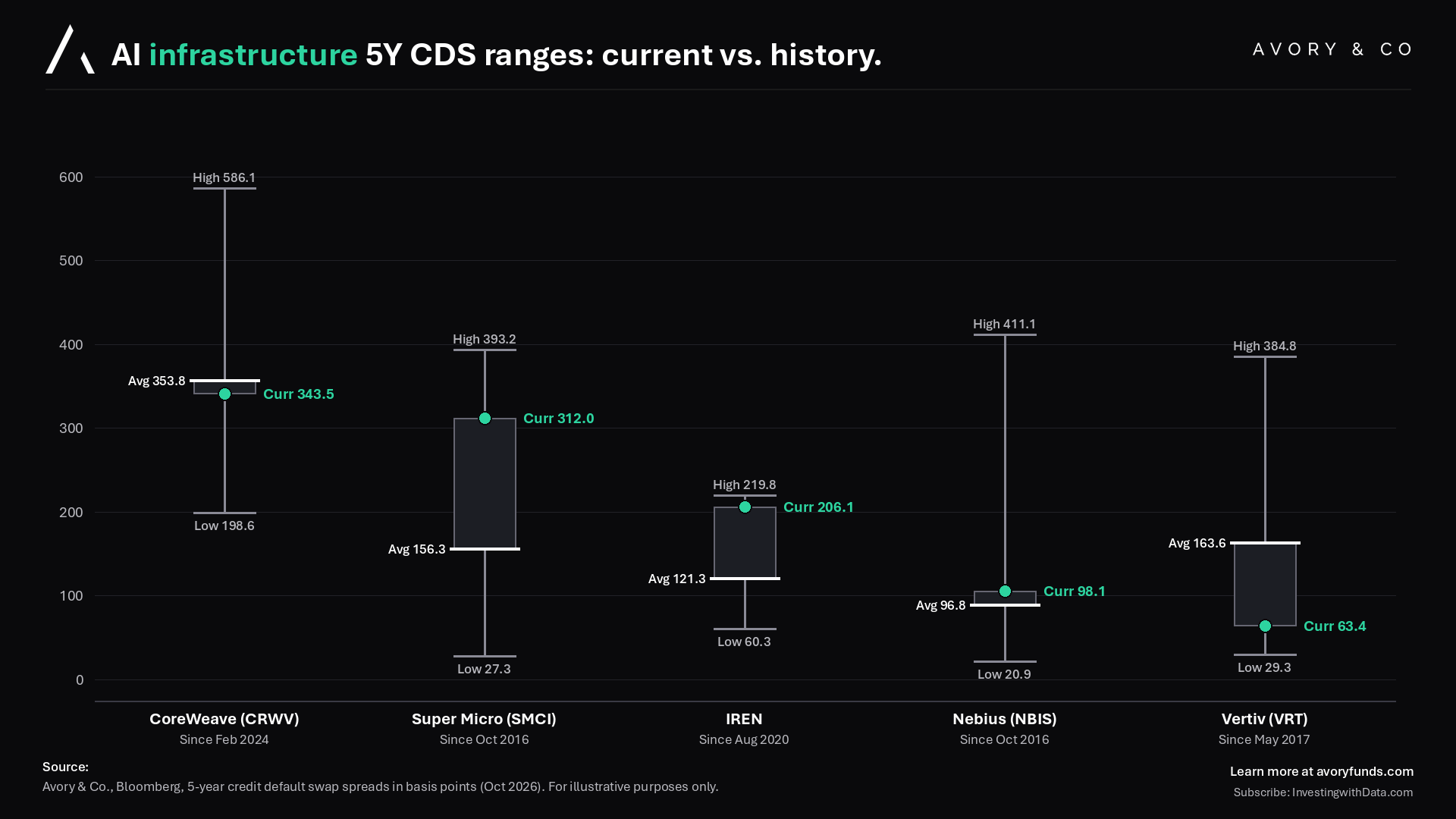
When you move from the hyperscalers to the leveraged AI neoclouds and infrastructure financiers, the credit market is in a completely different zip code.
CoreWeave 509 bps current (Low 298 bps, Avg 492 bps, High 709 bps)
SoftBank 291 bps current (Low 177 bps, Avg 266 bps, High 362 bps)
Nebius 425 bps current (Low 396 bps, Avg 443 bps, High 484 bps)
Credit investors are charging 300 to 500+ basis points a year to insure the debt of the companies financing the physical AI buildout. We talked about CoreWeave’s interest expense last week, and this is the bond market’s way of suggesting that risk is building here.
[3] Corporate guidance spreads are two-thirds of the way to the 2021 peak.
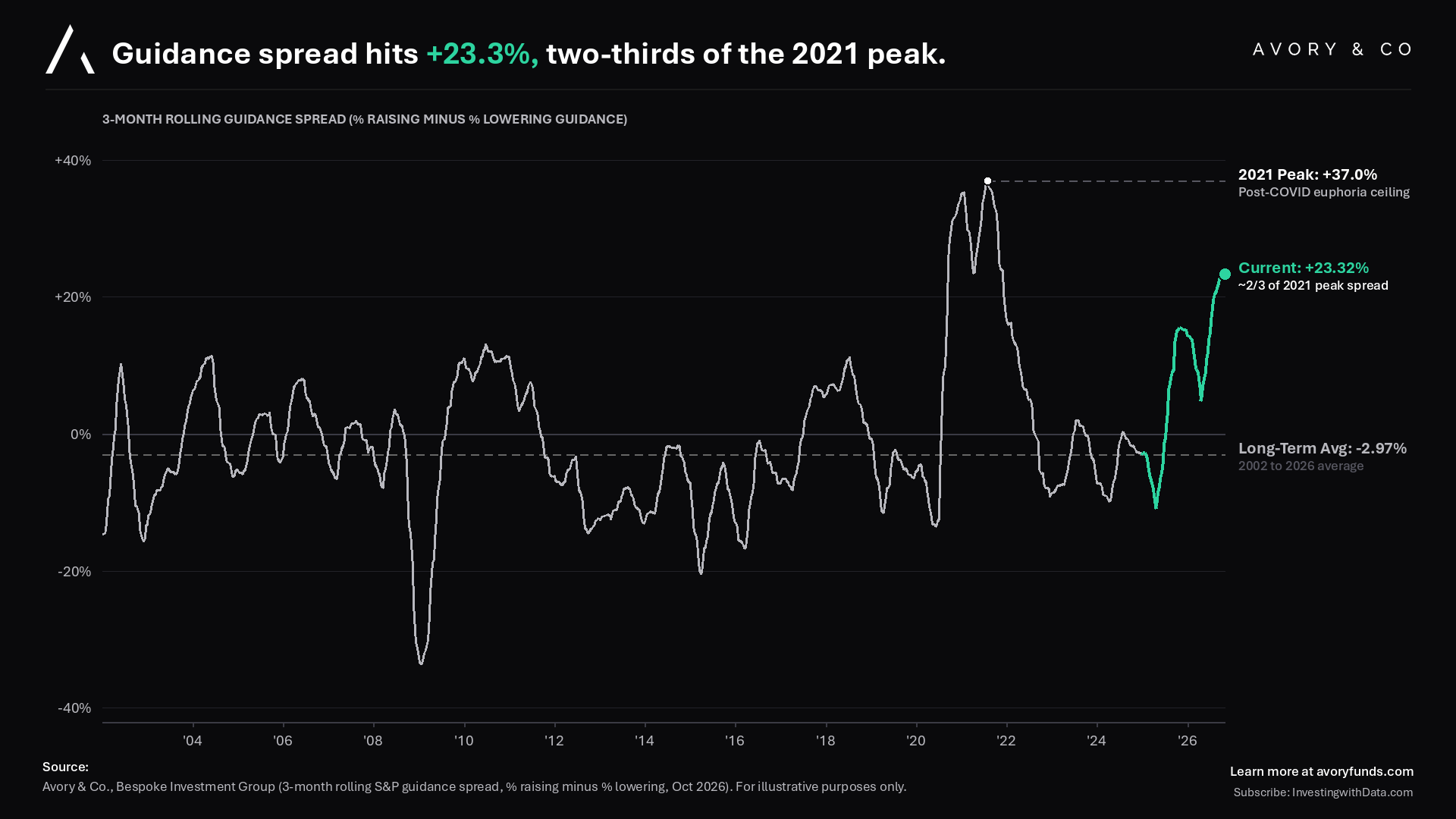
Now switching to the broader earnings picture. We are continuing to see far more companies raising guidance than lowering it, with the 3-month rolling guidance spread sitting at +23.32% versus a long-term average of -2.97%.
While there is still a huge chunk of earnings season to go, there are two clear signals here.
On one side, underlying activity remains fairly healthy across the economy.
On the other side, the guidance spread is now roughly two-thirds of the way to the +37.0% peak levels we saw in 2021.
If 2021 was a fair proxy for peak euphoria, eventually companies run out of incremental ability to keep beating and raising relative to already elevated expectations. Over the last decade, markets have focused heavily on the rate of change in beat and guidance spreads, which gives us even more ammo to keep rotating into economically sensitive industries that have kept their guidance bars much more muted…
[4] Meta’s revenue per employee is up 48% Y/Y as Reality Labs losses peak. WILD!
Now let’s get into the major earnings reports from this week, starting with Meta.
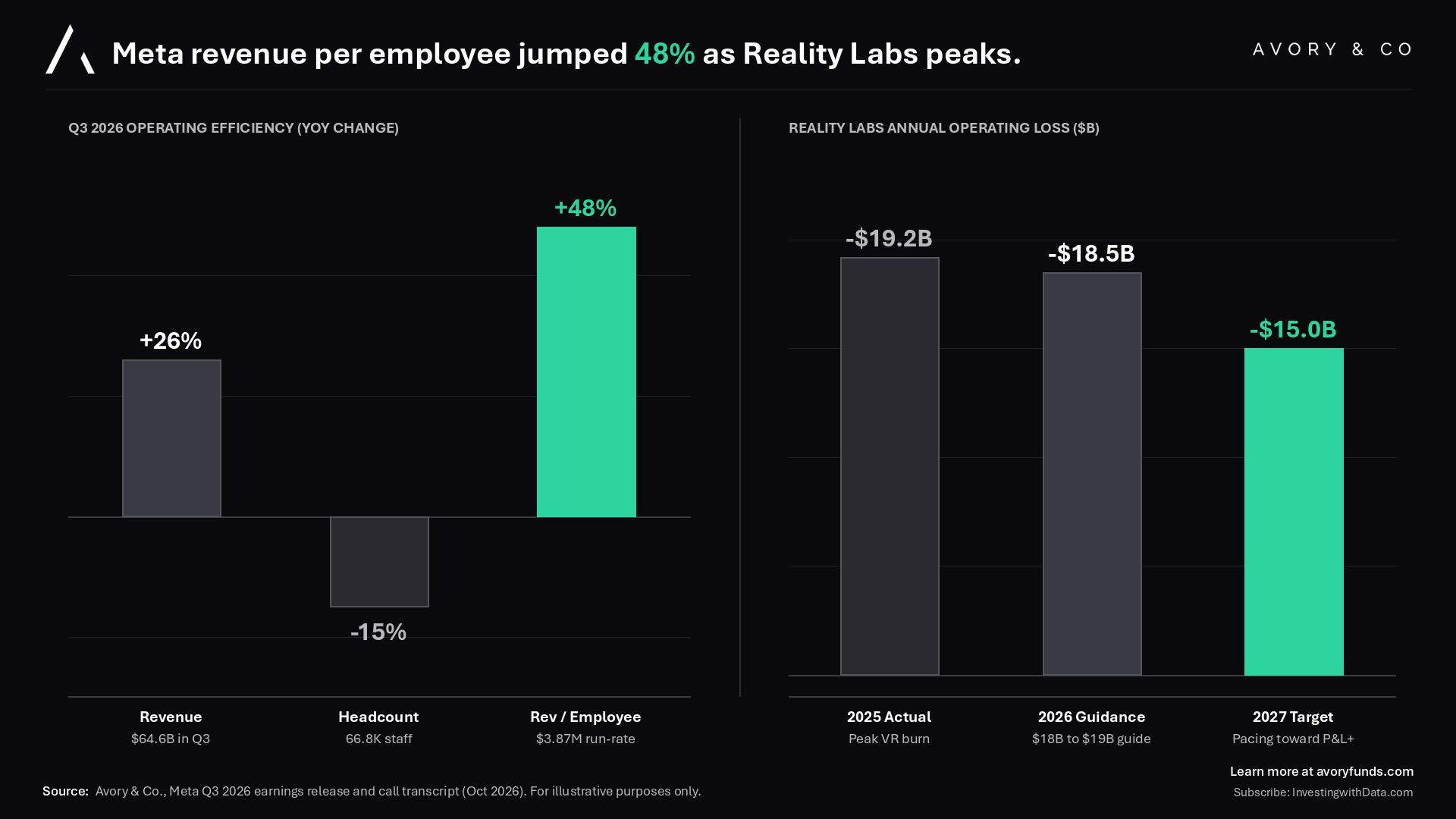
Q3 Revenue $64.6B (+26% Y/Y)
Headcount 66,775 (-15% Y/Y)
Annualized revenue per employee $3.87M (+48% Y/Y)
Reality Labs operating loss projected down to ~$15B in 2027 (from $19.2B in 2025)
Meta’s ad business is one of the best real-time reflections of the economy because advertisers only spend money when they are seeing return on investment dollars. Given that Meta is the biggest platform on earth for advertisers of all sizes, +26% Y/Y ad growth tells you consumer sentiment is holding up well (and later on in this newsletter, we show credit card and brick-and-mortar sales data that validates this). On top of that, Reality Labs is finally projected to stop being a growing burden on the P&L, which Mark Zuckerberg addressed directly on the call…
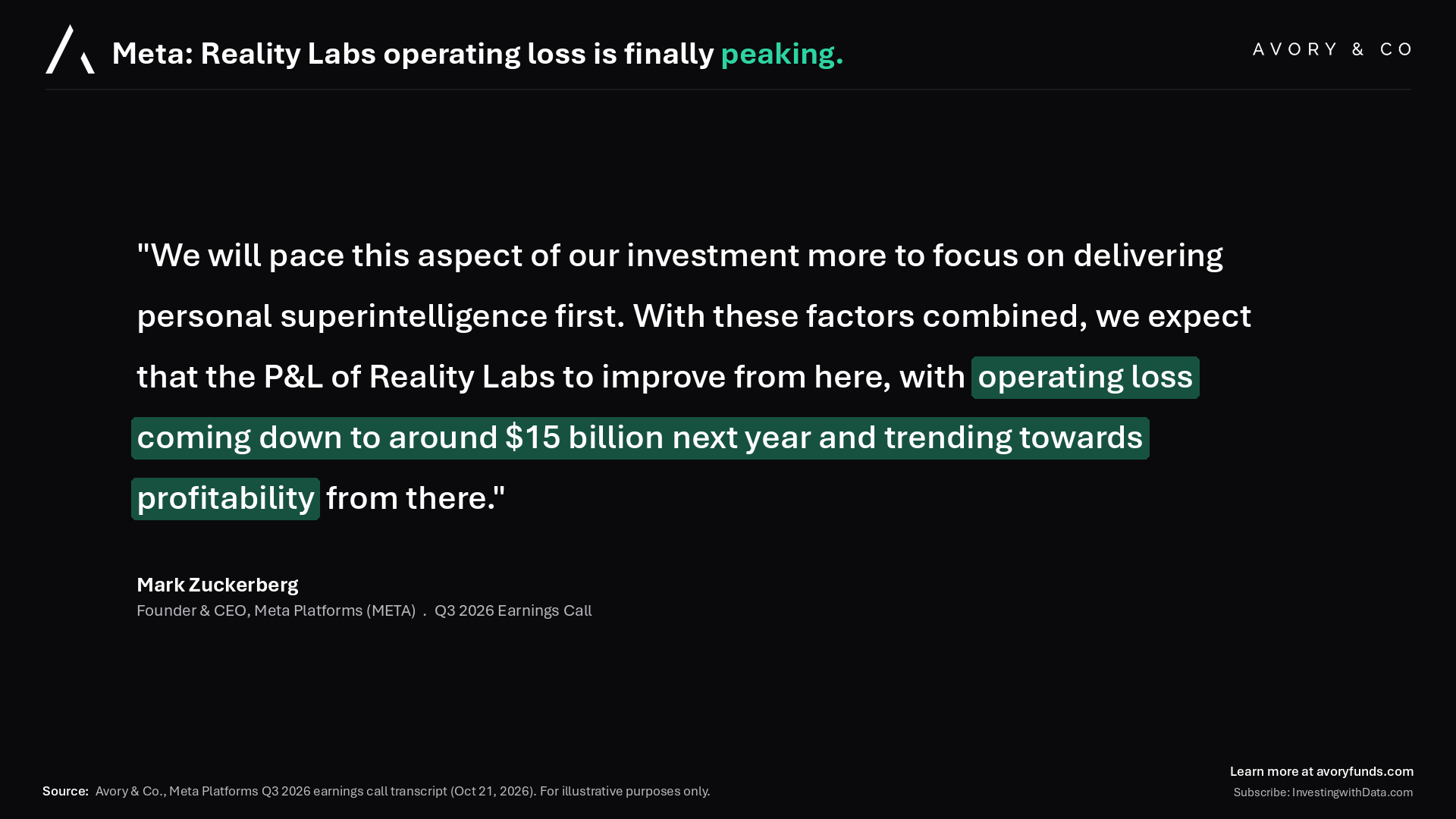
[5] Mark Zuckerberg on Reality Labs trending toward profitability.
Here is the exact quote from Mark Zuckerberg on the Q3 call laying out the turn in Reality Labs.
Pacing metaverse spend to focus on personal superintelligence first means Reality Labs operating losses come down to roughly $15B next year and trend toward profitability from there. Removing a $19B annual drag changes the earnings power of the whole business.
Not sure why this is not being discussed more. It is laughable.
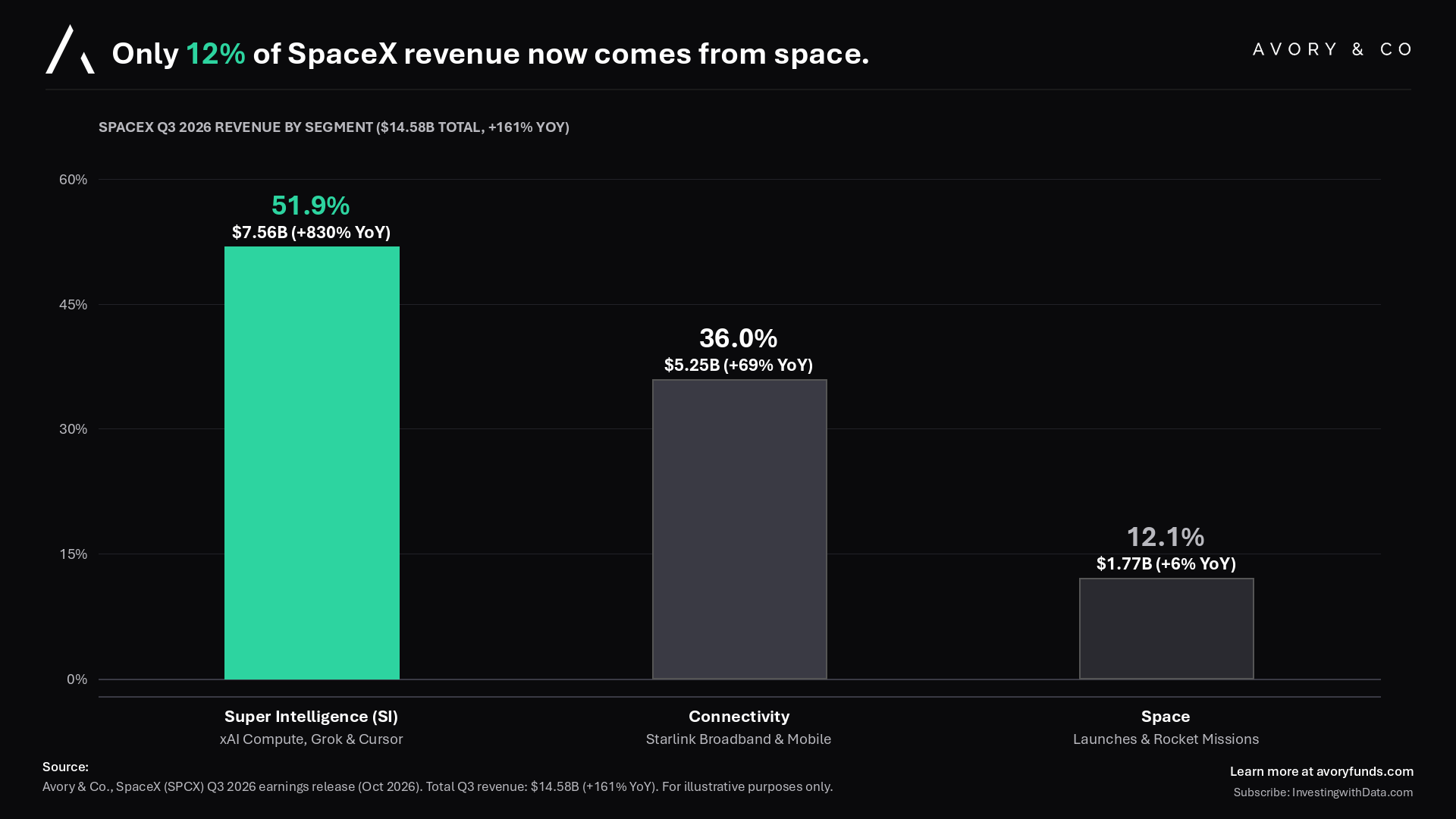
[6] Only 12% of SpaceX’s revenue now comes from Space.
Next up is SpaceX, which reported Q3 revenue of $14.58B (+161% Y/Y), and the revenue mix shows how much the story has evolved or flat out changed.
Super Intelligence (AI compute & xAI) $7.56B (51.9% of revenue, +830% Y/Y)
Connectivity (Starlink) $5.25B (36.0% of revenue, +69% Y/Y)
Space (launch & rockets) $1.77B (12.1% of revenue, +6% Y/Y)
The original SpaceX thesis is completely different from the current SpaceX thesis. Over half the company’s revenue now comes from AI compute and superintelligence, while traditional space launch is down to just 12% of the top line. Without the compute business, SpaceX is a completely different company, and you can see how dramatic that valuation math is on the next chart…
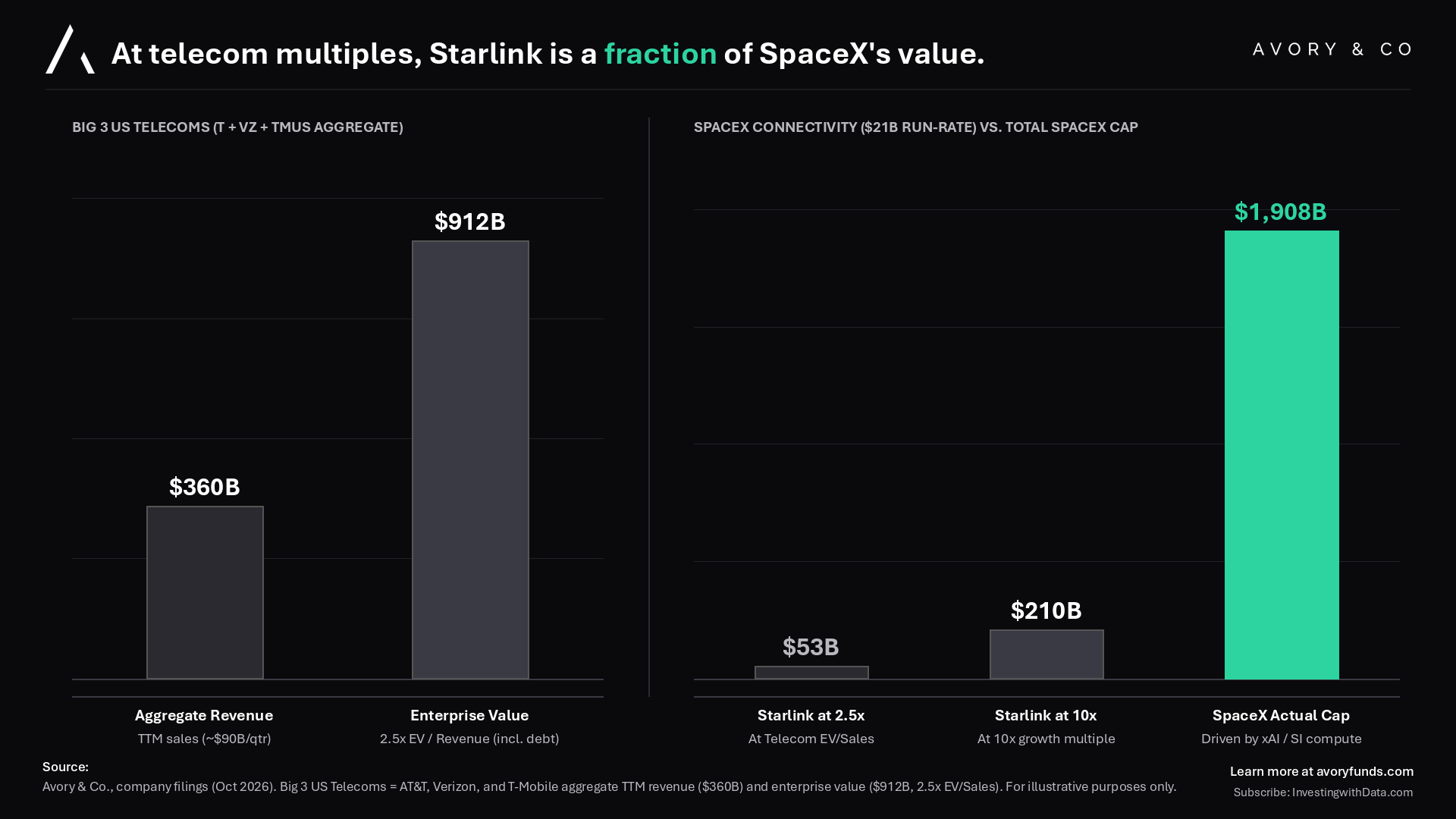
[7] Applying the telecom multiple to Starlink values it at $53B vs. SpaceX’s $1.9T cap.
To show why the compute business is carrying the valuation, we aggregated the Big 3 US telecom providers (AT&T, Verizon, and T-Mobile) and looked at their combined revenue and enterprise value including debt.
Big 3 US Telecoms aggregate revenue $360B TTM
Big 3 US Telecoms aggregate EV (including debt) $912B (2.53x EV/Sales)
SpaceX Connectivity annualized revenue $21.0B ($5.25B in Q3)
Implied Connectivity value at 2.53x EV/Sales $53B vs. $1,908B SpaceX market cap
Even if you give Starlink a massive growth premium over the 2.53x telecom multiple, Connectivity alone only accounts for a fraction of a $1.9 trillion valuation. Investors buying SpaceX today are underwriting a frontier AI compute giant. Today… right or wrong but without the AI narrative on it, the market would likely be dumping this.
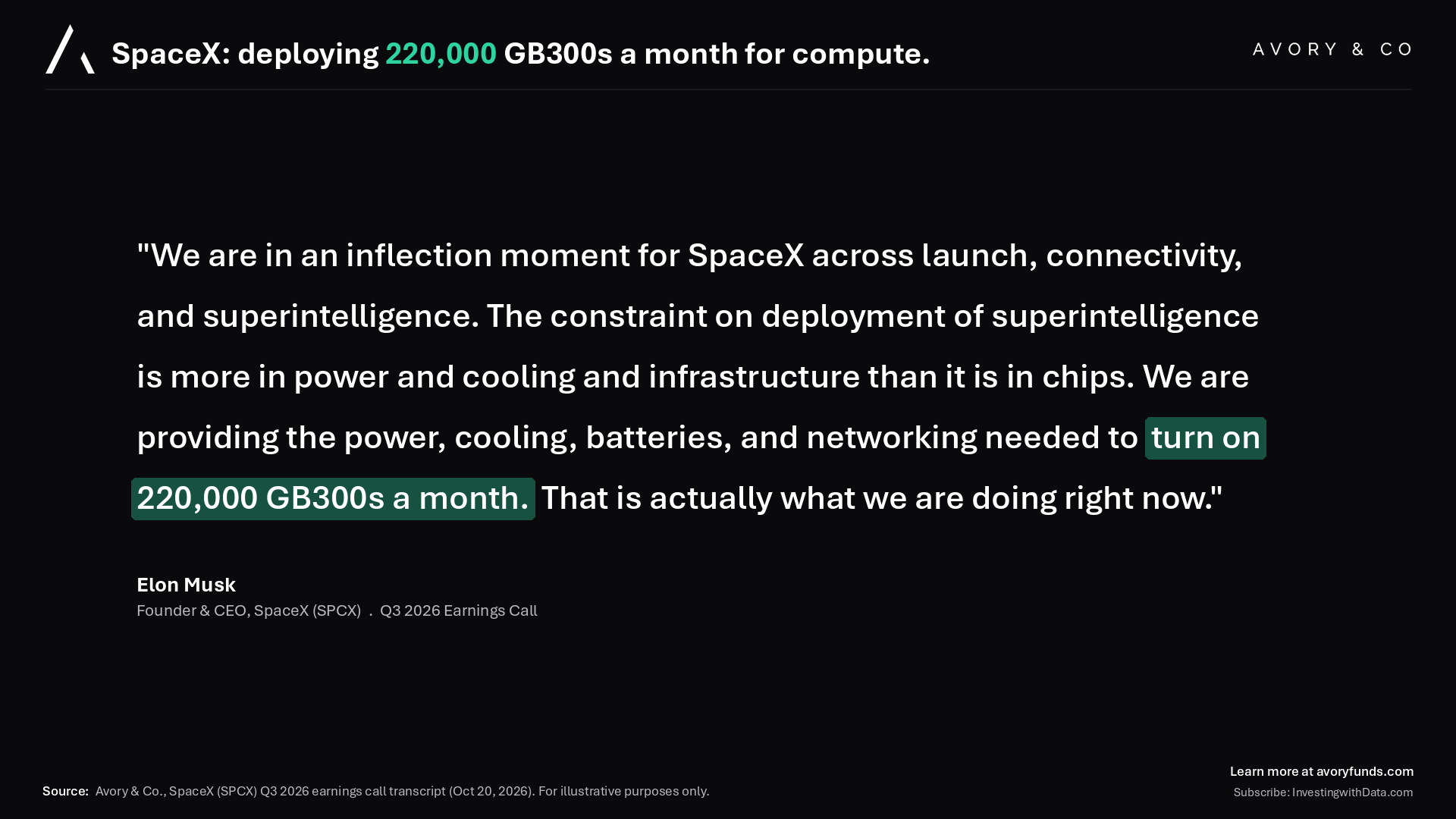
[8] Elon Musk on turning on 220,000 GB300s a month.
Here is how Elon Musk described the scale of that compute buildout on the SpaceX call.
SpaceX is providing the power, cooling, batteries, and networking needed to turn on 220,000 GB300s a month right now. That physical infrastructure bottleneck is where SpaceX is leaning in, and it leads directly into what is happening at Tesla…
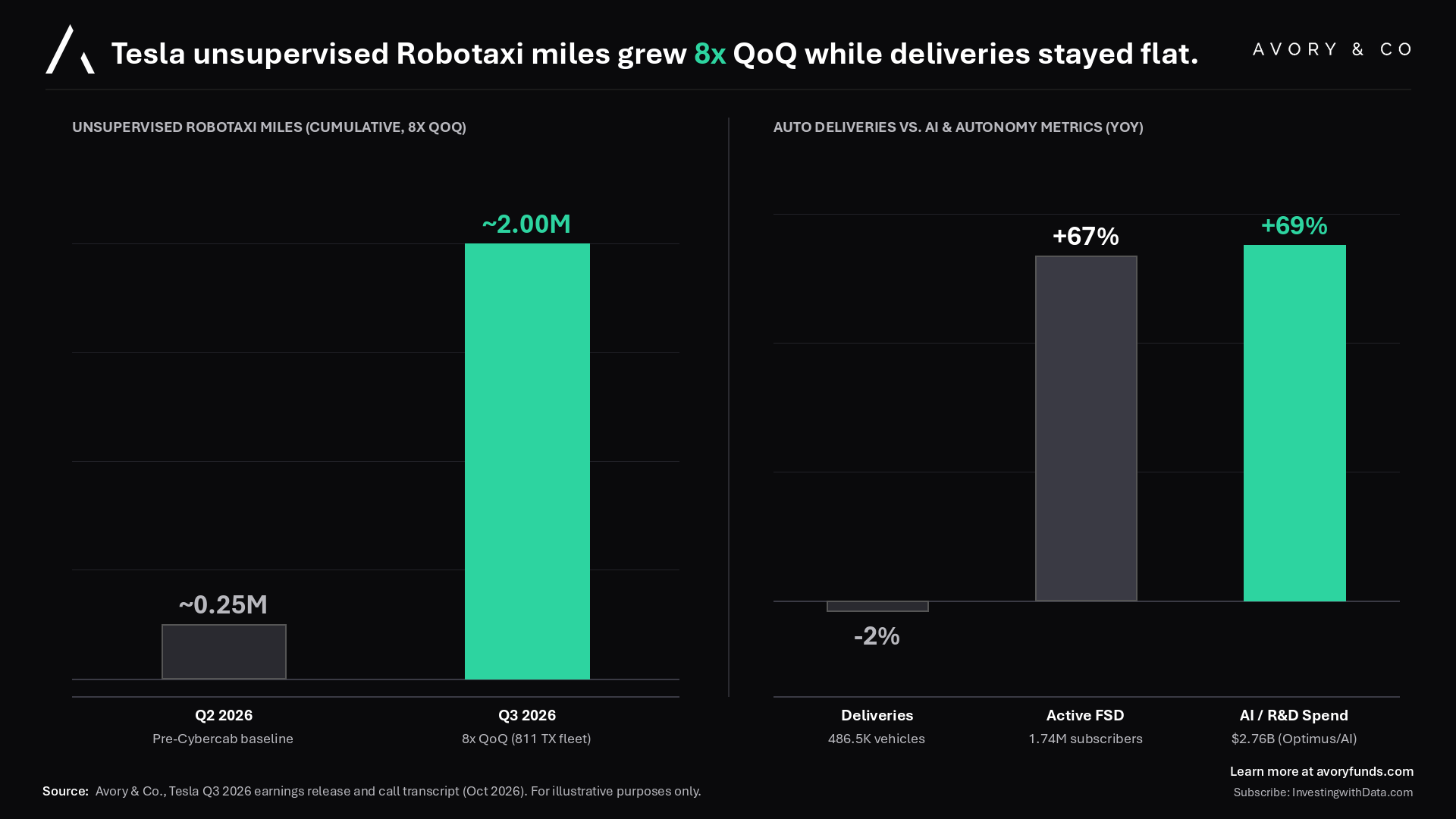
[9] Tesla’s Robotaxi miles jumped 8x Q/Q while vehicle deliveries stayed flat.
Looking at Tesla’s Q3 numbers, the divergence between the legacy auto business and the autonomy business could not be more clear to us here at Avory.
Cumulative unsupervised Robotaxi miles up 8x Q/Q to nearly 2.0M miles
Vehicle deliveries 486,532 (-2% Y/Y, roughly flat)
Active FSD subscriptions 1.74M (+67% Y/Y)
As Tesla moves more toward robotics and autonomous AI, a potential combination with SpaceX (which houses xAI) makes clear conceptual sense. The car delivery numbers are treading water, while the autonomous fleet is scaling exponentially.
[10] Elon Musk on the merit of combining Tesla and SpaceX.
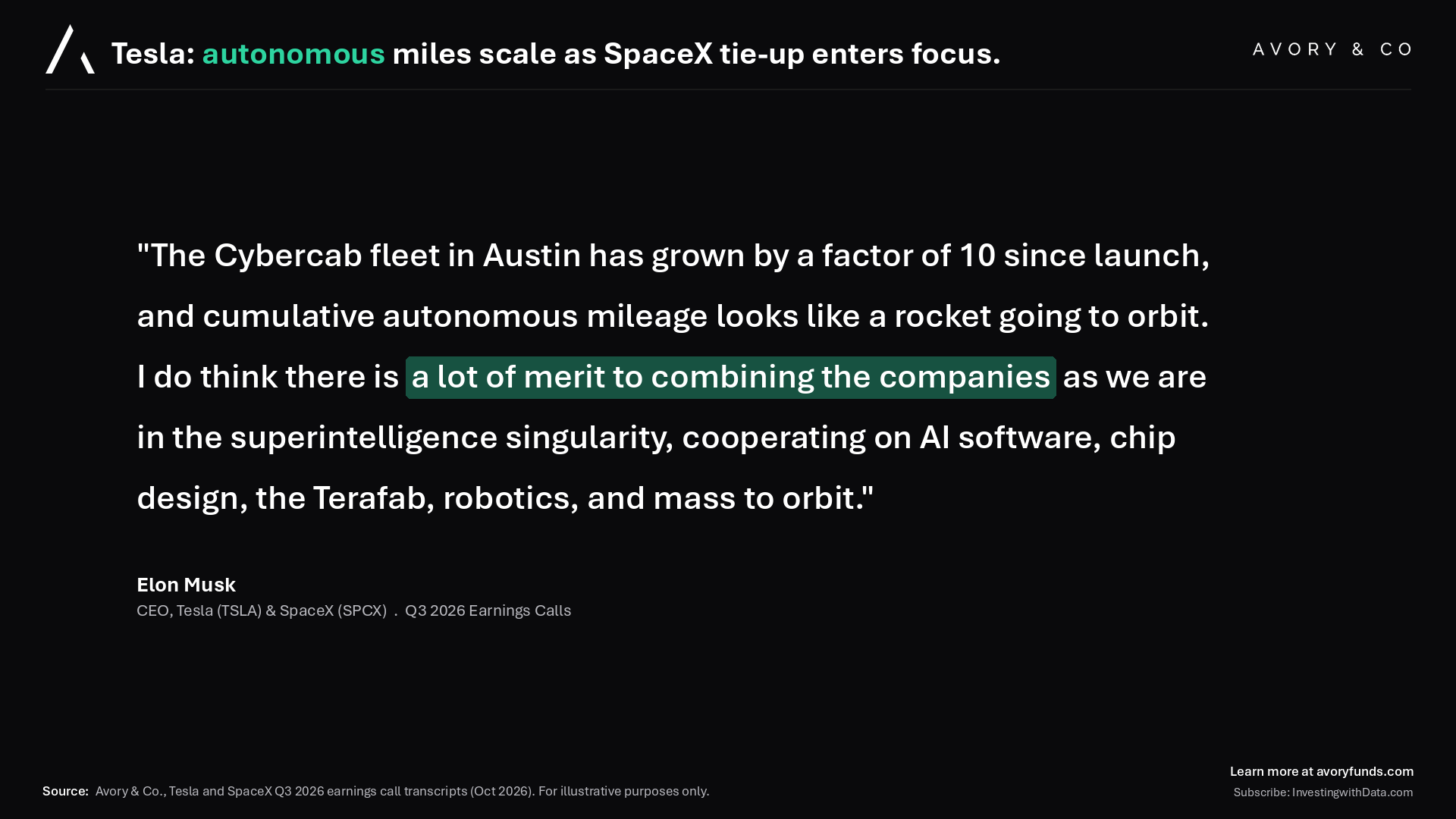
And Elon spoke about a potential tie-up across the companies.
Cooperating across AI software, chip design, the Terafab, robotics, and mass to orbit is why Elon sees real merit in combining the companies. Whether or not a formal merger happens near term, the operational overlap is already happening it seems.
[11] Credit and Insurance is now Blackstone’s largest asset class at $480B AUM.
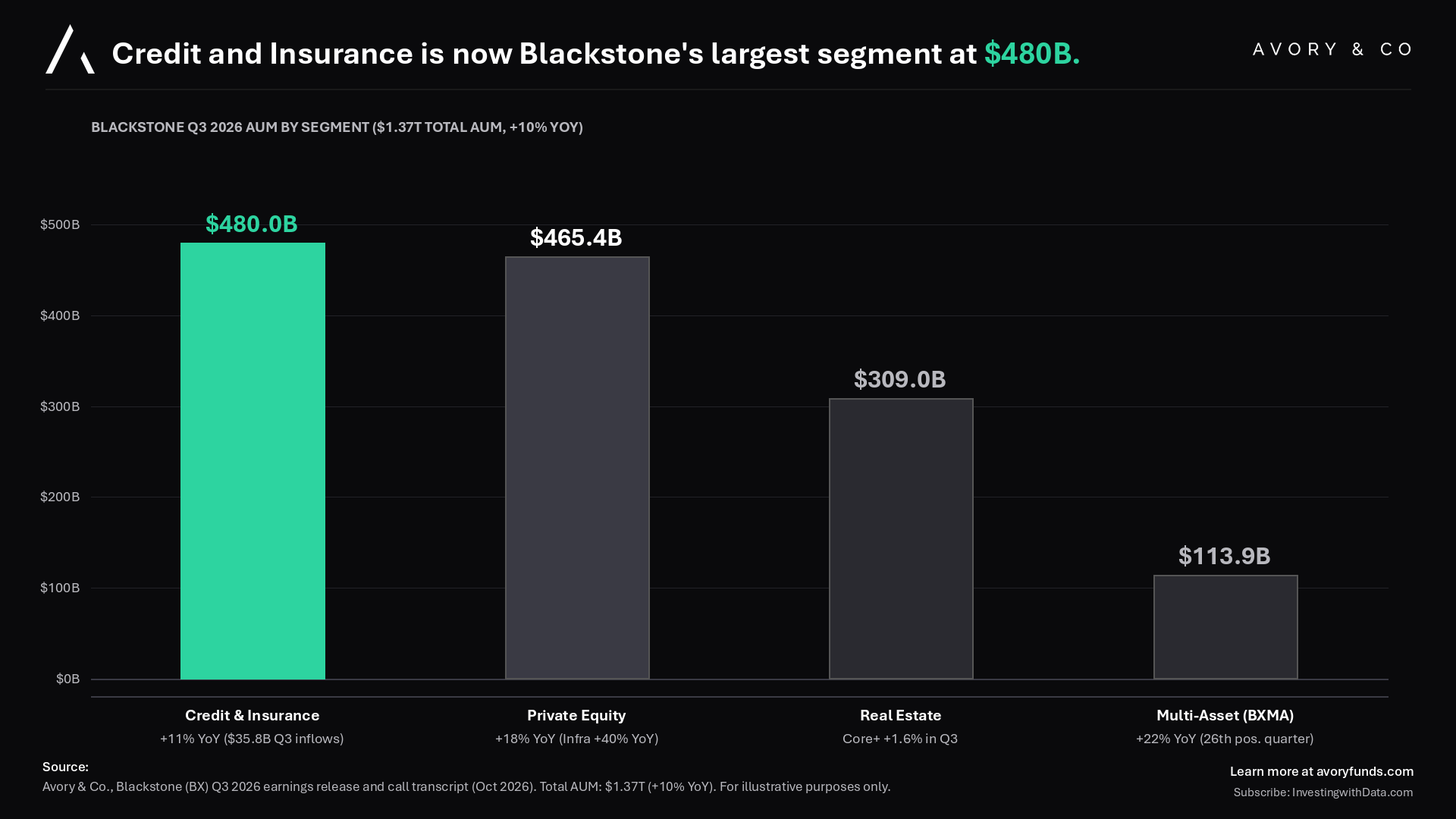
Now switching to Blackstone, which is an investment of ours. Total AUM reached $1.37 trillion (+10% Y/Y) in Q3, and the mix shift inside the firm is a big story.
Credit & Insurance $480.0B AUM (+11% Y/Y, $35.8B Q3 inflows)
Private Equity $465.4B AUM (+18% Y/Y)
Real Estate $309.0B AUM (-3% Y/Y)
Multi-Asset Investing $113.9B AUM (+22% Y/Y)
Credit and Insurance has officially overtaken Private Equity and Real Estate as Blackstone’s largest business, pulling in $35.8B of the firm’s $63.3B in Q3 inflows. Even more important was how management framed the disconnect between the stock price and the underlying value of the business…This is important because the others were sticky businesses, but insurance is even more sticky.
[12] Steve Schwarzman on the disconnect between Blackstone’s stock and its 50% earnings growth.
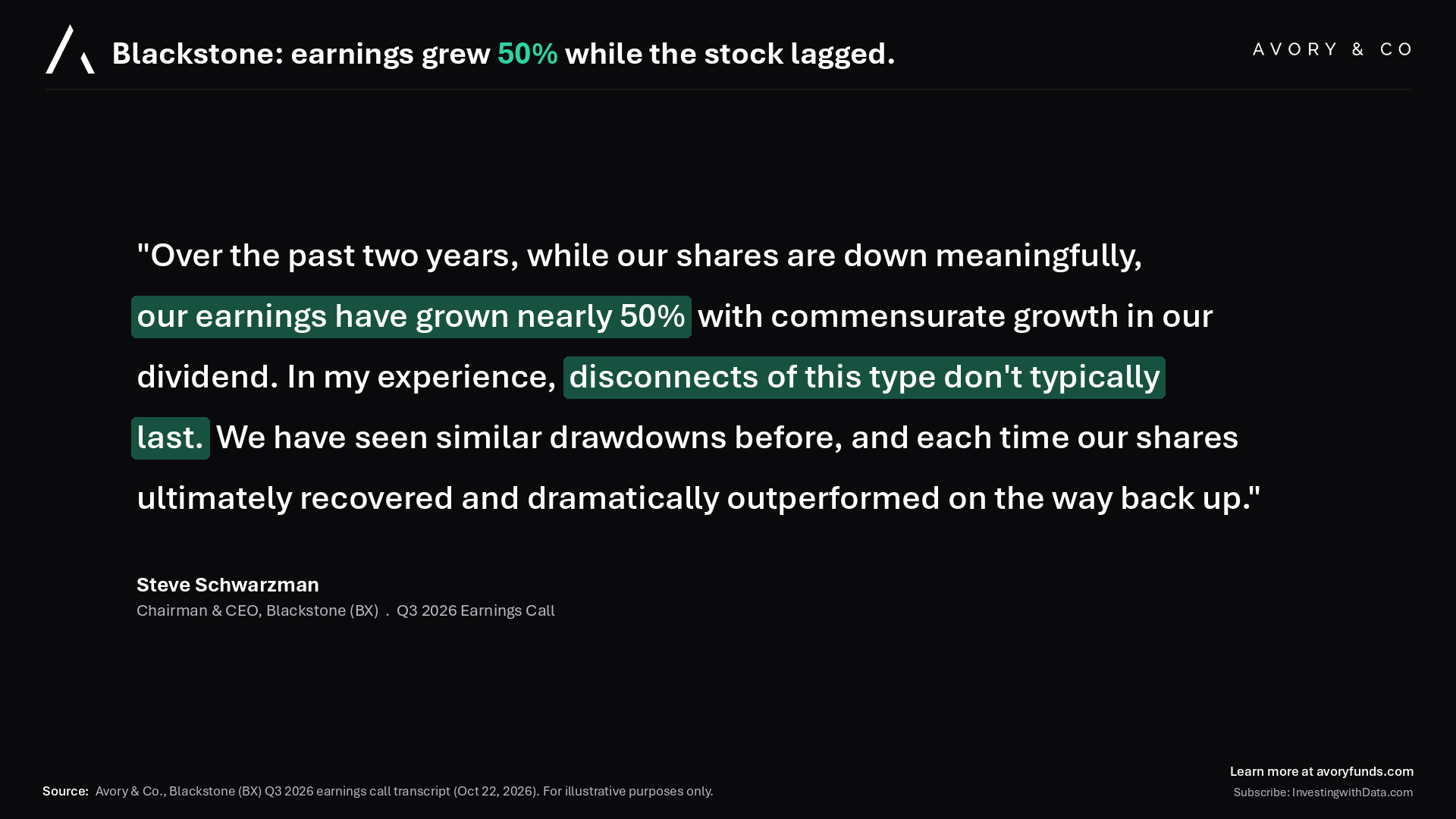
Steve Schwarzman laid out the exact disconnect we have been seeing across alternative asset managers. We only like Blackstone here to be clear…
We know that the underlying earnings grew nearly 50% alongside the dividend. As owners, we completely agree with Steve that disconnects of this type do not last, we bought more last week, and the stock was up 9% on earnings as the market started waking up to the numbers.
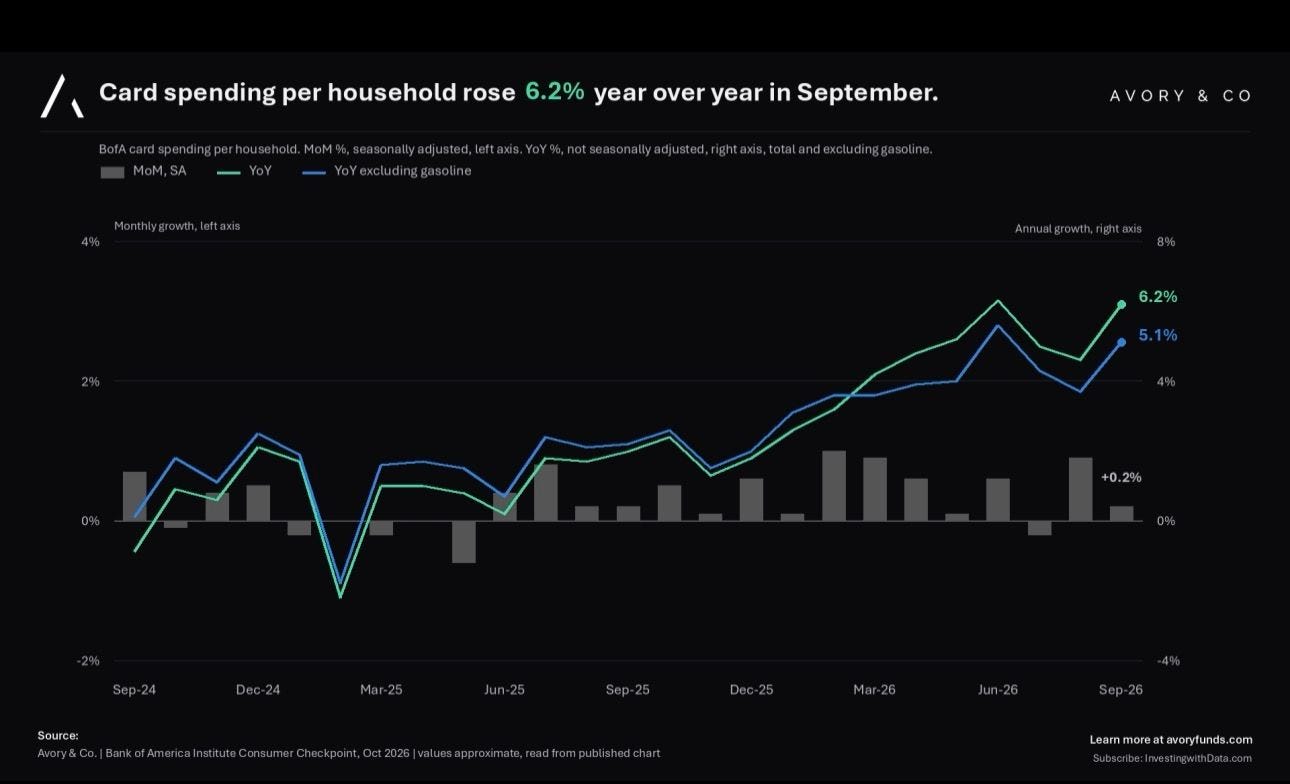
[13] Household card spending rose 6.2% Y/Y in September.
Earlier in the Meta section, we noted that Meta’s +26% Y/Y ad growth is a reliable proxy for consumer health because businesses only keep spending on ads when consumers are buying. Here is the hard data proving that out.
Total BofA card spending per household +6.2% Y/Y in September (+0.2% M/M SA)
Card spending ex-gasoline +5.1% Y/Y
Credit and debit card spending per household has accelerated steadily all year and is running above 5% Y/Y even after stripping out gas. You can see the same strength at physical checkout on final chart…
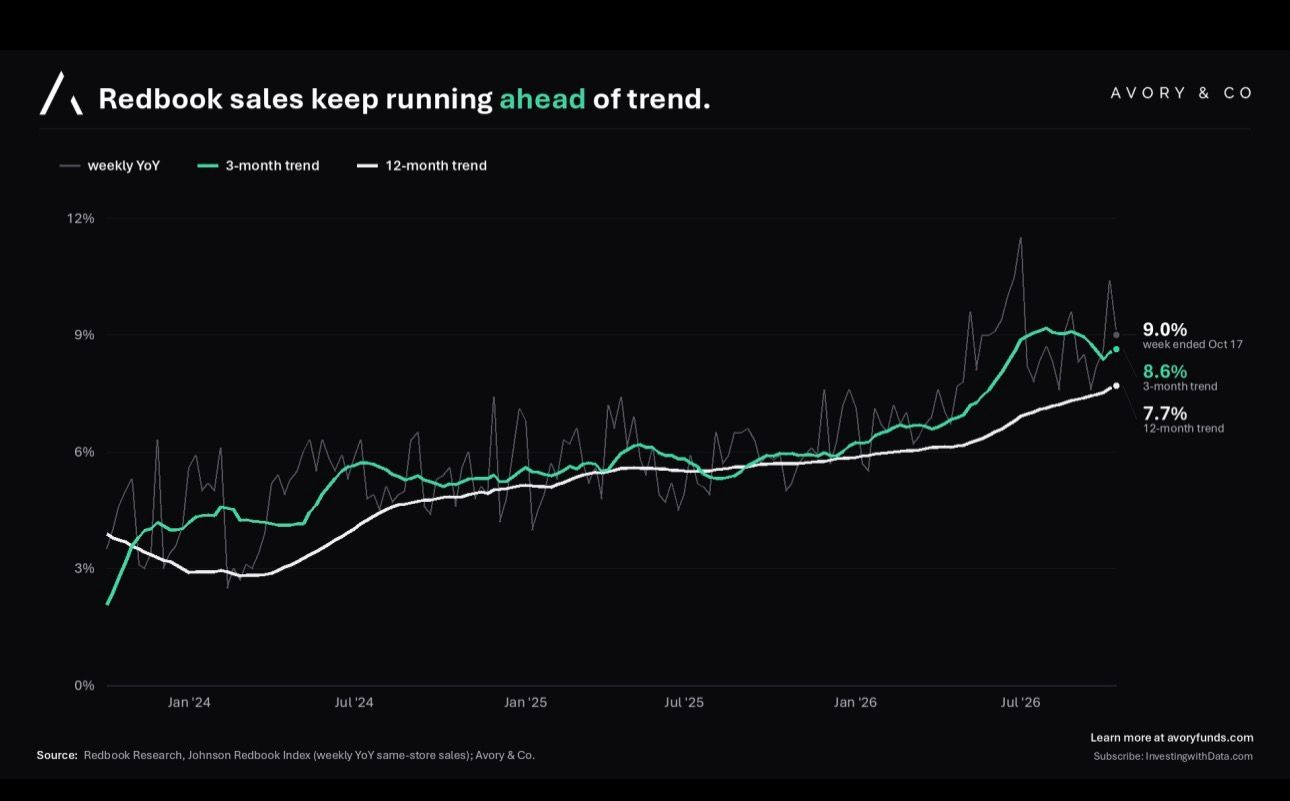
[14] Brick-and-mortar retail sales are running +9.0% Y/Y and well ahead of trend.
To tie this stuff together on the consumer, here is the Redbook same-store sales index for brick and mortar retailers. Also note Amazon this week said they are hiring 300k people for holiday, not a bad signal.
Weekly same-store sales +9.0% Y/Y (week ended Oct 17)
3-month trend +8.6% Y/Y
12-month trend +7.7% Y/Y
Physical retail sales are running at +9.0% Y/Y, well above both the 3-month and 12-month trends. Between Meta’s ad numbers, card data, and Redbook store sales, the consumer is in much better shape than the pessimists want to believe. We have been saying this like a broken record.
Net Net
So that’s it this week. The credit market is separating self-funded hyperscalers from leveraged AI builders, and corporate guidance spreads are now two-thirds of the way back to their 2021 peak. Not a warning but I think signal forsure.
Meanwhile, earnings from Meta, SpaceX, Tesla, and Blackstone show how quickly business models are evolving beneath the surface, and our consumer data confirms that household spending remains healthy. We will forsure keep leaning into economically sensitive businesses and category leaders where the valuation disconnect is still wide.
That’s all for this week!
About Avory & Co.
Investing Forward.
www.avory.xyz / www.avoryfunds.com
Avory specializes in high-conviction equity strategies, emphasizing Secular Growth and Transformation Stories driven by exceptional teams. Data guides decisions. We cater to high net worth investors, family offices, and institutional investors. Note: This information doesn’t constitute a recommendation to buy or sell any mentioned securities. Avory is based in Miami, Florida with clients all across the globe.
Speak to us:
Send us an email: Team@avoryco.com
Want to invest? We are on most platforms.
Want More
🎥 Avory YouTube: Channel
🎙️ Avory: Podcast
Disclaimer: Not a recommendation to purchase or sell any securities mentioned. This is for educational purposes only.