

Big Picture
💡 DoorDash buying Instacart is further evidence that companies are going after two parallel tracks in AI…
DoorDash ($DASH) buying Instacart ($CART) is the motivation this week on the data we are sharing, but it’s also just the cleanest example of something we’ve been talking about for a while now. In a world of AI, companies need to do everything again. I am seeing it everywhere now and it is the right move.
Here’s what I mean.
For the last decade a lot of companies won by doing one thing really well. One app for food, one app for groceries, one tool for email marketing, one tool for the sales team. That was the best in class product versus good enough product debate.
AI changes the math on much of this here. Building the second, third and fourth product is faster and cheaper than it’s ever been, customers want fewer vendors and fewer logins, and the businesses that already have the customer can expand sideways faster than a new entrant can catch up. We saw it earlier this month with Salesforce buying Braze, and now we’re seeing it in local commerce.
So you’ll still get vertical solutions in some places like Harvey in law, or Elise AI in real estate, but in theory everybody is gunning for the platform strategy. On the enterprise side that means being the place a company actually operates. Not just handling the workflows and use cases, but being the harness the agents run on, end to end, from the CRM to billing to support. On the consumer side it means being the one app people open for most of what they need…
Now another twist here that is shaking out is that the old super app playbook was to own every piece yourself. Payments, messaging, rides, food, shopping, all under one roof. Now there’s a real chance the super app ends up being a personal agent that doesn’t own any of those things. You just ask it for what you want and it goes and gets it from whoever can deliver. That leaves two ways to win:
Be the super app, meaning the agent or the one app people choose to live in
Be the infrastructure the super app depends on to actually get things done
DoorDash buying Instacart is a company trying to do both at the same time, ie little offense and defense here. As investors that’s the lens we care about as it sets the stage for the future. We want to invest in durable trends, not the flavor of the month…
Let’s get into the details and data!
[1] Platform-building deals tripled as a share of AI M&A.
Let’s start with the deal data, because this isn’t just a DoorDash story. Tech M&A hit $1.1T across 7,987 deals in the first nine months of 2026, up 36% Y/Y, and Tech has been the top sector for deals 11 quarters in a row according to Mergermarket.
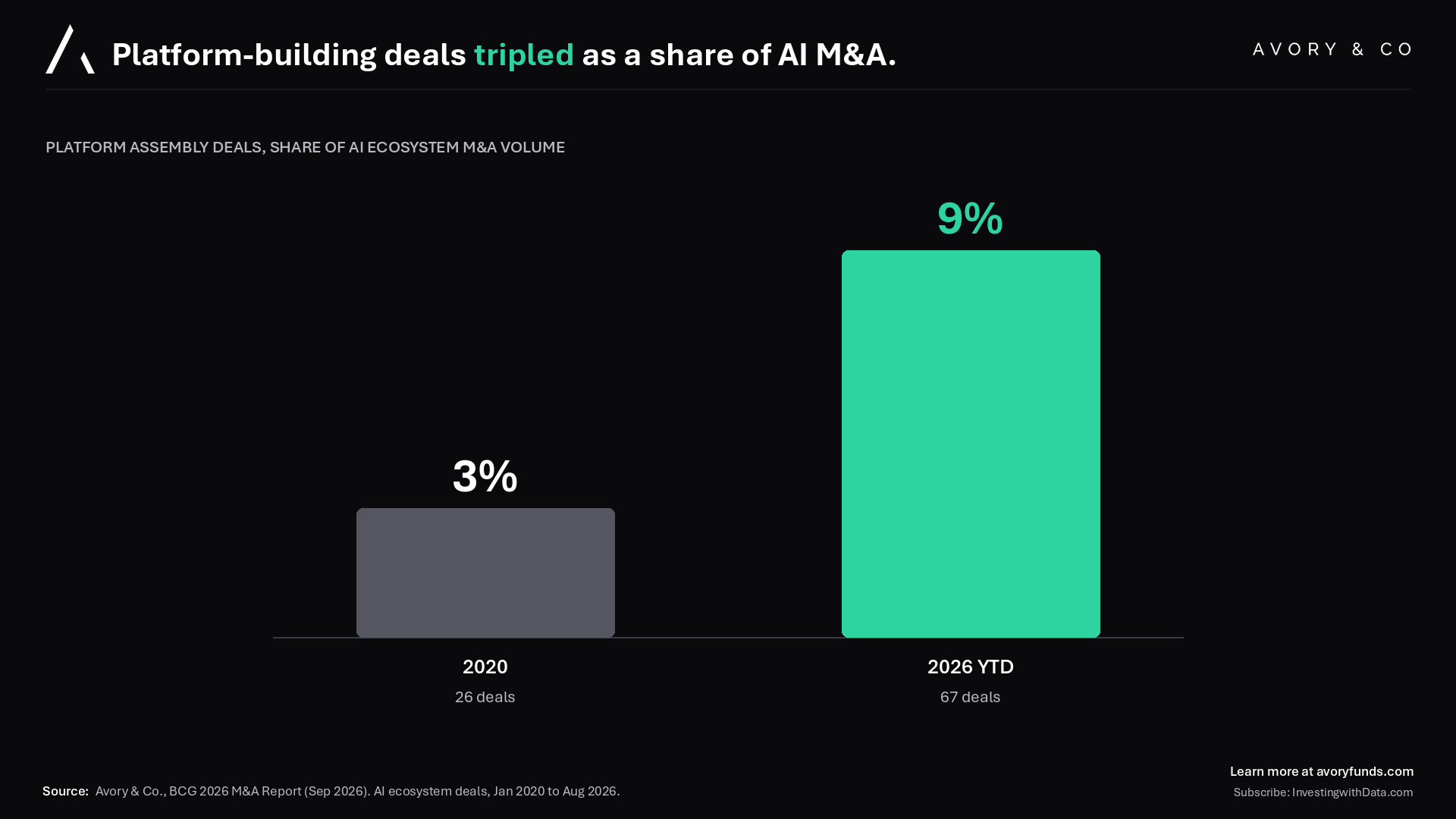
What’s being bought is the more telling part. Here is a study that went through more than 11,000 AI ecosystem deals since 2020 and sorted them by why the buyer did it. Most are still about buying a feature or a team. But “platform assembly,” meaning deals where the buyer is putting together a broader platform, went from:
3% of deal volume in 2020 (26 deals)
9% of deal volume so far in 2026 (67 deals)
Buyers are moving “from only buying capabilities to buying a position in the ecosystem.” That’s the shift, companies are paying for position, not just product. And in the study it also points out that true consolidation, competitors buying competitors, has barely started at 0.3% of deals. Which tells you we’re early in this, not late…
[2] The new super app might be a personal agent.
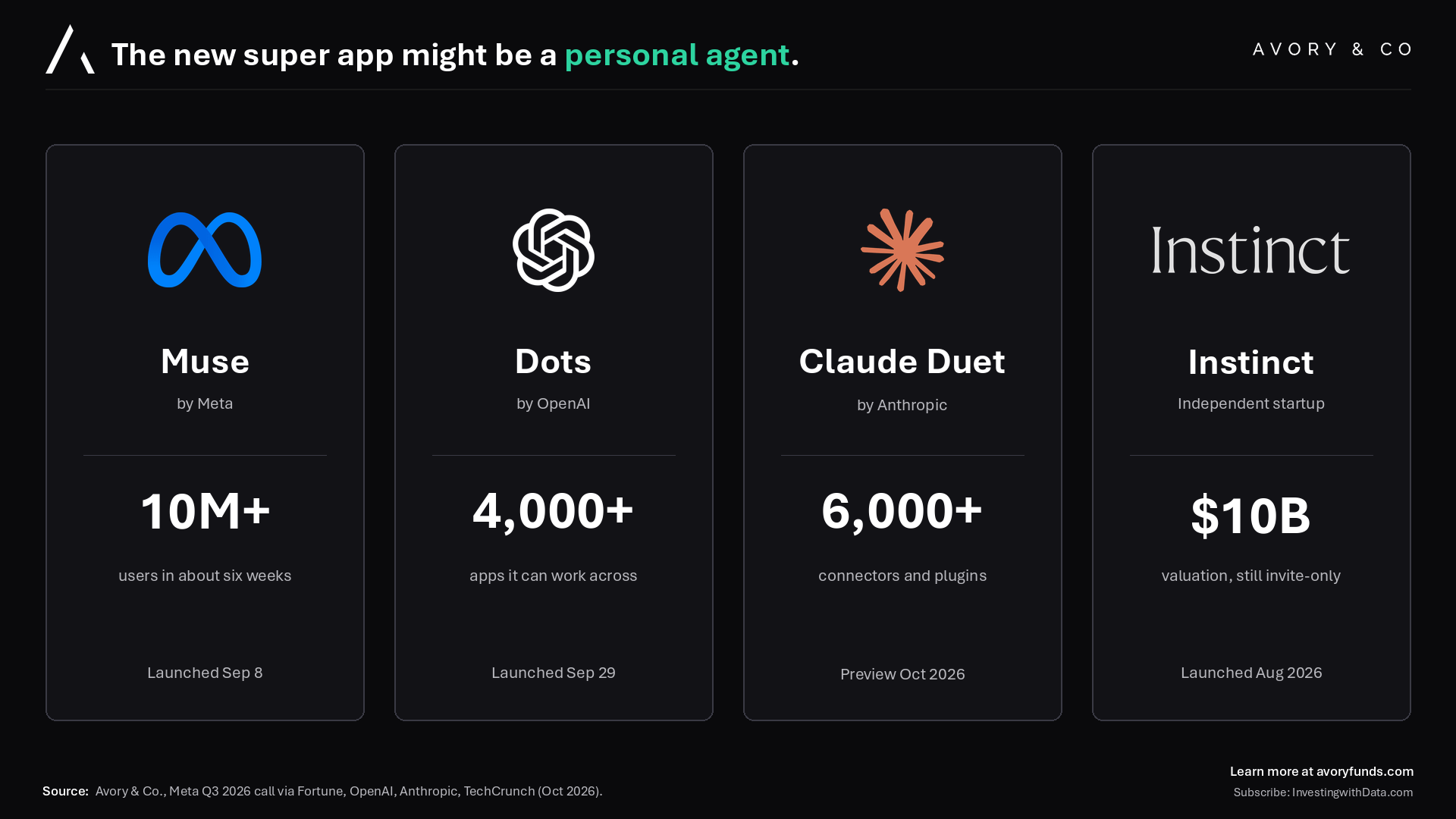
Now the other side of the equation. Since late summer the biggest AI labs, plus one very fast-moving startup, have all launched personal agents that don’t just answer questions, they go do things for you:
Meta’s Muse had more than 10M people in the U.S. and Canada set up an agent since its Sep 8 launch, per Zuckerberg on the Q3 call this past week.
OpenAI’s Dots launched Sep 29 and can work across more than 4,000 apps, with plans starting at $100 a month.
Anthropic’s Claude Duet opened a preview this month with more than 6,000 connectors and plugins.
Instinct, the startup you just text or call, raised $1B at a $10B valuation while still invite-only. I think they are approaching $30B round. Wild stuff.
Look at what Duet plugs into (they all have similar connectors fyi): Gmail, Slack, QuickBooks, Stripe, Gusto, HubSpot, DocuSign and Shopify. Proving SuperApp is actually just a harness now. None of these agents own a restaurant, a grocery shelf or a courier, they own the relationship and borrow everything else. That’s a very different kind of super app than what we’ve seen before…
[3] Shopping is the top use case for Meta’s Muse agent.
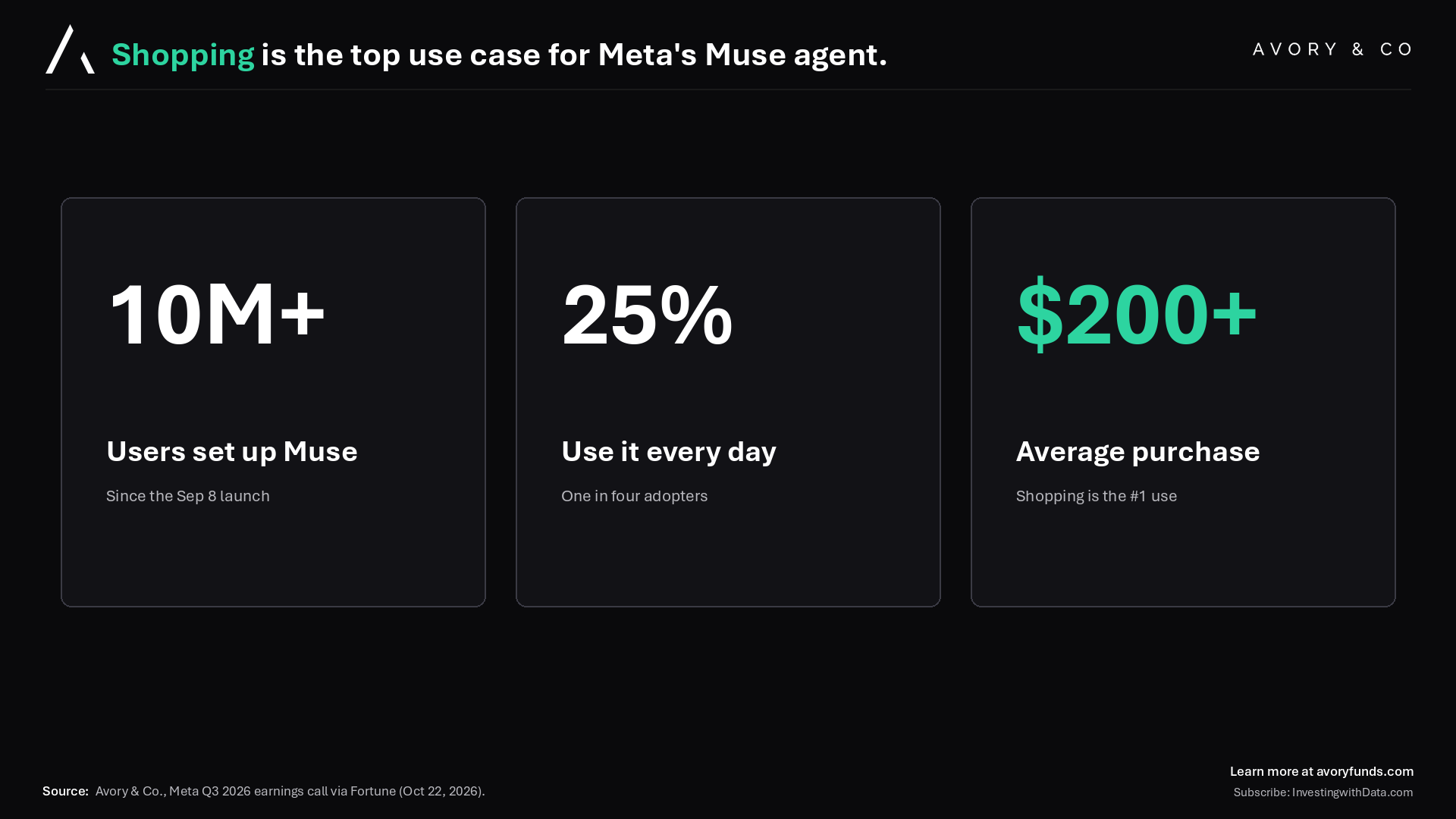
And the agents are already spending money. On Meta’s Q3 call Zuckerberg shared a few numbers…
10M+ users set up Muse in about six weeks
25% of them use it every day
$200+ is the average purchase, with shopping as the #1 use case (wild!!)
Demand was high enough that Meta had to work with Stripe to raise credit limits in the first week. Meta is also working with Shopify and Walmart on a Personal Agent Protocol so consumer agents can talk directly to business agents, and Zuckerberg said they want to get “a percent of the value that we are helping to create.” Once the agent takes a cut of the sale, it’s acting a lot like a super app, just without owning the inventory.
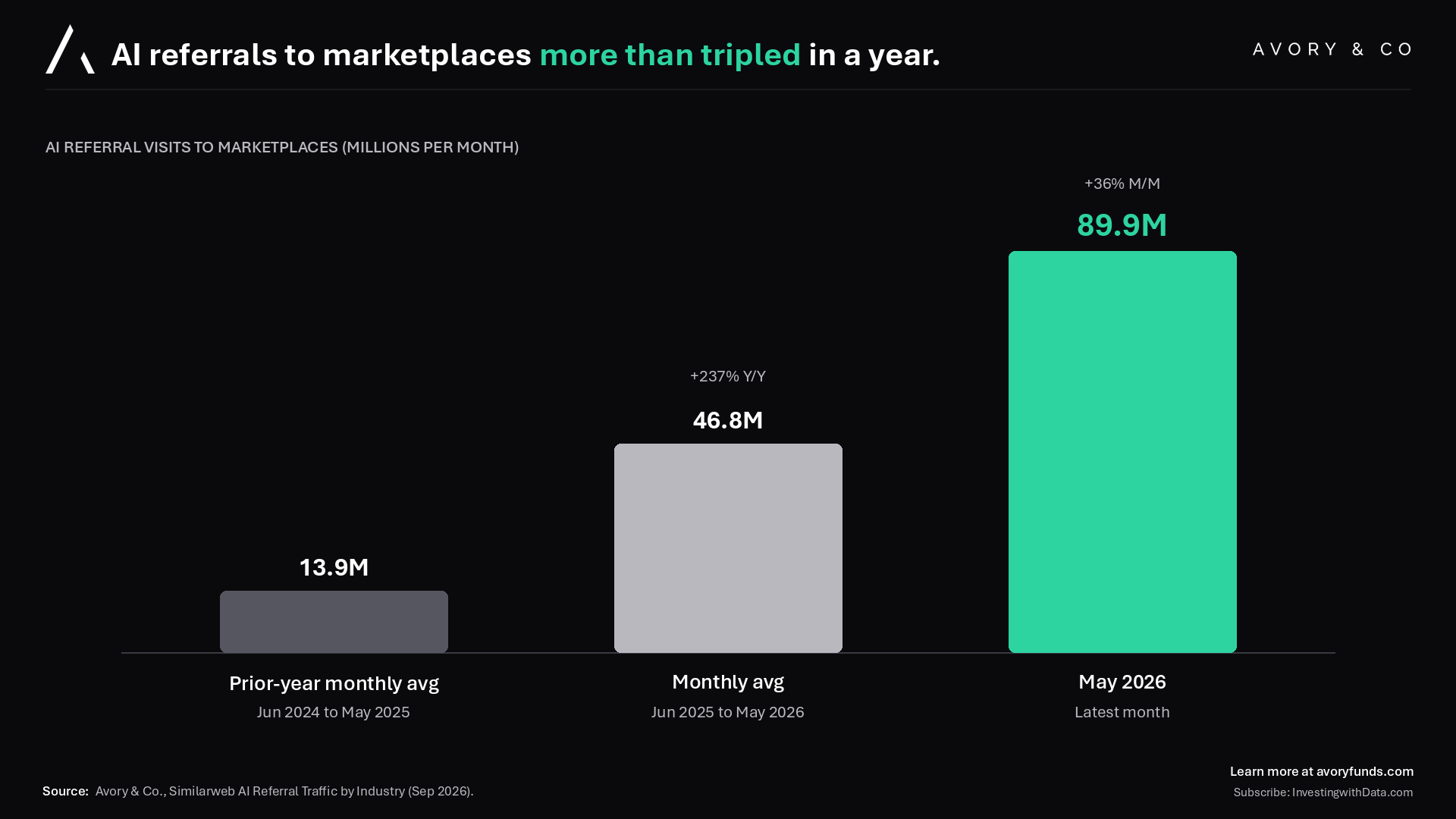
[4] AI referrals to marketplaces more than tripled in a year.
You can also see it in the traffic data. Similarweb tracks visits coming from ChatGPT, Gemini, Claude, Perplexity and others, and marketplaces get more AI referral traffic than any other industry at 46.8M visits a month.
The growth is big:
13.9M a month on average the year before
46.8M a month over the last 12 months, up 237% Y/Y
89.9M in May 2026 alone, up 36% M/M
When an agent shops, it goes to the places with the widest selection and the most reliable fulfillment first. That’s the aggregators, which is exactly the position DoorDash is trying to buy more of.
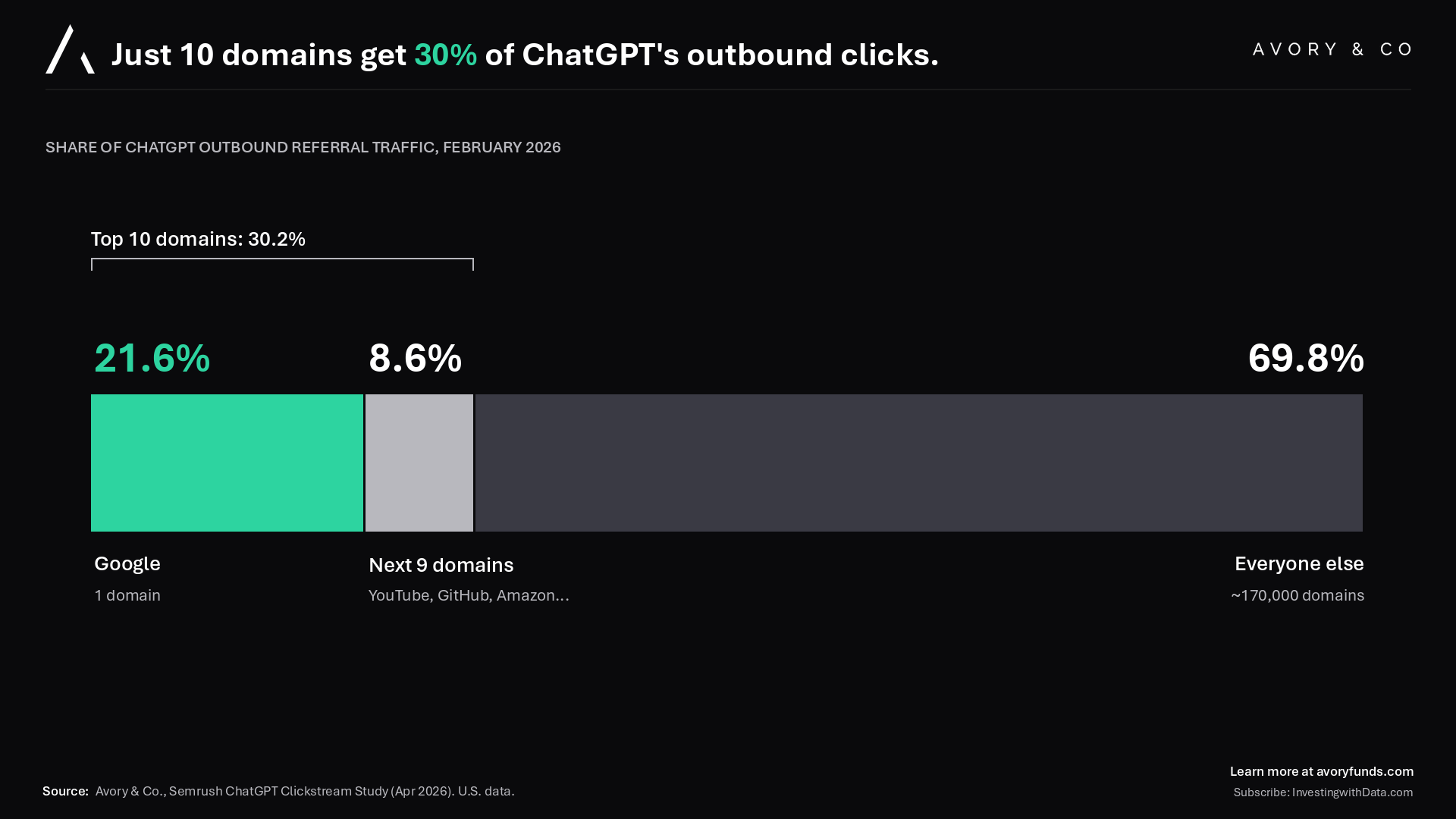
[5] Just 10 domains get 30% of ChatGPT’s outbound clicks.
A lot of people assumed AI would flatten the internet, that once you remove the search page the traffic spreads out to whoever has the best product. So far it’s going the other way. We looked at U.S. clickstream data and found that as of February 2026:
21.6% of ChatGPT’s outbound clicks went to Google alone
8.6% went to the next 9 domains (YouTube, GitHub, Amazon and others)
69.8% got split across roughly 170,000 other sites
Removing the search page doesn’t remove concentration it seems, it just changes who decides where to start that search journey. And now again when the agent is the one deciding, scale and breadth matter even more than before. So net net here is that it is still top heavy.
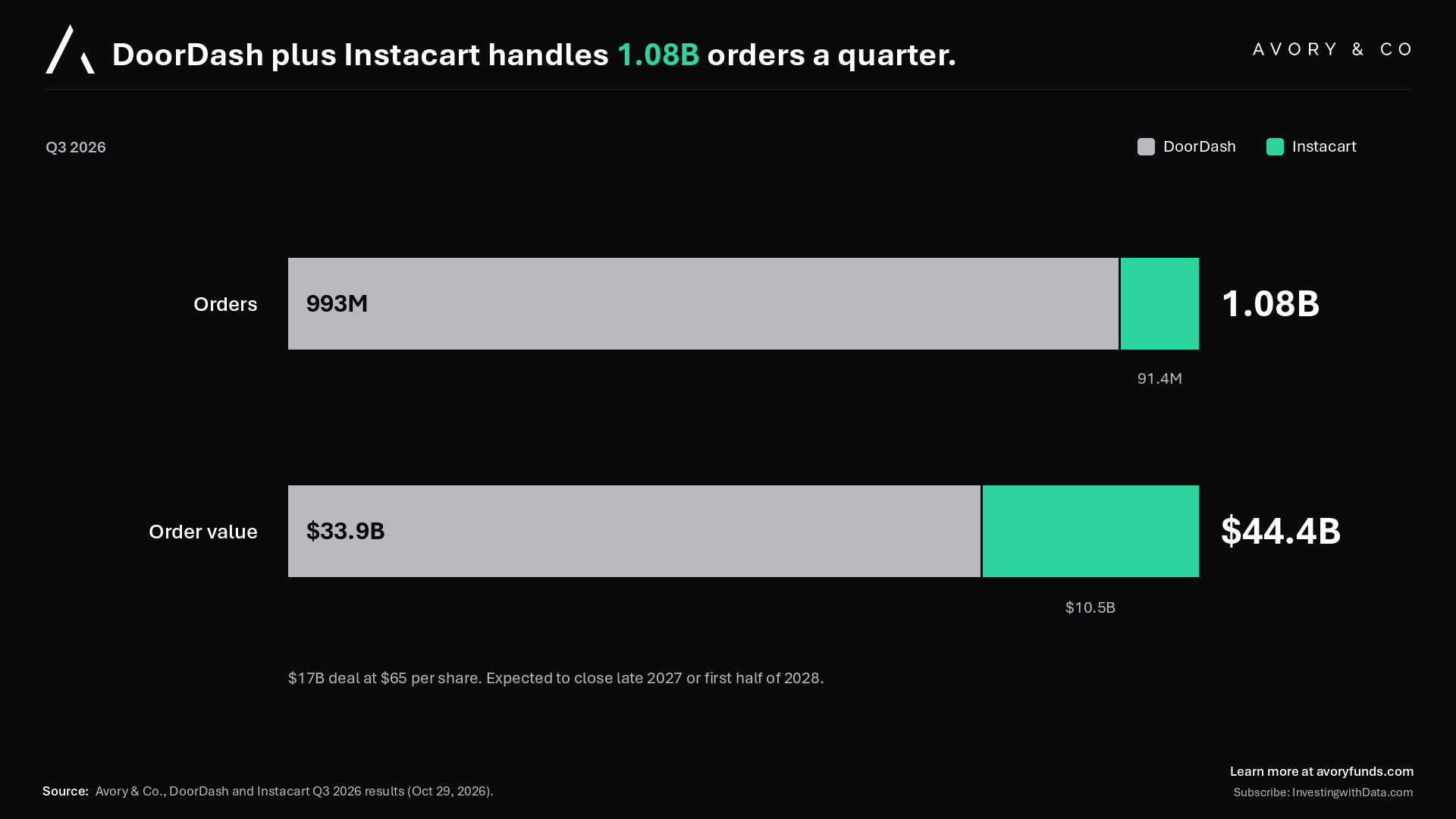
[6] DoorDash plus Instacart handles 1.08B orders a quarter.
So now the deal itself. DoorDash is paying $65 a share, at least 75% in cash, about $17B of equity value and a 26% premium to where Instacart traded before the news (DoorDash). Using the Q3 numbers both just reported:
993M DoorDash orders, up 28% Y/Y, plus 91.4M at Instacart, up 10% Y/Y
$33.9B of DoorDash GOV plus $10.5B of Instacart GTV
$44.4B combined per quarter, roughly $178B annualized
DoorDash is doing this from strength too, with revenue of $4.6B (+34% Y/Y) and adjusted EBITDA of $1.06B (+41% Y/Y) in the quarter. And both companies are already plugging into the agents. DoorDash has had a ChatGPT app since December, and Instacart says only a very small share of its orders come straight from AI agents for now. I am also Instacart user and they have been toying with their own agent inside the app.
This month DoorDash also launched a connector so companies’ own AI tools and agents can find items, build a cart and place an order on DoorDash.
Now Instacart brings 2,200+ retail banners and nearly 100,000 stores, which is big, and the catalog and store connections an agent needs to finish an order. The deal isn’t expected to close until late 2027 or the first half of 2028, so this is a long-dated bet on where commerce is going… honestly that amount of time creates a ton of risk given how fast AI is moving.
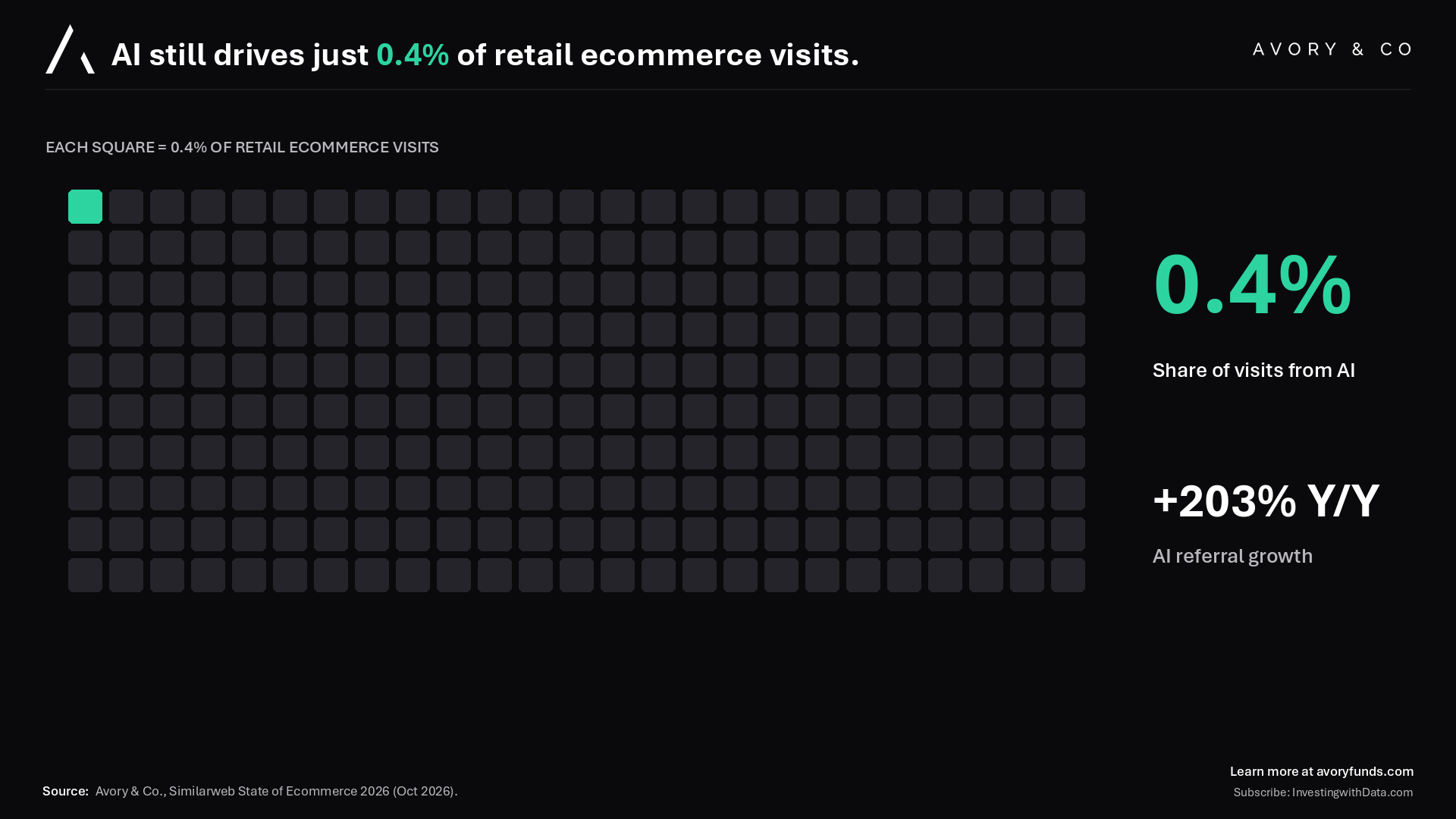
[7] HOWEVER, it’s still only 0.4% of visits.
Now the reality check for us here at Avory, because we don’t want to overstate this. Web data shows AI referrals grew 203% Y/Y BUT still make up just 0.4% of retail ecommerce visits. And 89% of people using AI to shop still use regular search too.
So how much ends up running through an agent versus someone opening an app and browsing? Half and half? Mostly agents? Mostly apps? Honestly nobody knows yet. You don’t wait for the share to hit 10% to position for it, you build the network while it’s 0.4%. Again why I said its offense if this does hit 10% or more, and defense if it does not.
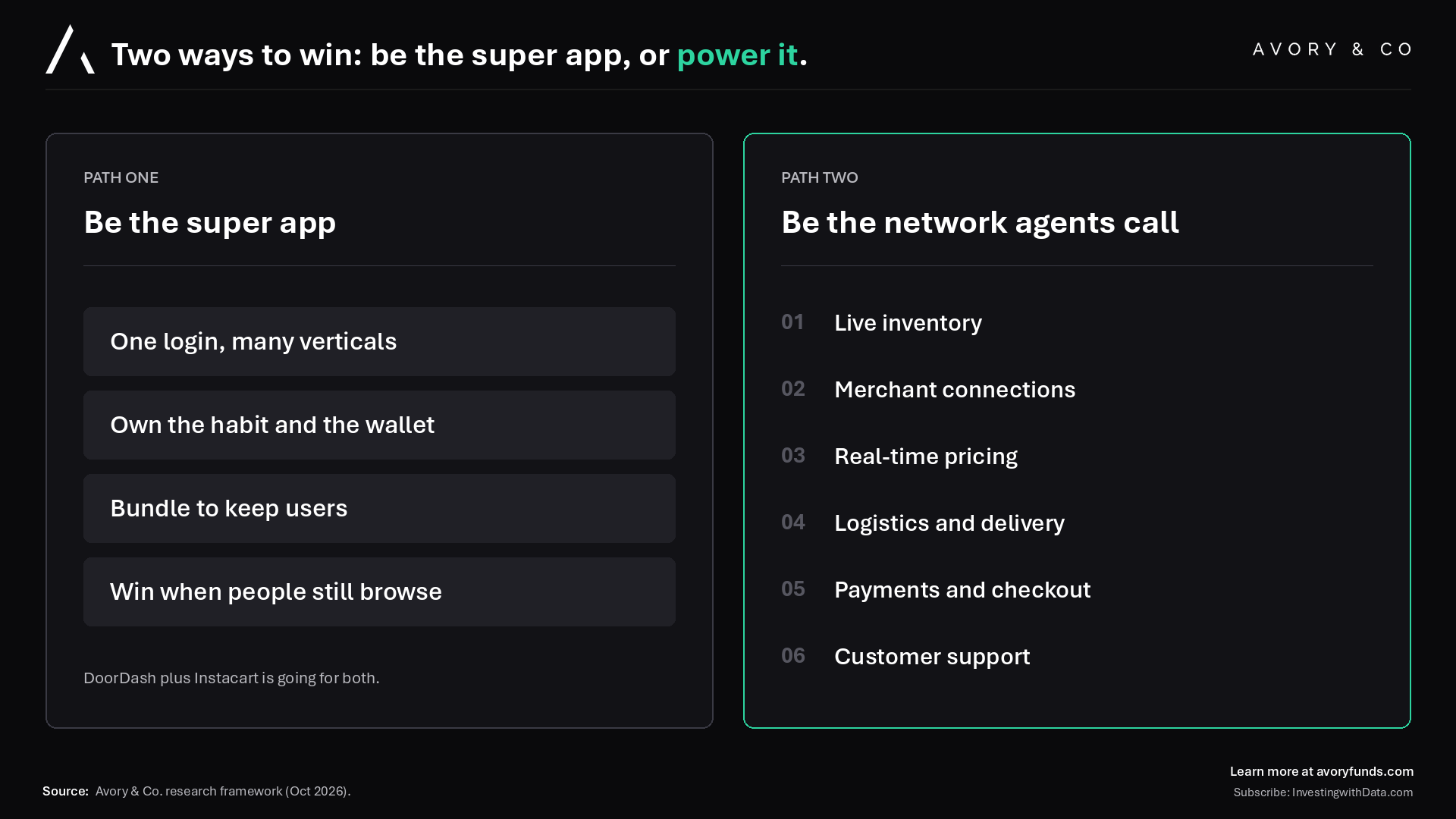
[8] Two ways to win: be the super app, or power it.
So back to the bigger picture I laid out at the start, and also tweeted (X) it this week.
Path one is being the super app. A lot of shopping is still fun and people still like to browse, myself included. For that customer, one login across restaurants, groceries, convenience and retail, with one wallet and one membership, gets more valuable, not less. That’s the offensive side of DoorDash plus Instacart.
Path two is being the network the agents have to call. If the agent picks for you, the app icon matters less and what sits behind it matters more, ie the infra. Somebody still needs live inventory, merchant connections, real-time pricing, logistics with people picking orders up, payments and checkout, and customer support when an order goes wrong. That last point is big. That’s the defensive side.
Now this goes way past delivery though, I can keep rambling lol but think about who else is lining up on each path:
Agents and super apps like Meta, OpenAI, Anthropic and Instinct going after the relationship
Infrastructure like Shopify on catalogs and Stripe and PayPal on payments, Block, already wired into these agents
Enterprise platforms like Salesforce buying Braze to own more of the harness and ServiceNow becoming CRM, ITSM and Security.
Local networks like DoorDash, Instacart and Uber owning the physical last mile
The ones caught in the middle are point solutions with a thin app on top and nothing an agent can’t get somewhere else.
Net Net
Ok so that is that. DoorDash and Instacart was a major headline this week and it feels as though every company is being forced to answer the same question. Are you the place people and businesses choose to operate, or are you the infrastructure the agents can’t skip? The durable businesses will own one of those two positions, and the very best might own both.
The ones that need to think hardest are single-product companies without proprietary data or fulfillment, and anyone renting their demand through paid search and affiliate clicks. We have said that in the past. For the scaled players the bar just went up, because the next phase of competition is about how many verticals and how much of the network you can bring under one roof before the agents decide for the customer. We are investors not traders, so we’ll keep tracking how fast the agent share actually moves, but the platform race is already on forsure and we are positioned for it.
That’s all for this week!
About Avory & Co.
Investing Forward.
www.avory.xyz / www.avoryfunds.com
Avory specializes in high-conviction equity strategies, emphasizing Secular Growth and Transformation Stories driven by exceptional teams. Data guides decisions. We cater to high net worth investors, family offices, and institutional investors. Note: This information doesn’t constitute a recommendation to buy or sell any mentioned securities. Avory is based in Miami, Florida with clients all across the globe.
Speak to us:
Send us an email: Team@avoryco.com
Want to invest? We are on most platforms.
Want More
🎥 Avory YouTube: Channel
🎙️ Avory: Podcast
Disclaimer: Not a recommendation to purchase or sell any securities mentioned. This is for educational purposes only.