

I wake up this AM and check my systems to see whether there was any overnight news on companies we own or track. Sure enough, we get a key SIGNAL on the state of play here for AI and software. The news was pretty straight forward, but again, the implications here I think are meaningful enough to write about. Read until the end, since its more than just Salesforce buying Braze.
So the news…
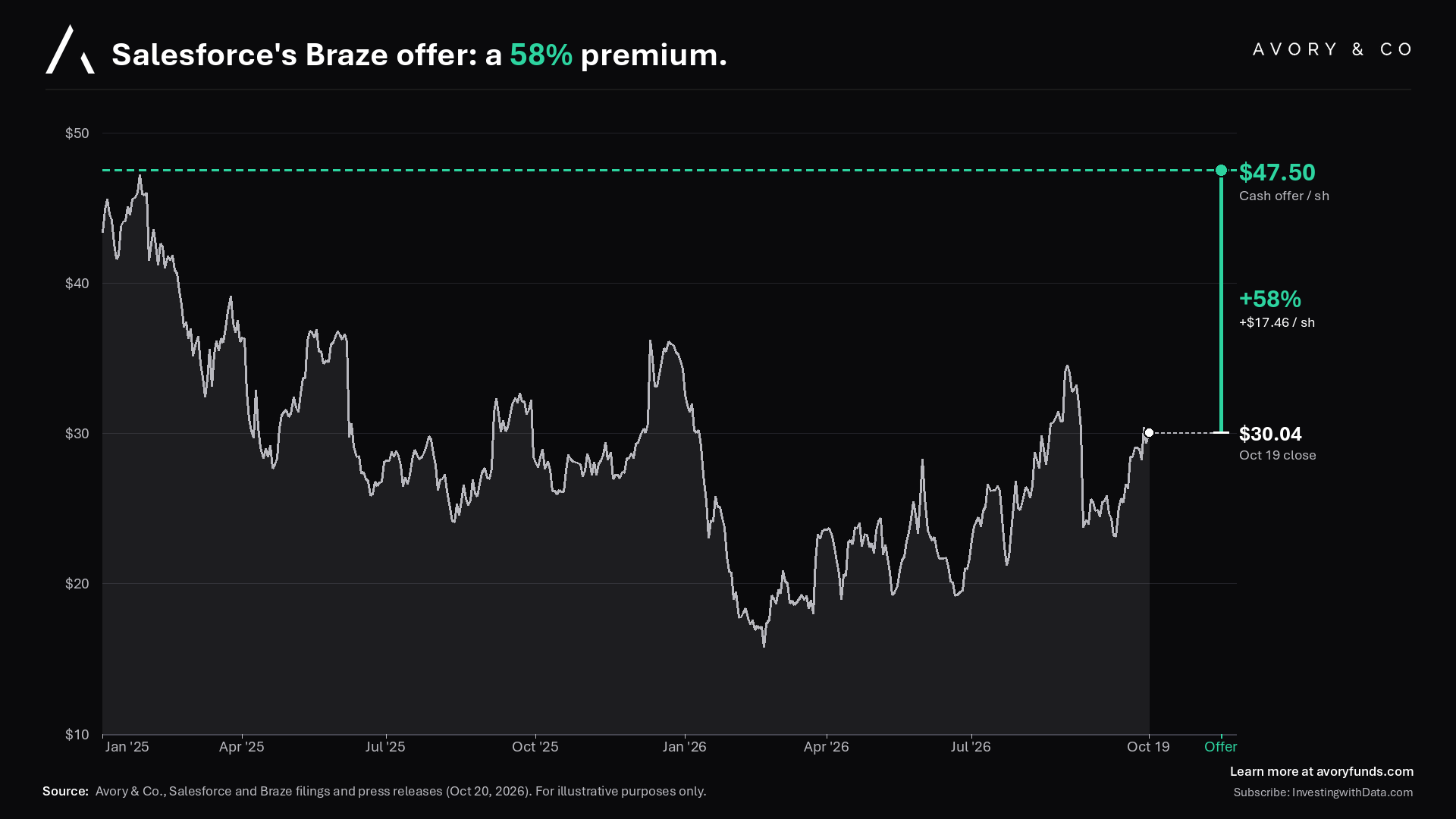
Salesforce agreed to acquire Braze this morning for about $5.66B in enterprise value, or $47.50 a share in cash. That’s a 58% premium to where Braze closed on Monday at $30.04. The deal is expected to close in Salesforce’s fiscal 2028, subject to shareholder and regulatory approvals. Cool, that was my morning.
Now if we zoom out on how Braze’s stock actually got here. Back in January 2025, Braze closed as high as $47.22. By February 2026, during the worst of the “AI is killing software” selloff, the stock had been cut by two-thirds down to $15.79 (YIKES). Public equity investors were pricing the business like AI agents were about to make customer engagement software obsolete. Markets are always efficient huh? Nope.
Then a strategic buyer generating $11.35B in quarterly revenue walked in and wrote an all cash check at $47.50, three times the February low and right back above the 2025 high.
While the headline around the deal is what you will keep hearing about on TV but for us at Avory & Co. the more interesting takeaway is what this gap between public-market sentiment and strategic buyer behavior may signal about the next phase of software investing...
I think large platforms are going to get increasingly interested in software and internet assets with unique access to customer information, embedded workflows, and distribution. Some of the same companies investors worried AI would disrupt could become valuable acquisition targets...
Here’s the deal and the round-trip in one picture.
Almost four years into ChatGPT, software is still growing.
ChatGPT launched in November 2022. We’re approaching its fourth anniversary. Time if flying. For almost four years, one of the loudest consensus narratives in Tech has been that generative AI would hollow out application software from the outside in.
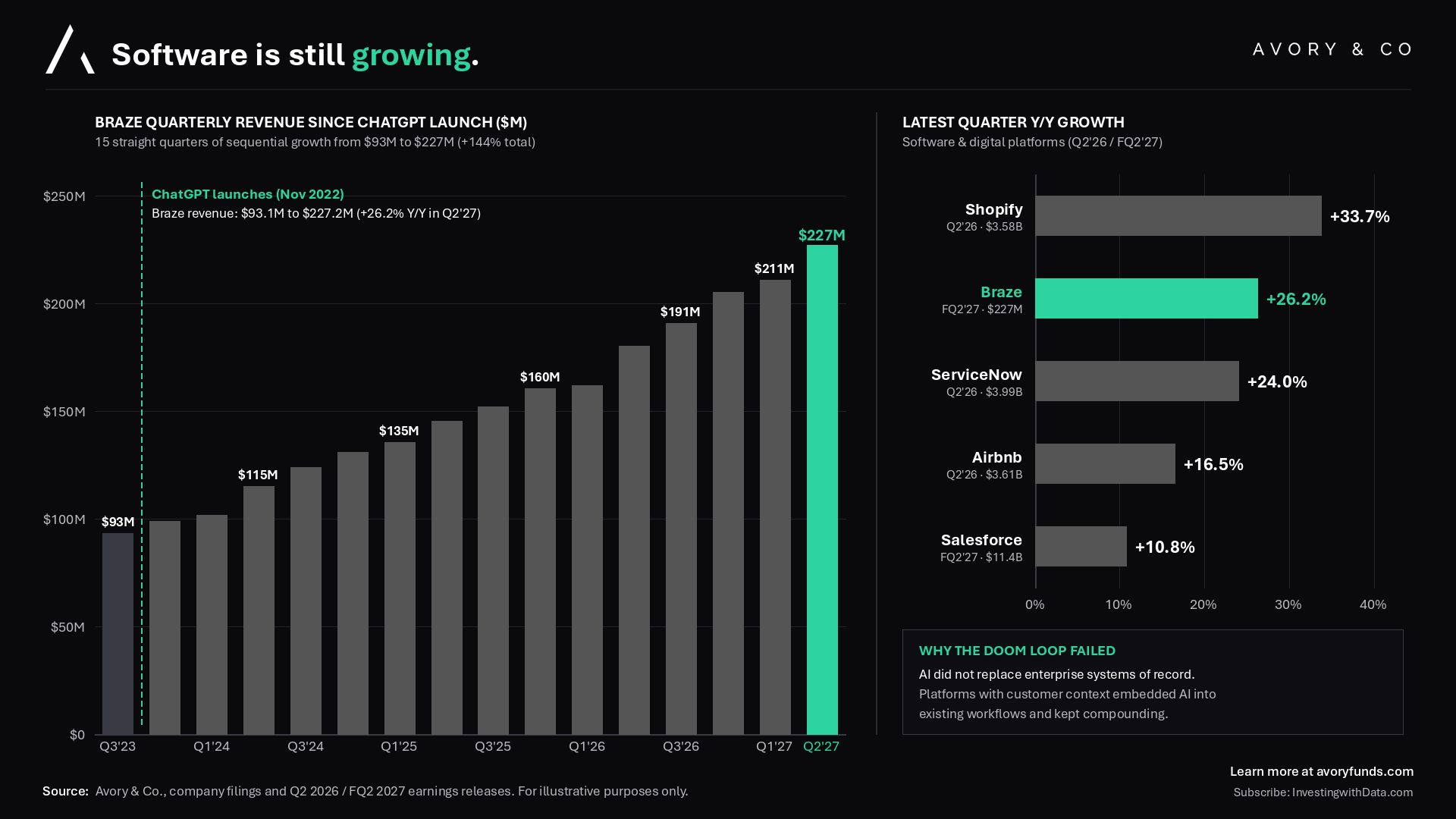
Look at what actually happened to Braze’s top line over that exact window.
In the quarter ended October 2022, right before ChatGPT launched, Braze generated $93.1M in quarterly revenue. Over the next 15 straight quarters, revenue went up every single quarter without a single sequential dip, reaching $227.2M in their July 2026 quarter. That’s 144% cumulative top-line growth while the market spent years debating whether AI would put them out of business.
Look at the numbers from their July quarter:
$227.2M in revenue, up 26.2% Y/Y
2,789 enterprise customers, up 15% Y/Y
110% trailing-12-month dollar-based net retention (112% among customers spending $500K+ a year in recurring revenue), a measure of revenue retained and expanded from existing customers.
And Braze isn’t an isolated outlier.
Across software and digital platforms, companies that own real customer workflows are still putting up healthy numbers.
Shopify grew revenue 33.7% Y/Y to $3.58B in its June quarter. ServiceNow grew 24.0% Y/Y to $3.99B.
Airbnb grew 16.5% Y/Y to $3.61B. Even Salesforce itself grew 10.8% Y/Y to $11.35B.
Now this doesn’t prove AI disruption is harmless. Revenue growth can coexist with falling margins, weaker retention, or competitive pressure that shows up later. But it does mean you should separate a plausible disruption narrative from deterioration that’s actually showing up in the numbers.
From point solution to platform.
A lot of software companies started by solving one narrow problem.
Five years ago, expanding into a second or third product line took years of engineering and a separate sales motion. Did not make sense at all…
Today, AI makes it faster to build adjacent features and connect workflows, so an incumbent that already sits inside the building can expand horizontally while going deeper into each customer relationship.
That flips the disruption argument on its head. Bearish investors assumed startups would use AI to clone incumbent features for pennies. In practice, enterprise buyers don’t want to rip out a system of record and wire up ten unproven point tools just to save a few dollars on seats. They’d rather let the vendor that already holds their security approvals, integrations, and user habits ship the AI features inside the workflow they already use.
You can see this playing out across both consumer platforms and enterprise software.
Airbnb is pushing beyond accommodations into services, experiences, car rentals, and boutique hotels.
Zoom, now generating $1.28B a quarter growing each quarter since ChatGPT launch, keeps expanding beyond video meetings into docs, contact center tools, and agentic customer-service workflows. Same idea: once you have the customer, the distribution, and a trusted workflow, adjacent products become easier to launch and more useful together...
Context, compute and capital.
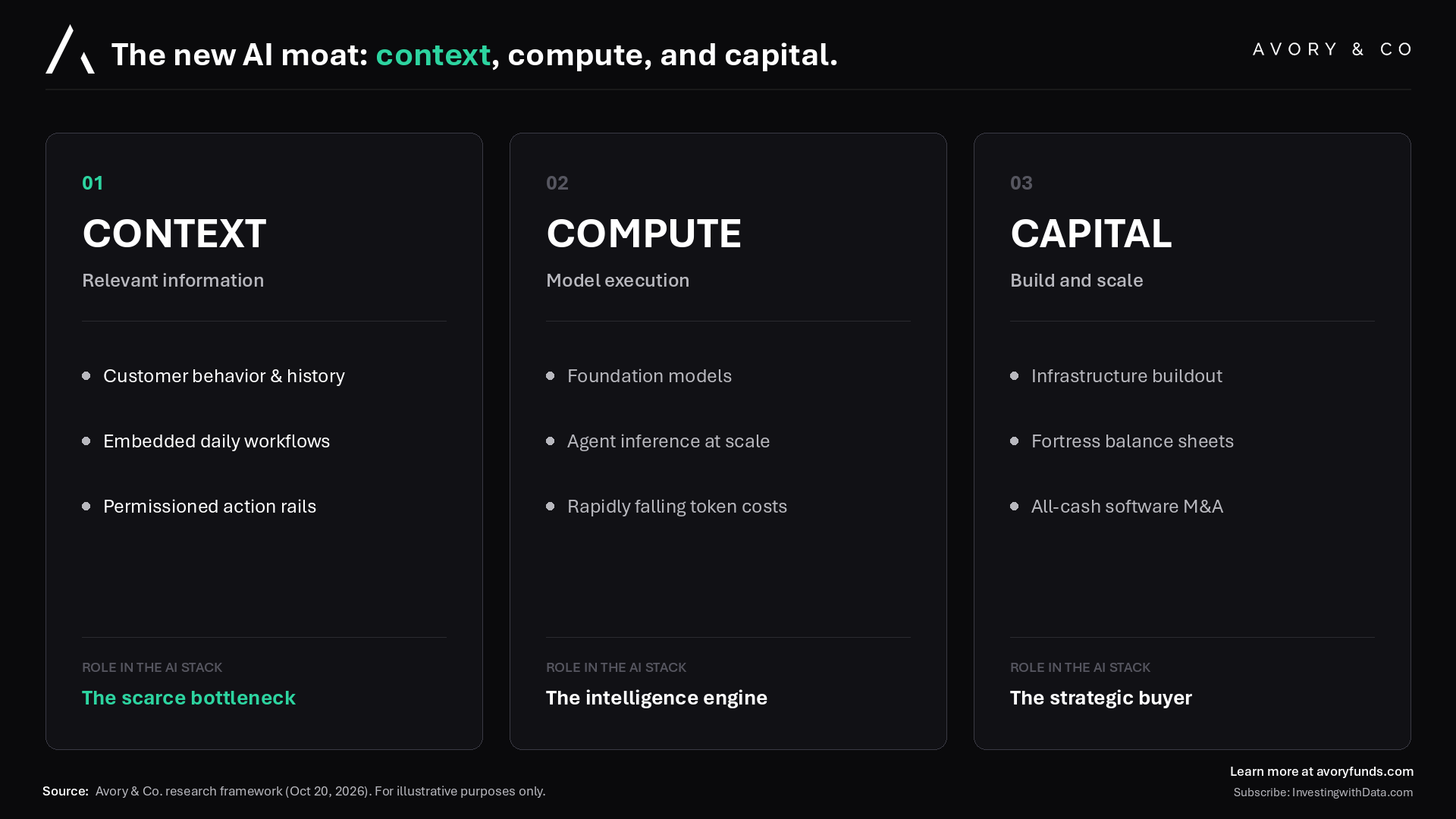
We keep coming back to three inputs behind useful AI: context, compute, and capital.
Capital finances the buildout and lets cash-generative incumbents buy capabilities when public multiples compress.
Compute runs the foundation models and powers agent inference at scale.
Context determines whether an AI system actually understands the customer, process, or decision it’s trying to help with.
Over the past three years, the market obsessed over compute and capital because that’s where the first wave of spending went. Hyperscalers poured hundreds of billions into GPUs (graphics processing units) and data centers, and foundation models got dramatically faster and cheaper. AND as raw model intelligence becomes more widely available, the bottleneck shifts downstream.
Think about what happens when an enterprise deploys an AI agent. A general-purpose model can write a convincing customer support reply or draft a marketing email.
A model with permissioned access to transaction history, past conversations, entitlements, churn signals, and live operational status can actually decide which offer to send, across which channel, at the exact moment a customer is about to act. That second case is where business value becomes measurable.
We wouldn’t claim context always matters more than capital and compute.
Frontier model quality and inference economics still matter enormously. But for application companies, differentiated context is the scarce ingredient that turns broadly available intelligence into real business outcomes.
That’s our view, and we think the Braze deal is clear evidence the big platforms are starting to price it in.
What Salesforce is really buying.
Let’s be precise about what Salesforce is buying here, and what it isn’t. It’s not buying raw ownership of customer data. Enterprise customers keep legal rights over their own information, and how that data gets used is governed by strict permissions and contracts. Buying a software vendor shouldn’t be read as acquiring unrestricted access to customers’ private records.
The real advantage is the software layer: integrations, live event streams, relationships, permissions, and the established places where actions get taken.
Think about Salesforce’s own AI push with Agentforce. Salesforce already sits on the core CRM (customer relationship management) system of record for sales and service teams. What Braze brings is the real-time behavioral engine across consumer-facing channels: mobile push, in-app messages, email, SMS, and web.
When a customer browses a product, abandons a cart, or hits a usage milestone, Braze sees that signal in real time and triggers the next step in the journey.
Building that plumbing from scratch across 2,789 enterprise accounts would take years of SDK (software development kit) installations and mobile engineering. Writing a $5.66B check buys that last mile execution layer overnight and plugs it directly into Salesforce’s distribution machine. That’s the strategic logic here.
But there is moree!
The short book just got more dangerous.
A familiar trade the past couple years has been long AI infrastructure, short a basket of application software and internet names thought to be AI losers. When software multiples were stretched and growth was decelerating, leaning short against the narrative worked well.
Look at Braze’s stock chart again at the top. If you were short Braze from $47.22 down to $15.79, you felt like a genius. Even at $30.04 on Monday afternoon, the short thesis sounded comfortable on a podcast. Then Tuesday morning arrives and the stock gaps up 58% to $47.50 on an all-cash bid. Yikes.
Strategic buyers introduce a completely different kind of risk for bears. The short can gap upward overnight for reasons that have nothing to do with the next quarterly earnings report.
Now, one 58% buyout premium doesn’t prove an industry-wide wave of takeovers. To make that case systematically, we’d want to see rising M&A (mergers and acquisitions) volume across the sector, high short interest in likely mid-cap targets, meaningful borrow costs, and broad short covering after deal announcements. HOWEVER, even a handful of credible all-cash transactions changes the payoff math for a crowded software short book. When strategic buyers start putting a floor under compressed valuations, pressing shorts at multi-year lows stops being a free ride.
What we’d look for from here.
If we’re entering a phase where big platforms use their cash to buy context and workflow layers, how do you separate the real targets from the value traps? It is all about hard to replicate information.
Here is what we’re watching across the software universe:
Freshness and uniqueness of the real-time information flowing through the product
Depth of workflow integration (MCP / API) and SDK footprint inside customer apps
Ability to actually take actions across channels, not just summarize or answer questions…
Switching costs, contractual permissions, and clear data rights
Retention (110%+ net dollar retention) and clean cash conversion
Strategic fit with cash-rich platform buyers looking to complete their AI agent stack
Short positioning and valuation compression relative to steady revenue growth
To be clear… some software incumbents will still get bypassed by AI agents, especially tools that only offer thin user interfaces over static databases. Others become more valuable as the intelligence layer expands because they hold the context and execution rails that agents need to do real work. Our working thesis is that the second group attracts more strategic buyers than the first.
Worth paying attention to from both sides of the book.
One final caveat worth stating plainly. A takeover premium is not a standalone investment thesis. We never buy a stock just hoping someone acquires it, because the business still has to compound on its own if a bid never shows up. Today’s deal is simply a loud SIGNAL to me that the tide is continuing to change.
About Avory & Co.
Investing Forward.
www.avory.xyz / www.avoryfunds.com
Avory specializes in high-conviction equity strategies, emphasizing Secular Growth and Transformation Stories driven by exceptional teams. Data guides decisions. We cater to high net worth investors, family offices, and institutional investors. Note: This information doesn’t constitute a recommendation to buy or sell any mentioned securities. Avory is based in Miami, Florida with clients all across the globe.
Speak to us:
Send us an email: Team@avoryco.com
Want to invest? We are on most platforms.
Want More
🎥 Avory YouTube: Channel
🎙️ Avory: Podcast
Disclaimer: Not a recommendation to purchase or sell any securities mentioned. This is for educational purposes only.
Sources
· Salesforce Signs Definitive Agreement to Acquire Braze, Salesforce investor relations, October 20, 2026
· Salesforce to acquire Braze in a $5.66 billion deal, Reuters, October 20, 2026
· Braze Reports Strong Fiscal Second Quarter 2027 Results, Braze investor relations
· Airbnb Q2 2026 financial results, Airbnb newsroom
· Shopify Q2 2026 financial results, Shopify
· Airbnb 2026 Summer Release, Airbnb newsroom
· Zoom drives connected customer relationships with new agentic AI capabilities, Zoom newsroom, October 2026
· Introducing ChatGPT, OpenAI, November 30, 2022