

Big Picture
So we know the results now (market numbers here are as of this morning, before the open as I write this ).
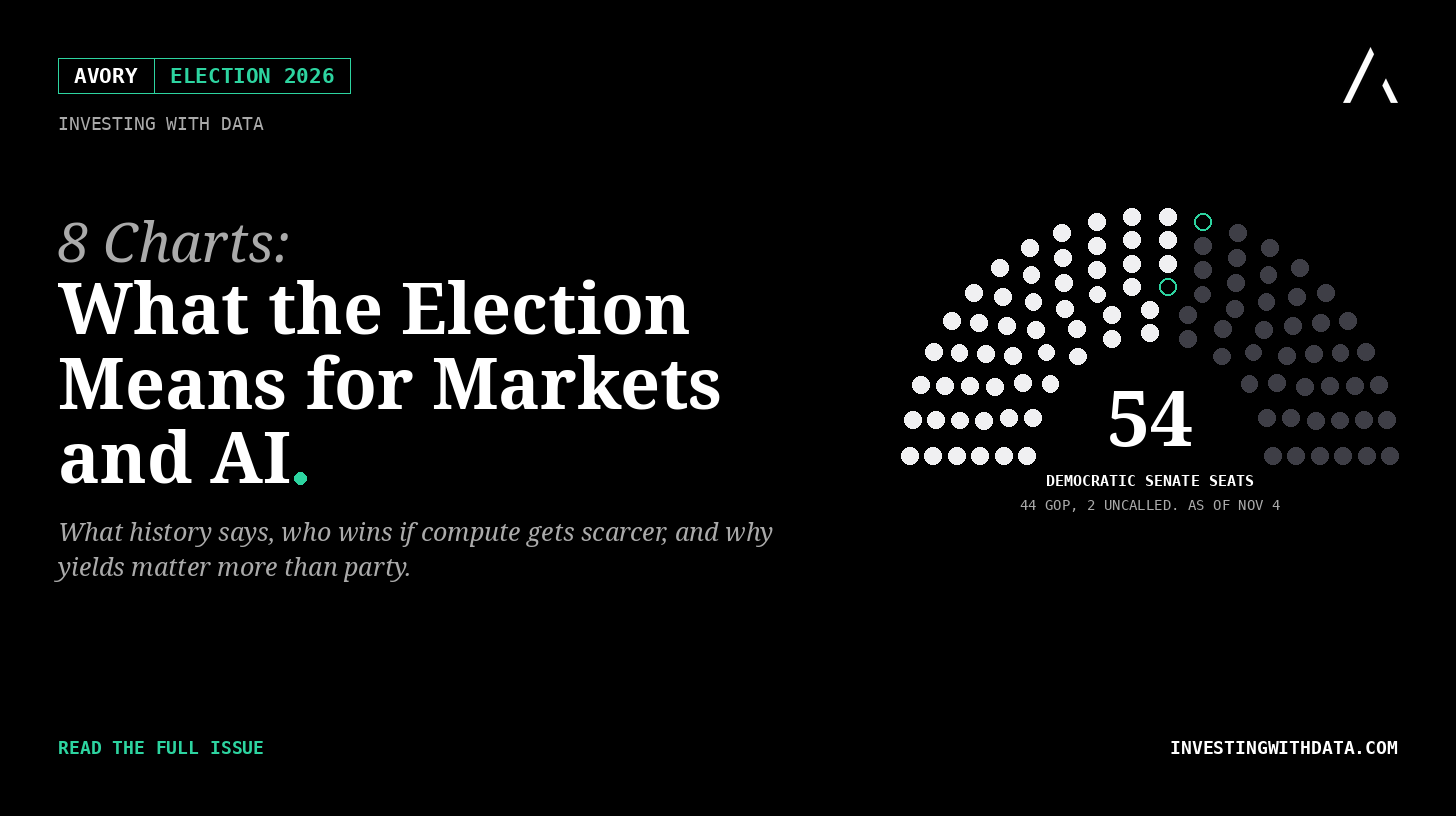
Democrats won the House and the Senate, flipping seven Senate seats along the way (Texas, Kansas and South Carolina among them, which nobody had on their bingo card a year ago), so for his final two years President Trump will be working with a Democratic Congress. Overall though this isn’t your avg election as the states where seats changed have specific economic exposures like AI, energy sources and housing.
The overnight move suggested that the market was worried.
Nasdaq 100 futures fell as much as 2.4% and S&P 500 futures as much as 1.4% as the results came in, and then people started to probably see what we see…
By 6:24 AM, S&P futures were up about 1% and the Dow about 1.4%. Under the surface it was a very clear the dynamics taking place.
We saw the data center names like CoreWeave heading lower, Tesla and SpaceX were down more than 3%, and solar ripped, with First Solar up about 9%. Again these will all move around so take that as is.
The 10-year hit 4.89% overnight, and gold moved also. (And keep in mind the Nasdaq 100 went into a correction on Monday, so a lot of this fear was priced in before a single vote was counted.)
In plain terms, the first read I think was that AI gets more scrutiny and the deficit gets some reprieve. Honestly I think this is a good thing for the economy.
Also to be clear, our take is that this isn't as simple as "gridlock is good" or "regulation is bad."
A Democratic Congress, plus new governors in states like Texas, could make new AI infrastructure harder to build, make the infrastructure that already exists more valuable, and bring the cost of capital down all at the same time. Those three things point to different winners and losers, and that's what we care about as investors.
So this issue is in two parts. First, what history says about markets in a setup like this one (charts 1 to 3). Then what it means for AI, software and rates, and where we think the durable winners are (charts 4 to 8)…
We are investors, not traders. Lets get into the details and data!
[1] A Republican president with a Democratic Congress ranks last.

Starting with the broad market. Going back to 1953, the S&P 500 has averaged a 4.9% annual price return with a Republican president and a Democratic Congress, the lowest of the six combinations.⁶
For comparison:
13.3% with a Republican sweep
8.0% with a Democratic sweep
17.0% with a Democratic president and a split Congress
Before anyone panics, the sample is small and a couple of really bad years drive it.
One well-followed strategist called it "the worst possible combination" this morning, but also pointed out the financial crisis is a big part of why that number is so low.⁷ None of these categories are statistically significant either. So again lets grab some more data before making conclusions as party control has rarely been the thing that decides a market. Earnings, rates and valuations do that.
[2] The S&P 500 was higher 12 months after all 20 midterms.
Measured from the close before Election Day to one year later, the S&P 500 has been higher after all 20 midterms since 1946, with an average gain of +14.8%(median +14.2%) versus +8.7% for all years.⁸
So that is a little more meaningful dataset.
Now the closer match to today.
Seven times a midterm left a Republican president facing a Democratic House and Senate (1954, 1958, 1970, 1974, 1986, 1990 and 2006). The 12 months after those elections averaged +16.1%, with 1986 the weakest at +2.0% and 1954 the best at +33.0% (that's our math off the same data). So not bad.

So how do you square that with the 4.9% on chart 1? The annual averages cover the whole stretch of a regime, including years like 1974 and 2008, while this chart starts the clock on Election Day, after the midterm-year selloff has usually already happened.
The weak part of the cycle has typically come before the vote, not after it.
[3] Year three has been the best year of the presidential cycle.
That's the presidential cycle, and it's one of the more consistent patterns we track. Since 1932, midterm years have averaged 3.3% with a median of just 0.6%, while the third year of a term has averaged 14.0% with a median of 18.1%.⁶
2027 is year three.
The avg midterm year has also seen a 20.8% peak-to-trough drop, followed by an average 46.3% gain from that low to the high the following year.
The Nasdaq 100 going into a correction this week fits that pattern so far.
And in 5 of 8 midterm cycles since 1930 where the president's party lost the House, the S&P still rose through year-end.

History doesn't promise anything, but the setup going into year three has usually been a good one for patient investors.
[4] Big Tech is guiding to roughly $730B of capex this year.
Now to what we think matters most for portfolios, AI. The four largest hyperscalers are guiding to roughly $730B of capex for 2026:
Amazon about $220B
Alphabet $195B to $205B
Microsoft about $170B
Meta $135B to $145B
(Definitions differ by company, so treat the total as directional, not precise.)

The part we care about more is that demand is still running ahead of supply. Microsoft trimmed its number because third-party data center capacity showed up late, not because demand slowed.
Last quarter Azure grew 48%, Google Cloud 103% and AWS 39%, and Microsoft's commercial backlog hit $677B. Keep in mind we have some interesting internal data trying to figure out what percent of the CAPEX growth is from pricing versus more units being shipped, and it is not that small… if you want the data let me know.
But, back to this, what happens if Washington and the states make new capacity harder to permit, power and connect?
[5] Lawmakers in 16 states have weighed banning new data centers.
As of mid-September, lawmakers in 16 states had proposed bills to ban or pause new data center development.
To be clear, that's 16 proposals, not 16 bans. Seven are still sitting at introduced, six failed, Maine's was vetoed, Virginia's carried over and New York's passed the legislature.

Most of the real decisions on data centers sit with states, utilities and grid operators, not Congress. But last night matters here too. Democrats won the Texas Senate seat AND the governor's mansion, and Texas is one of the biggest data center buildout markets in the country. One analyst flagged overnight that Texas could end up looking at a moratorium "as New York did," and CoreWeave and SpaceX were both lower premarket on that exact worry.
For the picks and shovels, that splits the group in two.
Businesses that need a steady stream of new greenfield construction could see orders pushed out,
while power that's already connected, transmission access and efficiency tools could earn a scarcity premium.
If it gets harder to build new data centers, the ones already built, powered and connected get more valuable.
[6] Three clouds already control 63% of the market.
Which brings us to who benefits. AWS, Azure and Google Cloud held 28%, 20% and 15% of worldwide cloud infrastructure in Q2, so 63% combined, in a market that grew 43% Y/Y to $143.4B.

Think of it as regulatory capture without anyone writing a law that picks winners.
Maybe this is what Dario and Sam wanted? (being little facetious) but they want to scare locals, slow down development? Who knows, but anything is possible given importance here.
Conceptually though, slower approvals and interconnection queues favor whoever already has the land, the power contracts and the customers. That's been our view for a while now, power, land and capacity are harder to replicate than the models themselves, and over time the models start to look more like the internet (everywhere, and cheap).
HOWEVER, scarcity cuts both ways… the frontier labs running the biggest training runs need that same capacity. If the US buildout slows, open-weight and Chinese labs get an opening to close the gap on efficiency instead of scale.
So this one is hard. Likely the clouds that own compute, are scaled already, and have the customer win big, the labs if they move down market into the power and shell then maybe they win too, but then if the buildout is constrained and model improvements slow, then yeah not easy to decipher.
[7] Large companies scaling AI agents jumped from 27% to 40%.
Now the software side. If new infrastructure gets harder to add, the companies already sitting inside the enterprise workflow (permissions, data, trust, distribution) get more time to turn AI into product.
And adoption is moving fast. In a recent survey of more than 1,700 companies, 44% said AI is scaling across their enterprise, up from 38%, and among companies with $1B+ in revenue, the share scaling AI agents jumped from 27% to 40%.¹⁹
That's the same reason we bought ServiceNow here recently (we think it may be one of the leaders in orchestrating AI).

But we're not going to ignore the other side of the same survey.
32% said they skipped buying at least one software product or feature because they could build it themselves with agentic coding tools.
Incumbency buys time and distribution, but it doesn't protect every software revenue stream. The ones we want own the workflow and the place where the work actually gets done, not just the interface. Again ServiceNow is great example.
[8] The 10-year yield is already off its October high.
Rates might end up being the bigger story for most portfolios. The bond market's first read is that a Democratic Congress puts the brakes on another round of deficit-funded tax cuts or spending, which could take some of the fiscal risk premium out of yields. One rates desk put it simply, "bonds are coming out as the clear winner.”
We said a few weeks back that yields looked peakish, and so far so good. We timed that pretty good and portfolio reacted accordingly.
The 10-year topped at 5.31% on October 5, closed at 4.95% yesterday and traded as low as 4.89% overnight.

The starting point is still tough though. The fiscal 2026 deficit came in around $2.0T, $218B more than last year, and gridlock doesn't fix that. The president also keeps plenty of power on tariffs and foreign policy without Congress.
What matters is WHY yields fall. If yields come down because the fiscal risk premium eases while earnings hold up, that's good for housing, private markets, consumer names and longer-duration growth. If they come down because growth is rolling over, that's a very different market. So far earnings are holding up, which points to the first one and I think that continues.
It's also why we like where we're positioned in healthcare. With a divided government, sweeping healthcare legislation is harder to get through, which means less headline risk for names like Omnicell, Quest Diagnostics and Labcorp, all of which also tend to do well in the everything else rally we get when yields ease. (not recommendation)
Net Net
The election changes the policy path which changes for now market path. History says the rough part of the cycle usually comes before the vote, and year three has been the best year of the four.
For AI, our read is that scarcity favors incumbents. The winners are companies with capacity that's already built, powered and connected (AWS, Azure, Google Cloud), workflow owners like ServiceNow, and rate-sensitive areas like housing and private markets if yields fall for the right reasons. The ones at risk are businesses that need nonstop greenfield construction and software that only owns the interface. But I think those risks would be present regardless.
The scenario we're watching most is frontier training slowing while AI adoption inside companies keeps speeding up, which would mean AI's effect on margins , good and bad. We'll be watching data center approvals, capex versus capacity actually delivered, and whether yields are falling with earnings or against them.
Sources
1. The New York Times, "Midterm Election Results" live coverage, Nov 4, 2026. [Link](https://www.nytimes.com/live/2026/11/04/us/midterm-election-results-democrats)
2. Reuters via Fidelity, "Wall St futures jump as Democrats sweep midterms," Nov 4, 2026. [Link](https://www.fidelity.com/news/article/us-markets/202611040721RTRSNEWSCOMBINED_L6N46L0RJ_1)
3. Reuters, "AI data center stocks dip, renewables surge after Democrat sweep," Nov 4, 2026. [Link](https://www.reuters.com/business/aerospace-defense/ai-data-center-stocks-dip-renewables-surge-after-democrat-sweep-us-midterm-2026-11-04/)
4. Reuters, "Stocks rally, dollar dips after Democrats' blue sweep victory," Nov 4, 2026. [Link](https://www.reuters.com/world/china/global-markets-wrapup-1-2026-11-04/)
5. The Business Times, "How markets reacted to Democrats' win in US midterms," Nov 4, 2026. [Link](https://www.businesstimes.com.sg/international/global/how-markets-reacted-democrats-win-us-midterms-stocks-u-turn-gold-gains)
6. RBC Wealth Management, "Midterms, the market, and what matters." S&P 500 price returns, 1953 to 2025 by party control and 1932 to 2025 by cycle year. [Link](https://www.rbcwealthmanagement.com/en-us/insights/midterms-the-market-and-what-matters)
7. Longbridge, Ryan Detrick (Carson Group) comments, Nov 4, 2026. [Link](https://longbridge.com/en/news/304233072)
8. DaveManuel.com, "Stocks after midterm elections," Oct 21, 2026. Avory & Co. calculation for the seven highlighted years. [Link](https://www.davemanuel.com/2026/10/21/stocks-after-midterm-elections/)
9. Yahoo Finance, Ned Davis Research data on midterm cycles, Nov 4, 2026. [Link](https://finance.yahoo.com/markets/stocks/articles/us-stock-futures-tumble-democrats-045740739.html)
10. CNBC, Meta Q3 2026 earnings coverage, Oct 21, 2026. [Link](https://www.cnbc.com/2026/10/21/meta-earnings-q3-2026-live-updates.html)
11. CNBC, Amazon Q3 2026 earnings report, Oct 29, 2026. [Link](https://www.cnbc.com/2026/10/29/amazon-amzn-q3-earnings-report-2026.html)
12. CNBC, Alphabet Q3 2026 earnings, Oct 28, 2026. [Link](https://www.cnbc.com/2026/10/28/alphabet-googl-earnings-q3-2026.html)
13. Yahoo Finance, Big Tech Q3 2026 earnings and capex coverage. [Link](https://finance.yahoo.com/markets/stocks/articles/amazon-slides-3-alphabet-12-162243527.html)
14. Betashares, "Big Tech centre stage." [Link](https://www.betashares.com.au/advisers/insights/big-tech-centre-stage/)
15. National Conference of State Legislatures, "Which states are banning data centers," Sep 15, 2026. [Link](https://www.ncsl.org/fiscal/which-states-are-banning-data-centers)
16. Reuters via Yahoo Finance, Mirae Asset comments on Texas, Nov 4, 2026. [Link](https://ca.finance.yahoo.com/news/us-stock-futures-dip-investors-010842458.html)
17. Morningstar / Dow Jones, "North American Morning Briefing," Nov 4, 2026. [Link](https://www.morningstar.com/news/dow-jones/202611044312/north-american-morning-briefing-stock-futures-higher-as-investors-weigh-blue-win)
18. Synergy Research Group, Q2 2026 cloud infrastructure services market. [Link](https://www.srgresearch.com/articles/q2-cloud-market-passes-143-billion-highest-growth-rate-in-eight-years)
19. McKinsey, "The State of AI," 2026. 1,719 respondents, fielded May 4 to Jun 8, 2026. [Link](https://www.mckinsey.com/capabilities/quantumblack/our-insights/the-state-of-ai)
20. Morningstar / Dow Jones, TD Securities comments, Nov 4, 2026. [Link](https://www.morningstar.com/news/dow-jones/202611043020/stock-futures-turn-higher-treasurys-strengthen-after-democratic-sweep-update)
21. Cboe 10-Year Treasury Yield Index (^TNX), daily closes, Jan 2, 2025 to Nov 3, 2026. [Link](https://finance.yahoo.com/quote/%5ETNX/)
22. Congressional Budget Office, Monthly Budget Review, fiscal 2026. [Link](https://www.cbo.gov/publication/61985)
About Avory & Co.
Investing Forward.
www.avory.xyz / www.avoryfunds.com
Avory specializes in high-conviction equity strategies, emphasizing Secular Growth and Transformation Stories driven by exceptional teams. Data guides decisions. We cater to high net worth investors, family offices, and institutional investors. Note: This information doesn’t constitute a recommendation to buy or sell any mentioned securities. Avory is based in Miami, Florida with clients all across the globe.
Speak to us:
Send us an email: Team@avoryco.com
Want to invest? We are on most platforms.
Want More
🎥 Avory YouTube: Channel
🎙️ Avory: Podcast
Disclaimer: Not a recommendation to purchase or sell any securities mentioned. This is for educational purposes only.